
 SiliconPath Law
A USCIS RFE document that is already provided is one of the most disorienting notices a petitioner can receive. The request lists an item, perhaps as Exhibit 14, that was assembled, labeled, and shipped with the original filing.
The instinct is to assume the exhibit was lost or never received. This assumption may be accurate sometimes and wrong often.
The evidence may sit exactly where it was placed, indexed in the original submission, yet the adjudicator’s review did not connect the RFE item to the existing record.
The notice arrives with language that suggests the record is silent. Exhibit 14 is named as missing, or the RFE states that evidence for a particular criterion was not submitted.
However, the petitioner’s file contains Exhibit 14 at the tab and page identified in the original cover letter.
This is not a hypothetical scenario. This is frequently observed in RFEs for matters with evidence already submitted, especially in EB-1A and NIW RFE proceedings, where the exhibit index is lengthy and adjudicative review is compressed.
Why It Can Happen: Indexing Gaps, Packaging Errors, and Reported Tagging Issues
Two explanations often repeat in practitioner discussions:
- Number 1: it could be mechanical. This means an exhibit may have been mislabeled, placed under the wrong tab, or separated from its index page during scanning or reassembly.
- Number 2: On a more technical level, the scenario involves reports of automated document tagging within USCIS intake systems. Under this account, exhibit identifiers may not be captured with the precision the petitioner assumed during assembly.
These accounts rest on practitioner reports, not agency confirmations. They are included here for context only and not as an accusation.
However, the practical takeaway remains unchanged: an RFE wrong-evidence request warrants verification before drafting any rebuttal.
First 48 Hours: Receipt, Exhibit Index, and Page-Cite Capture
The first task is not writing. It is verification. Pull the original receipt notice, cover letter, and exhibit index, and compare them against the RFE’s description of the record.
A line-by-line audit should be performed. For each RFE item, the corresponding exhibit number and the page within that exhibit must be identified in the filed record. These page cites become the evidentiary anchor for the response.
If the exhibit index shows Exhibit 14 at pages 47 through 52, that page range is the citation that will be used.
Response Structure: The Cross-Reference Table
A cross-reference table is the most efficient instrument for an RFE response exhibit reference that points back into the existing file. The table should be placed early in the response, before argument, so the adjudicator encounters the map before the territory.
The table carries four columns. The first identifies the RFE item by its number or quoted language. The second names the exhibit and the precise page range within the filed record.
The third provides a one-line factual explanation of what the cited page establishes. The fourth is a pinpoint copy of the relevant page, attached behind the table for immediate review.
The tone throughout is factual. Language such as “the record at Exhibit 14, pp. 47–52 demonstrates” is preferred to any characterization of the notice itself. Accusation is unnecessary and counterproductive. The table does the work.
Missing or Unconvincing: When the RFE Signals Insufficiency, Not Error
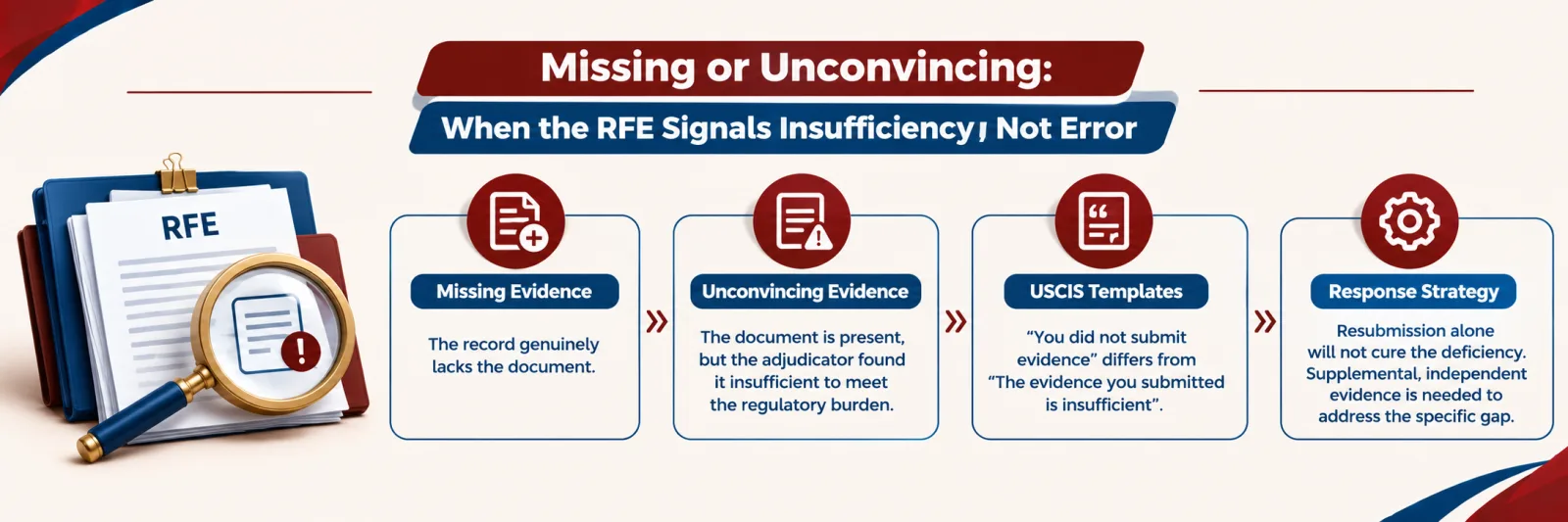
Not every RFE for evidence already submitted is an indexing failure. You must distinguish between missing evidence and unconvincing evidence.
- Missing evidence means the record genuinely lacks the document.
- Unconvincing evidence means the document is present, but the adjudicator found it insufficient to carry the regulatory burden.
USCIS templates distinguish these formulations: “You did not submit evidence” differs from “The evidence you submitted is insufficient”.
If the RFE states that the evidence was received but does not establish the criterion, the response strategy shifts. Resubmission alone will not cure the deficiency, and you need supplemental, independent evidence that addresses the specific gap.
Prevention Checklist: Packaging Discipline Before Filing
The strongest response to an exhibit-reference RFE is a filing that never invites one. A packaging discipline review sets out the practices that reduce that risk.
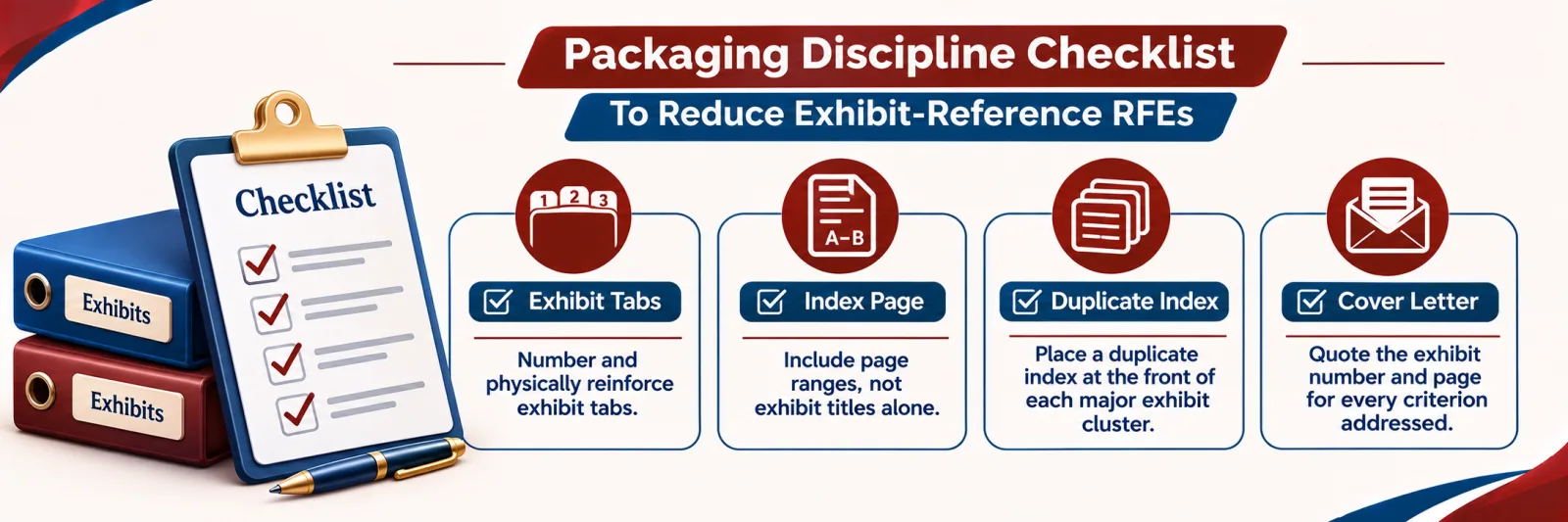
The checklist is brief: exhibit tabs should be numbered and physically reinforced, the index page should carry page ranges rather than exhibit titles alone, a duplicate index should be placed at the front of each major exhibit cluster, and the cover letter should quote the exhibit number and page for every criterion addressed.
How SiliconPath Law Assists with RFE Responses
SiliconPath Law is a boutique immigration firm that handles EB-1A RFE and NIW RFE responses through a documented review process.
Our firm maintains an exhibit-level audit protocol for every RFE response, mapping each RFE item to the filed record before the beginning of drafting.
Communication cadence here centers on the response deadline.
We deliver a preliminary record audit within the first review window. A draft cross-reference table and response index are shared for client review before argument sections are finalized.
Attorney review is available before filing, a step that has proven useful in identifying how an exhibit may be perceived from the adjudicator’s perspective.
Technology supports, not replaces, legal review. Document comparison tools verify that the exhibit index in the response matches the index in the original filing.
Page-cite extraction is performed systematically to reduce the risk of a misplaced reference.
The objective is a response package in which every USCIS RFE document already provided is located, cited, and explained without ambiguity.
To schedule a consultation regarding an RFE response, book a consultation.
FAQs
1. Can USCIS issue an RFE for a document I already submitted?+
Yes. An RFE may be issued when the adjudicator’s review of the record does not reflect receipt or consideration of a submitted document. This can result from packaging, indexing, or scanning issues, or from a substantive finding that the document was received but found insufficient.
2. Why might that happen?+
Practitioners have reported indexing gaps, exhibit separation during scanning, and limitations in automated tagging. No agency has confirmed a systemic tagging error, and each notice must be read on its own terms.
3. How do I respond?+
A cross-reference table mapping each RFE item to the exhibit and page in the filed record is the recommended structure. Factual pinpoint citations are preferred to argument. If the RFE characterizes the evidence as insufficient rather than absent, supplemental evidence should be considered.
4. Should I resubmit everything?+
Not necessary. Resubmitting the entire filing obscures the specific record the response is intended to highlight.
5. How do I point the officer to the right page?+
The response should state the exhibit number, the page range within that exhibit, and a one-sentence description of what the cited page establishes. A table format with these elements, placed at the front of the response, reduces the burden of review.
6. How do I tell a missing-evidence RFE from an unconvincing-evidence RFE?+
The notice language controls. “You did not submit” indicates a missing-record finding. “The evidence submitted is insufficient” or “does not establish” indicates a substantive sufficiency finding. The two require different response postures, so confirm the distinction before drafting begins.
7. Attorney Advertising Disclaimer+
This content is provided for informational purposes only and does not constitute legal advice.
A targeted response that cites the existing exhibit and page, with a pinpoint copy attached, is more effective. Re-filing the complete package may be reserved for cases where the original submission was materially incomplete.