
 SiliconPath Law
Key Takeaways
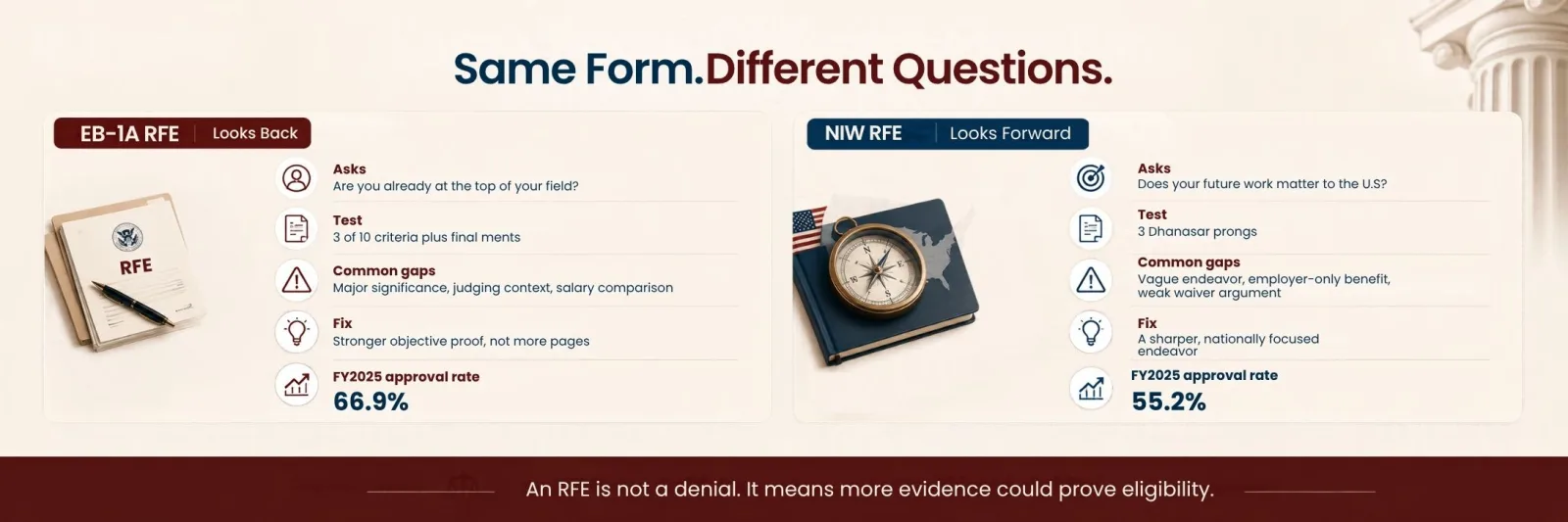
- An EB-1A RFE usually questions what you have already achieved. An NIW RFE usually questions what you plan to do and why it matters to the country.
- EB-1A petitions are judged under the ten regulatory criteria and a final merits determination. NIW petitions are judged under the three-prong Matter of Dhanasar framework.
- According to USCIS data, the FY2025 approval rate was 66.9% for EB-1A and 55.2% for EB-2 NIW, and both fell sharply by the fourth quarter.
- An RFE is not a denial. USCIS policy is to issue one when more evidence could establish eligibility.
You filed your green card petition, waited, and then received a Request for Evidence. The first thing most people do is search online for “how to respond to an RFE.” The problem is that most of what comes up treats every I-140 RFE the same way.
If you filed under EB-1A (Extraordinary Ability) or EB-2 National Interest Waiver (NIW), that one-size-fits-all advice can hurt you. These two categories rest on different laws, different legal tests, and different questions about your career. An EB-1A RFE asks whether you are already at the top of your field. An NIW RFE asks whether your future work is important enough to the United States to waive the job offer requirement.
This guide explains why the two get confused, what typically triggers each one, how response strategies differ, and what an RFE really says about your case.
The Numbers Behind the Pressure
USCIS adjudication has tightened across both categories. According to USCIS Immigration and Citizenship Data for Form I-140:
| EB-1A (FY2025) | EB-2 NIW (FY2025) | |
| Receipts | 29,582 | 66,276 |
| Approvals | 12,468 | 19,532 |
| Denials | 6,165 | 15,863 |
| Full-year approval rate | 66.9% | 55.2% |
| Q4 FY2025 approval rate | 53.4% | 35.7% |
The NIW trend is especially sharp. USCIS data shows the NIW approval rate was 95.7% in FY2022, compared with 55.2% in FY2025. EB-1A denials rose from 1,091 in Q1 FY2025 to 2,033 in Q4 FY2025, even though filings stayed roughly flat.
When adjudication tightens, more petitions receive RFEs, which makes a precise, category-specific response more important than ever.
Why People Treat These RFEs as the Same
It is easy to see why the two get lumped together.
- Same form. Both categories use Form I-140, so RFEs arrive on the same USCIS letterhead.
- Same audience. Many applicants are researchers, engineers, founders, and physicians who qualify for both, and many file both petitions at the same time.
- Overlapping evidence. Publications, citations, recommendation letters, and media coverage appear in both types of petition.
- Generic templates. A lot of online advice is built around a generic “strengthen your evidence” checklist that ignores the legal test being applied.
The overlap in evidence hides a basic difference in purpose. The same set of 40 citations might be used in an EB-1A petition to show sustained acclaim, and in an NIW petition to show you are well positioned to advance your endeavor. If you answer an NIW RFE as though it were an EB-1A RFE, you may prove a point the officer never asked about.
What Triggers an EB-1A RFE
EB-1A is governed by INA § 203(b)(1)(A) and 8 CFR § 204.5(h). You must show extraordinary ability through sustained national or international acclaim, either through a major one-time achievement or by meeting at least three of ten regulatory criteria.
USCIS reviews EB-1A petitions using the two-step analysis from Kazarian v. USCIS, 596 F.3d 1115 (9th Cir. 2010), which is built into the USCIS Policy Manual, Volume 6, Part F, Chapter 2:
- Step one: Does the evidence meet at least three criteria?
- Step two (final merits): Taken as a whole, does the evidence show you are one of the small percentage who have risen to the very top of your field?
Common EB-1A RFE Triggers
- Original contributions “of major significance.” Showing that your work is novel is not enough. Officers look for evidence of broad impact, such as widespread adoption, licensing, or significant citation relative to your field.
- Judging without context. Peer review counts, but officers may ask for invitations, confirmation that you completed reviews, and the standing of the journal or competition.
- Published material about the wrong subject. Media coverage has to be about you and your work, not mainly about your employer or a product.
- High salary without comparison data. Pay has to be shown as high relative to others in your field, usually with government wage data or industry surveys.
- Awards that are not national or international. Internal company awards or university honors often fall short.
- Final merits concerns. Even when three criteria are met, an RFE may say the record does not show sustained acclaim, especially when most of the evidence is recent or concentrated in one period.
USCIS updated its EB-1 guidance in October 2024 to clarify how it evaluates evidence, including comparable evidence and team-based achievements. Strong responses reflect that current guidance, not older templates.
What Triggers an NIW RFE
NIW is governed by INA § 203(b)(2)(B)(i) and the precedent decision Matter of Dhanasar, 26 I&N Dec. 884 (AAO 2016). Before the waiver is even considered, you must first qualify for EB-2 as an advanced degree professional or a person of exceptional ability under 8 CFR § 204.5(k).
Then USCIS applies the three Dhanasar prongs:
- Your proposed endeavor has substantial merit and national importance.
- You are well positioned to advance the endeavor.
- On balance, it would benefit the United States to waive the job offer and labor certification requirements.
USCIS updated its NIW Policy Manual guidance on January 15, 2025. The update emphasized that EB-2 eligibility is a threshold issue, clarified how officers assess national importance, and made clear that not every entrepreneur will qualify.
Common NIW RFE Triggers
- EB-2 threshold gaps. Foreign degree equivalency is unclear, or experience letters do not show five years of progressive post-baccalaureate experience.
- A vague proposed endeavor. “I will continue my research in AI” is too broad. Officers want to know specifically what you will do, where, and how.
- Importance to an employer, not the nation. Dhanasar looks at the endeavor’s broader implications. Benefits limited to one company or a local client base often trigger RFEs.
- Weak evidence you are “well positioned.” Your track record, plans, funding, interest from stakeholders, and progress to date need to connect directly to the endeavor.
- A thin prong three argument. Many petitions assume the waiver follows automatically. An RFE may ask why labor certification is impractical or why the U.S. benefits from your contributions without it.
- Business plan issues for entrepreneurs. Following the January 2025 update, officers look closely at whether broad economic claims are supported by realistic, specific projections.
Key Differences in Response Strategy
| EB-1A RFE Response | NIW RFE Response | |
| Core question | Have you already reached the top of your field? | Is your future endeavor nationally important? |
| Time orientation | Looks back at your record | Looks forward to your plan |
| Legal framework | 8 CFR § 204.5(h)(3) and Kazarian two-step | Matter of Dhanasar three prongs |
| Evidence focus | Objective proof of acclaim and impact | Specific endeavor, national scope, and readiness |
| Letters should show | Independent experts confirming your standing | Why your specific work matters nationally and why you can deliver it |
| Common mistake | Adding more volume instead of stronger proof | Restating credentials instead of clarifying the endeavor |
How to Approach an EB-1A RFE
- Answer criterion by criterion. Address each point the officer raised, using the officer’s own structure.
- Replace weak criteria rather than defend them. If one criterion is shaky, it can be more effective to build a strong case for a different one.
- Address final merits directly. Show how the whole record adds up to sustained acclaim, not just a checklist.
- Prioritize independent, objective evidence, such as citation benchmarks, adoption data, and media coverage by major outlets.
How to Approach an NIW RFE
- Define the endeavor precisely. Often the most powerful fix is a clearer, more specific statement of what you will do.
- Tie the endeavor to national interests using government sources, such as federal research priorities, agency reports, or the White House list of critical and emerging technologies.
- Show momentum. Grants, pilot results, partnerships, and letters from users or stakeholders can support prong two.
- Make an explicit prong three argument, explaining why the national interest is better served by waiving labor certification.
A Rule That Applies to Both
Eligibility must be established as of the filing date under 8 CFR § 103.2(b)(1) and Matter of Katigbak, 14 I&N Dec. 45 (Reg. Comm. 1971). New achievements that happened after you filed generally cannot fix a gap in eligibility. What they can do is explain, contextualize, or corroborate evidence that already existed. Under 8 CFR § 103.2(b)(8)(iv), USCIS can give you up to 12 weeks to respond, and in most cases you get a single opportunity, so the first response needs to be complete.
Is an RFE a Bad Sign?
No. An RFE is not a denial, and it is not a judgment on your career.
In June 2021, USCIS reinstated guidance directing officers to issue an RFE or Notice of Intent to Deny when additional evidence could potentially establish eligibility, instead of denying outright. In practical terms, an RFE means the officer sees a path to approval but needs more support.
That said, an RFE should be taken seriously. Given the approval trends in FY2025, the quality of your response often decides the outcome. A focused, well-argued response that speaks to the correct legal standard puts you in the strongest possible position.
FAQs
1. Is an RFE for EB-1A a bad sign?+
No. An EB-1A RFE means USCIS needs more evidence on specific criteria or the final merits determination. Many petitions are approved after a strong RFE response.
2. How do NIW RFEs differ from EB-1A RFEs?+
EB-1A RFEs focus on your past achievements and whether you have sustained acclaim. NIW RFEs focus on your proposed endeavor, its national importance, your ability to advance it, and whether the job offer requirement should be waived.
3. What evidence gaps trigger each?+
EB-1A RFEs are often triggered by weak evidence of major significance, judging without context, media that is not about you, or salary without comparison data. NIW RFEs are often triggered by a vague endeavor, benefits limited to one employer, EB-2 eligibility gaps, or a weak prong three argument.
4. Can I file EB-1A and NIW at the same time?+
Yes. Many professionals file both. Because the legal tests differ, each petition and any RFE response should be tailored to its own framework.
5. How long do I have to respond to an I-140 RFE?+
The deadline appears on your notice. Under USCIS regulations, the maximum response period is 12 weeks, and extensions are generally not granted.
6. Can I submit achievements from after my filing date?+
Generally, they cannot establish eligibility, because eligibility is judged as of the filing date. They may still help to corroborate or explain evidence that existed when you filed.
Received an RFE? Respond With Strategy, Not a Template.
An EB-1A RFE and an NIW RFE ask different questions, and your response should answer the right one. The right strategy starts with understanding exactly what the officer found missing.
Schedule an RFE response consultation with SiliconPath Law today and get a response plan built for your category, your evidence, and your deadline.
This article is for general information only and is not legal advice. Immigration rules change frequently. Consult a licensed immigration attorney about your specific situation.