
 SiliconPath Law
The premium processing fee increase has raised the cost of expedited review for eligible employment-based immigrant petitions to $2,965 as of March 1, 2026. This mandatory inflationary adjustment, implemented by the U.S. Department of Homeland Security (DHS), affects key categories such as Form I-140 for EB-1A Extraordinary Ability and EB-2 National Interest Waivers (NIW).
For startup owners, tech industry managers, and skilled engineers, premium processing is never just about whether the corporation can afford it based on the budget. Rather, it is a more complex issue that revolves around whether the guaranteed statutory timeframe provided by the service will be sufficient leverage for the extra cost.
Here is a definitive analysis of the change that happened on March 1, 2026, and what a $2,965 fee for filing the application really gets you under USCIS regulations.
What Changed: The 2026 Fee Adjustment Breakdown
The USCIS Stabilization Act provides for an arrangement under which the DHS is empowered to modify premium processing fees every two years according to the Consumer Price Index for All Urban Consumers (CPI-U). March 1, 2026, modification will take into account the cumulative effect of inflation for the period running from June 2023 to June 2025.
With respect to the Form I-140 employment-based immigrant worker petition application, the premium processing enhancement fee increased from $2,805 to $2,965, representing a $160 increase.
2026 USCIS Premium Processing Fee Schedule
| Form / Benefit Category | Prior Premium Fee | 2026 Premium Fee | Total Increase | Statutory Action Clock |
| Form I-140 (Employment-Based Immigrant Petitions) | $2,805 | $2,965 | +$160 | 15 Business Days |
| Form I-129 (Most Nonimmigrant Workers: H-1B, O-1, L-1, TN) | $2,805 | $2,965 | +$160 | 15 Business Days |
| Form I-539 (Change/Extension of Status for F-1, J-1, etc.) | $1,965 | $2,075 | +$110 | 30 Business Days |
| Form I-765 (Employment Authorization / OPT Requests) | $1,685 | $1,780 | +$95 | 30 Business Days |
PAYMENT COMPLIANCE WARNING
- Premium processing is an optional add-on service requested via Form I-907.
- The $2,965 fee MUST be paid separately from the base Form I-140 filing fee.
- Petitions postmarked on or after March 1, 2026, submitted with obsolete
- fee amounts will be rejected entirely and returned by the USCIS lockbox.
What It Actually Guarantees: Action vs. Approval
By far, the most important thing to understand is that paying for expedited processing means getting an answer fast but not a positive answer.
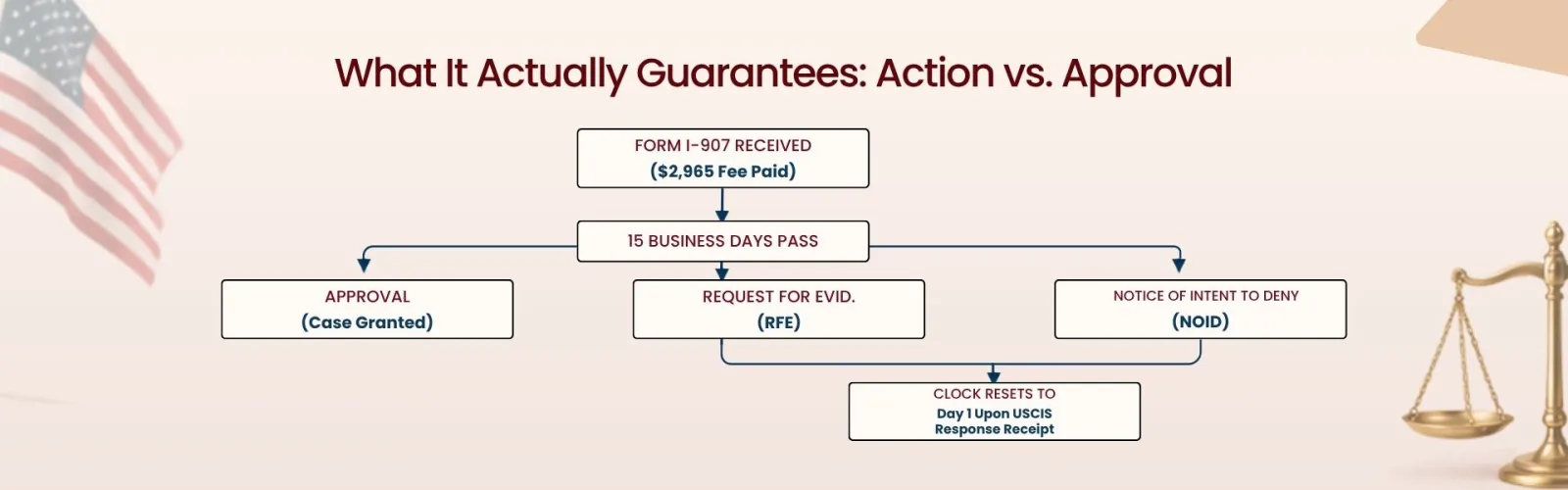
Upon filing your Form I-907, along with your $2,965, USCIS is required to take a final adjudicative step within 15 business days from the day it receives your request at the appropriate service center. (Keep in mind that recent changes to regulations have set the timeline in business days only).
The 5 Qualifying USCIS Actions
In order to fulfill its statutory requirement within the period of 15 business days, USCIS shall issue any of the following five administrative decisions:
- An Approval Decision: All regulatory requirements have been fulfilled and the petition is approved.
- A Denial Decision: The petition does not demonstrate eligibility for the requested classification.
- A Request for Evidence (RFE): The USCIS decides that more evidence needs to be submitted in order to make a decision on the case.
- Notice of Intent to Deny (NOID): Specific deficiencies of legal nature have been identified which will result in the denial of the case unless successfully rebutted.
- An Investigative Notice: Starting an administrative investigation into the case due to fraud or misrepresentation.
In the absence of one of the above mentioned decisions within 15 business days, USCIS is obligated to reimburse the petitioners $2,965 premium processing fee. However, this will neither disapprove nor approve the case, but it will stay in the premium process until the decision has been made.
The RFE Reset Mechanism
An RFE or NOID puts an end to the 15-business-days clock immediately. After the legal representative of the applicant sends the formal reply, a fresh 15-business-days clock starts all over again from the first day of receipt of that reply by USCIS. So, although premium processing helps get quick feedback, an application that needs further documentation will take more time for a decision.
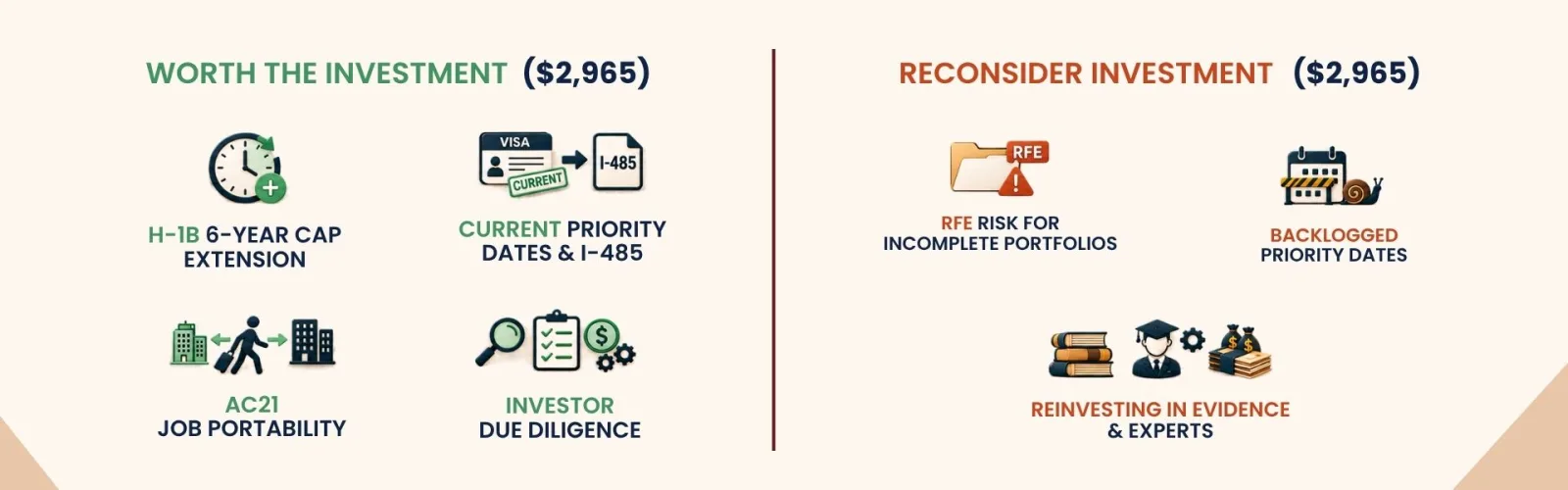
When Premium Processing May NOT Be Worth the Investment
- Cases That Demand More Evidence: Prematurely rushing an incomplete EB-1A or NIW petition through premium processing often results in an RFE. In many instances, investing more time in assembling a stronger initial evidentiary package that includes the best expert opinions, citation statistics, and venture traction can be much more efficient than spending $2,965 and obtaining a quick RFE.
- Backlogs in Priority Date: In cases where your priority date is not going to be current in the Visa Bulletin for years to come (e.g., because of the country of birth per-country limitations), speeding up the process of I-140 approval does not offer any immediate opportunity for filing an I-485 green card petition.
- Investing Strategically: In the context of startups, keeping $2,965 aside for reinvesting into core legal services, technical assessments, and expert testimonies proves to be more profitable.
Frequently Asked Questions (FAQs)
1. How much does USCIS premium processing cost in 2026?+
Effective March 1, 2026, the premium processing fee for eligible Form I-140 immigrant petitions (including EB-1A and EB-2 NIW) and Form I-129 nonimmigrant petitions (such as H-1B, O-1, and L-1) is $2,965. This fee must be paid separately via Form I-907.
2. What does premium processing actually guarantee?+
USCIS guarantees that it will issue a qualifying response an approval, denial, Request for Evidence (RFE), Notice of Intent to Deny (NOID), or fraud investigation notice; within 15 business days of receipt. It does not guarantee that your petition will be approved.
3. Is premium processing worth it for an EB-1A Extraordinary Ability case?+
Premium processing, along with the eba1 premium processing fee, is highly valuable for EB-1A applicants who have a current priority date, face impending visa status deadlines, or need immediate certainty for career planning. However, if your EB-1A portfolio is still being assembled or lacks sufficient primary evidence, upgrading can trigger a fast RFE. It is best used when the petition is already fully optimized.
4. Why did the premium processing fee increase?+
The Department of Homeland Security proposed a new premium processing fee pursuant to the USCIS Stabilization Act, which authorizes biennial fee increases tied to inflation measured by the Consumer Price Index (CPI-U). The March 2026 increase covers inflation measured between June 2023 and June 2025.
5. Does USCIS refund the premium processing fee?+
USCIS refunds the premium processing fee only when it fails to take adjudicative action within the guaranteed 15-calendar-day window. The refund safeguards the agency’s timeliness—not unfavorable outcomes or filing defects.
6. How much is the H-1B (I-129) premium processing fee?+
The H-1B (I-129) premium processing fee is $2,965 for requests postmarked on or after March 1, 2026.
Aligning Your Immigration Strategy
Premium Processing is an extraordinary operational lever if used strategically however, Premium Processing is still merely a lever of timing and not a replacement for substance. The payment of $2,965 expedites the decision-making process, but securing a favorable decision entails developing a proper evidentiary package.
At SiliconPath Law, we assess each corporate client’s evidentiary package to see whether a premium processing filing right away makes sense from a strategic point of view or whether additional development will be more beneficial.