 SiliconPath Law
2026 Visa Bulletin & USCIS Rule Changes: What It Means
In some corner of the world, there is an employee at Lumon Industries who would recognize this split screen, a fitting image for the 2026 visa bulletin and USCIS rule changes 2026 currently reshaping the immigration landscape. The innie and the outie each experience a different reality, where each does not know what the other is going through, in the TV show "Severance." This is pretty much how the visa bulletin of 2026 is currently acting. Family-based categories are having the time of their lives, but employment-based categories, under the same roof, find themselves in a windowless corridor, waiting for numbers which may not come until the fiscal year ends.
Add in USCIS rules of 2026 which were issued throughout the spring and summer, and you end up with two systems which are moving in different directions but on the same calendar. Clients usually see "the visa bulletin" as one dial to monitor. But it isn't, and in this particular year, the chasm between its dials has widened.
2026 Visa Bulletin Update: Family vs. Employment Split
In the August 2026 chart, the tale told depends on whether one uses the Dates for Filing table or the Final Action Dates chart – with family-sponsored applicants using the former and those who are employment-based relying on the latter, a fact which comes as a shock to many clients each time around.
F1 has advanced by about 5.5 months, F2B by about 7 months, F3 by 3 months, and F4 by about 3.5 months for most countries – rare good news!
But the employment categories are all bad news! The India-specific EB-2 and EB-5 India (unreserved) categories are "Unavailable" (meaning there is no priority date comparison) until numbers open, and the EB-1 India category has retrogressed to October 15, 2022, while the State Department itself has warned that EB-1 India may well become "unavailable" by the end of the fiscal year.
This year is not the right paradigm for those who think that a "cutoff date" approach would work for all categories!
Schedule Your Call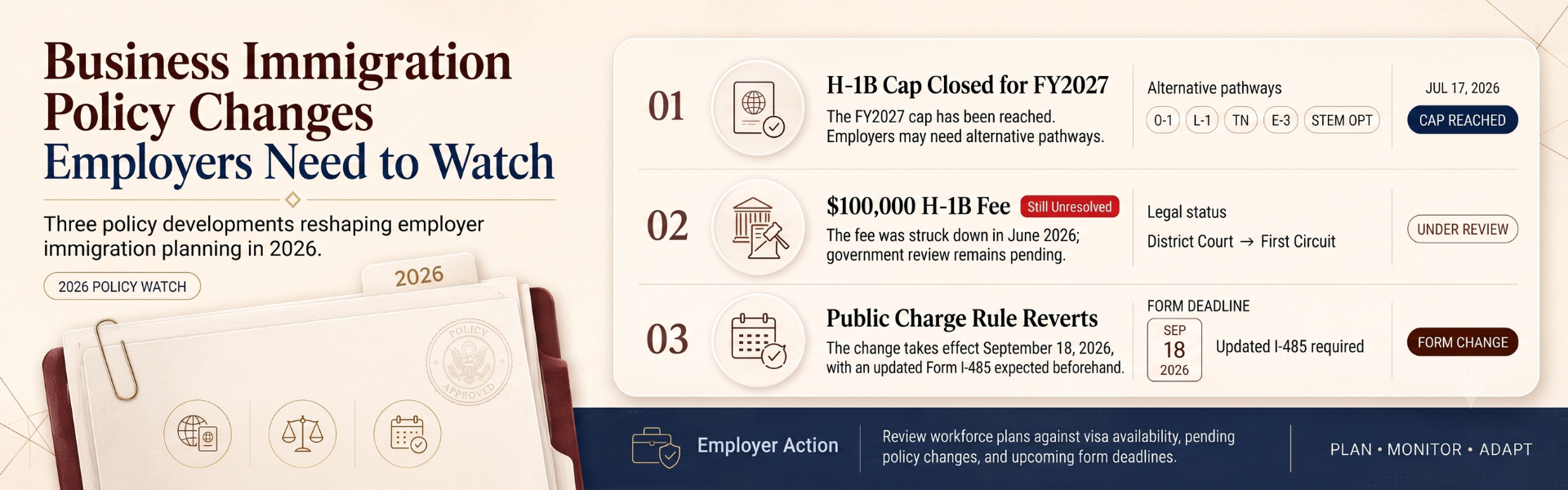
Business Immigration Policy Changes Employers Need to Watch
H-1B Cap Closed for FY2027
USCIS announced on July 17, 2026 that the cap has been hit. With the H-1B cap being met and for those companies who still plan on hiring foreign nationals in this year’s cycle, their options will be to look into O-1, L-1, TN, E-3 visas, or STEM OPT Extensions.
The $100,000 H-1B Fee: Still Unresolved
A District Court struck down the $100,000 fee in its entirety in June 2026 on the basis that the fee operated as a tax and was in violation of the Administrative Procedure Act on several fronts. The government has filed a petition for review with the First Circuit and it is yet to be seen whether or not the vacatur will stand. The government did not succeed in staying the vacatur at the district level.
Public Charge Rule Reverts
The rescission of the public charge rule by the DHS will become effective September 18, 2026, and will be accompanied by an updated form of I-485 prior to this date. Any petitions made using the old form after this date will be automatically rejected.
EB-1A, EB-2 NIW Rule Changes: Confirmed vs. Proposed
This is the part that must be absolutely accurate, and it is the part that changed the most since this article was first written.
What was proposed, and where it stands now: "Petition for Immigrant Worker Reforms" (RIN 1615-AC85), concerning EB-1, EB-2 (NIW), and EB-3, has been on the DHS Spring 2025 Unified Regulatory Agenda. The regulatory description in the agenda spoke of successorship-in-interest and ability to pay policies, extraordinary ability revisions, and NIW evidentiary standards, rather than the sensational "Kazarian, Dhanasar, new AI/biotech standards" being touted by some of the immigration community.
What's changed: In the latest DHS/USCIS Unified Agenda, RIN 1615-AC85 has been removed from the list of ongoing rulemakings completely. Pursuant to Executive Order 14192, a rule not included in the current agenda cannot be issued by an agency. Thus, for the moment, the method for implementing this specific change has been put aside, and no NPRM has been released. Moreover, there is no information that it is currently being processed.
Practical guidance: There is always a possibility for the item to be included in the list again, and the other rulemakings of the DHS regarding the EB-5 and H-1B this year show that DHS is still busy making new regulations. The best course of action would be to continue using the well-tried Kazarian and Dhanasar test.
Talk to Our TeamUSCIS Policy Update 2026: The Adjustment of Status Shift
Perhaps more important than any other of the memos issued during the year, PM-602-0199 changes the interpretation of adjustment of status within the U.S. to that of "administrative grace," which means that applying for AOS in place of consular processing when it is "expected and available" may now be considered an unfavorable discretionary factor.
Those with dual intent (H-1B, L-1 visas), while in a better position than those with single intent, are not automatically exempt from that rule. For everybody, including F-1 students and B-1/B-2 visitors, but especially for those with single intent, relying on in-country applications is no longer the safe option.
USCIS Rule Changes 2026: Litigation Reshaping Policy in Real Time
With regard to any changes in immigration law by 2026, there is one pattern that can be observed: policy making, litigation, and reversal. An example would be the fee of $100,000. Another example includes the Dorcas International Institute v. USCIS where the court held that the four USCIS hold policies relating to 39 countries were not in line with the Administrative Procedures Act, with USCIS certification being done on June 12, 2026.
Also, the comment period regarding the EB-5 Reform and Integrity Act NPRM issued on July 2, 2026 will be closing on August 31. This shows that the regulations concerning EB-5 are uncertain.
Visa Bulletin Forecast: What to Watch Before September 30
FY2026 ends on September 30, and the last few weeks of the fiscal year are typically when the biggest changes take place. There may be a chance of EB-1 India being unavailable before the end of the fiscal year, and there will be a numerical reset on October 1.
Employment Based Immigration Updates: Action Items by Client Type
- Business owners: Rethink your H-1B alternatives now, and be prepared for the likelihood of the $100,000 fee being restored on appeal.
- India EB-2/EB-5 applications with pending I-485s: Unavailability does not mean rejection; it means your final approval will depend upon availability of a visa number. Early renewals of your EAD/Advance Parole should be made.
- EB-1A/NIW applicants: Rulemaking that had threatened to make standards more stringent is no longer on DHS's regulatory calendar, which means your Kazarian and Dhanasar standards are safe. File strong cases now, not later when reform is unlikely to come.
- All in deliberation about AOS versus consulate processing: Get personalized advice first, don’t assume in-country processing is normal anymore.