
 SiliconPath Law
A Department of Homeland Security (DHS) proposed rule does not take effect until the DHS issues a final rule. This rule is bound to a specific date. Until then, the regulations currently in force remain fully applicable. This principle is equally relevant to the announcement made regarding the OPT fees on October 8, 2026.
Disclaimer: This article is an advertisement by attorneys and contains general information for learning purposes only. It is neither any kind of legal advice nor establishes any lawyer-client relationship. Updated November 2, 2026.
Proposed Rule vs. Final Rule: Understanding the Differences
A proposed rule is a draft regulation published in the Federal Register to solicit public comment. A final rule, by contrast, is the definitive regulatory text DHS adopts after analyzing the public feedback. A proposed rule does not amend the Code of Federal Regulations (CFR); only a final rule carries that effect.
Of equal importance, agency rulemaking must remain strictly within the statutory authority granted by Congress. Federal courts review agency regulations to ensure they neither exceed those statutory boundaries nor violate the Administrative Procedure Act (APA).
The DHS Rulemaking Process: Step-by-Step Framework
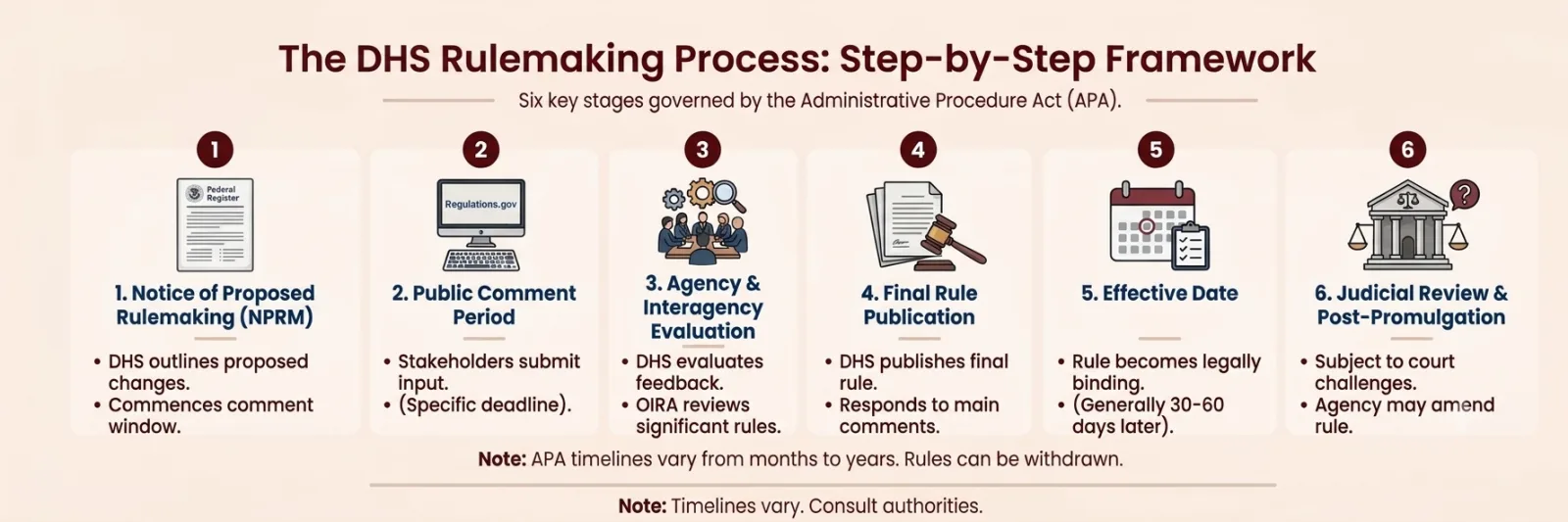
Most DHS regulations proceed through six distinct stages, governed principally by the Administrative Procedure Act (APA), 5 U.S.C. § 553.
- Notice of Proposed Rulemaking (NPRM): DHS issues a formal notice in the Federal Register outlining the proposed legal changes, the legal authority relied upon, the legal reasoning, and the public comment window.
- Public Comment Period: Stakeholders and members of the public submit written comments through Regulations.gov during the designated comment period.
- Agency & Interagency Evaluation: DHS evaluates significant comments. Economically significant rules also undergo interagency review by the Office of Information and Regulatory Affairs (OIRA) under Executive Order 12866.
- Final Rule Publication: DHS publishes the finalized regulatory text together with comprehensive responses to public comments. Final provisions may incorporate modifications made in light of that feedback.
- Effective Date: The rule becomes legally binding on the specific date designated in the final publication, which typically follows publication by 30 to 60 days.
- Judicial Review & Post-Promulgation: Final rules remain subject to potential judicial challenges, injunctions, or subsequent amendments by the agency.
The APA has specified no kind of strict timeline for an agency to transit from a proposed rule to a final rule. Some rules are primarily finalized within months while others require years and some are ultimately withdrawn.
Immigration Rule Effective Date: How Timelines Are Determined
The official effective date is stated in the section marked as DATES of the final rule notice. Under 5 U.S.C. § 553(d), several regulations generally require a minimum 30-day window, which has to be between publication and enforcement.
However, specific exceptions permit immediate or accelerated effective dates; for instance, rules that relieve restrictions, interpretive rulings, policy statements or rules for which the agency demonstrates for good cause.
Major rules with substantial economic impact fall under the Congressional Review Act (5 U.S.C. § 801(a)(3)), which requires at least a 60-day delay before taking effect. Final rules may also specify separate compliance dates for affected entities.
In certain circumstances, DHS may publish an interim final rule that takes effect before soliciting or reviewing public comments. Verifying the exact document classification in the Federal Register header is therefore essential.
Case Study: The Proposed OPT Fee Rule
The OPT fee proposal remains a draft regulatory proposal. It is not currently in effect. None of its proposed terms govern active applications. Below is an overview of the published NPRM parameters as of November 2026:
The proposed 60-day implementation period represents DHS’s suggested timeframe. DHS retains full authority to modify proposed fee amounts, scope or provision of transition upon issuing a final rule. This proposal illustrates agency procedures and should not be treated as a general template for all rulemaking.
Governing Standards During Pending Rulemaking
When the rule is under development, aspects like statutes, regulations, forms and fee schedules continue to apply. For OPT, the governing provisions remain in 8 CFR § 214.2(f) without the additional institutional fees that were proposed.
- Consider these essential steps in tracking any pending regulatory change:
- Confirm Document Type: Determine if the notice is a Proposed Rule, Final Rule, or Interim Final Rule in the header of the Federal Register.
- Track Deadlines & Dockets: Note the comment period deadline and associated Federal Register docket number.
- Track Final Rule Publications: Monitor the publication of the final rule to determine the effective date.
- Utilize Official Sources: Double check the information from verified official websites, such as the Federal Register, USCIS, and Study in the States.
- Seek Professional Legal Assistance: Consult an immigration lawyer or DSO regarding specific deadlines and risk factors.
- Judicial Review & Legal Challenges to Final Rules
- The published final rule is still subject to modifications or delays. The Department of Homeland Security can promulgate additional regulatory amendments, and the federal courts have the power under 5 U.S.C. §§ 705 and 706 to delay, enjoin, or reverse any unlawful agency actions.
- Important immigration rules are often subject to federal litigation. The federal court order controls which regulation to follow when there is a delay or vacation of the rule. Congress also has the authority to pass a joint resolution of disapproval under the Congressional Review Act.
Attorney-Directed Strategy with Silicon Path Law
Navigating pending regulatory changes requires precise legal strategy and proactive planning. At Silicon Path Law, our attorney-led immigration practice assists F-1 students, corporate employers, and academic institutions in evaluating how proposed DHS rules impact their immediate and long-term immigration plans.
We provide thorough analysis of proposed regulatory changes, compliance requirements, and filing timelines tailored to your unique circumstances. Contact Silicon Path Law to schedule a strategic consultation with an experienced immigration attorney.
FAQs
1. Does a proposed rule apply immediately, and when does a DHS proposed rule take effect?+
No. A proposed rule creates no binding legal obligations. It becomes enforceable only if DHS issues a final rule and the effective date arrives. An interim final rule, by contrast, carries immediate legal effect upon its specified date, before post-promulgation comment review.
2. What happens during the comment period?+
Members of the public submit written comments to the public docket via Regulations.gov. DHS is required by law to evaluate and address significant public comments when preparing the final rule. Existing application standards remain unchanged during this period.
3. How quickly does DHS issue a final rule after public comments close?+
There is no mandatory statutory timeframe. Final rule timelines vary based on comment volume, regulatory complexity, OIRA review, and agency priorities.
4. What is the comment deadline for the OPT fee proposal?+
General public comments under docket ICEB-2026-0100 are open through November 9, 2026, following the submission instructions in the Federal Register notice.
5. Where is the effective date located in the Federal Register notice?+
The effective date is prominently listed in the DATES section near the top of the published final rule notice.