 SiliconPath Law
Can an F-1 student file EB-1A? Yes. But “can file” and “should file now” are different questions. Same with O-1A; it does not require an H-1B lottery win, and it does not require PERM. But it does require a petitioner and, that petitioner cannot be you.
The real issue with both pathways is not whether you qualify on paper today. It is how much of your record has been built in a way that a USCIS officer can actually verify. That kind of record does not materialize three months before your OPT end date.
Why Timing Matters for F-1 Students?
F-1 status does not bar you from filing an I-140 for EB-1A. There is no regulation that says you cannot. But F-1 is a nonimmigrant intent category. Filing an I-140 creates a record inside USCIS that you intend to immigrate.
Inside the United States, this is generally not a problem. USCIS will adjudicate the I-140 on its merits. The issue arises at a consulate. If you travel abroad to renew your F-1 visa or to apply for OPT-related travel, the DS-160 asks whether you have ever filed an immigrant petition. You must answer yes. That gives the consular officer a fact they may use to question your nonimmigrant intent.
Practitioners have seen cases where a pending I-140 was disclosed at a consulate and the visa was still issued without incident. But that is discretion, not entitlement. For F-1 students considering EB-1A or O-1A, the first calculation is not citation count. It is whether you have international travel planned in the next twelve months, and what visa you would need to re-enter on.
What EB-1A and O-1A Require That Takes Time to Build
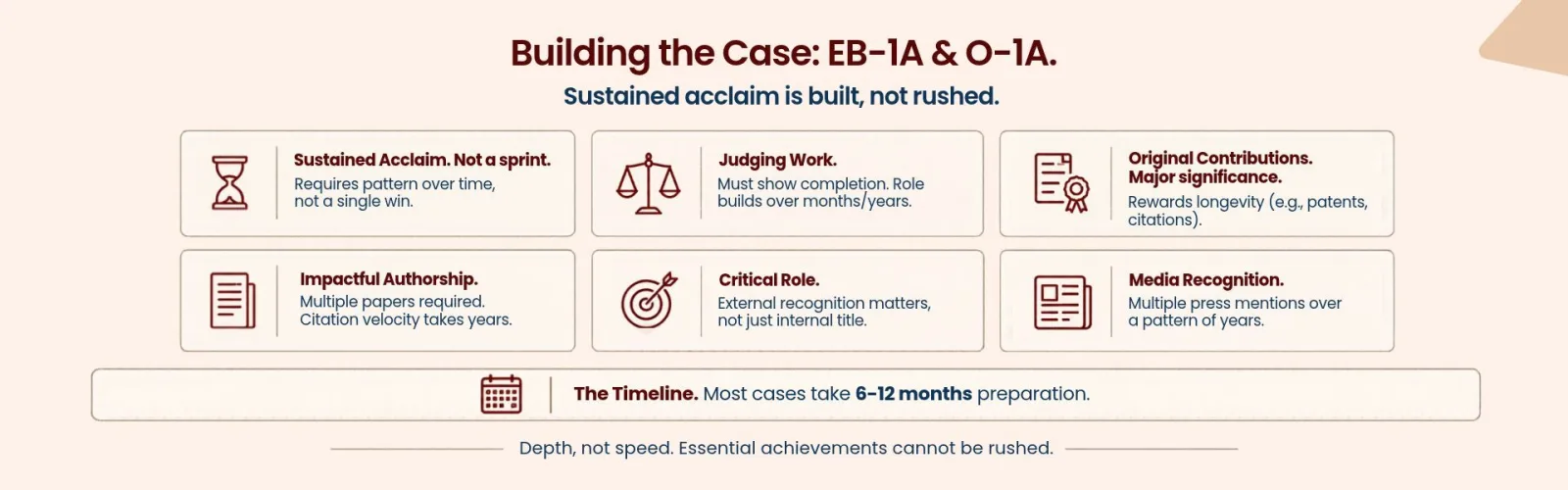
EB-1A requires “sustained national or international acclaim” and that the applicant be among the “small percentage who have risen to the very top” of their field. This is not measured by your degree, your institution’s ranking, or your GPA. It is measured by whether peers in your field have recognized your work publicly and in a verifiable way.
Meeting three criteria is only the threshold. USCIS then conducts a final merits determination: looking at the record as a whole, has this person actually risen to the top?
For F-1 students, this means the strength of an EB-1A case is not determined by your resume on graduation day. It is determined by whether you have spent the prior two to three years accumulating externally recognizable evidence in a consistent direction.
O-1A operates more directly. You must satisfy three of eight criteria. For someone still in school, the ones most plausibly built during study are:
- Authorship and published material: This does not mean you published papers. It means your work has been written about, cited, or discussed by others. Publishing a paper is authorship. Someone else writing about your paper is published material. They are separate criteria.
- Judging: Peer review, conference abstract review, hackathon judging. These can be done on F-1 status without separate work authorization.
- Original contributions: Whether your research or project has had demonstrable impact — adopted by others, covered in industry press, used as a foundation for subsequent work. This criterion is shared by EB-1A and O-1A and is the hardest to manufacture on a compressed timeline.
Leading or critical roles and high salary typically require an employment relationship, which usually means CPT or OPT. Waiting until OPT begins to start building those two is a tight timeline.
The Risk of Waiting Until OPT Ends
O-1A has no cap-gap protection. The H-1B cap-gap extends OPT to October 1. O-1A has no equivalent. Your OPT end date is your OPT end date. An O-1 petition can be filed as a change of status inside the United States, but if the adjudication is not complete before your OPT expires, you have no work authorization in the interim.
A pending EB-1A I-140 grants you no status and no work authorization. It is a queue position. If your priority date is current; and for EB-1A, Visa Bulletin movement for China-born applicants must be checked separately, you can file I-485 concurrently and obtain an adjustment-based EAD. But if the priority date is not current, an approved I-140 does not extend your OPT.
The practical risk is not “can I stay in the U.S. after OPT ends.” It is whether USCIS has received a pending petition before OPT ends that can support your next status. An O-1A change of status via I-129 can accomplish that. But only if you already hold three O-1A criteria that will survive scrutiny. Those cannot be assembled in the final three months of OPT.
What to Start Now
If you are currently on F-1 or have more than six months of OPT remaining, the useful exercise is not asking a lawyer whether you “qualify for EB-1A.” It is examining what you already have, measured against the regulatory criteria.
For O-1A before OPT ends, three things matter:
– Consolidate scattered records. Peer review records, conference invitations, award notifications, media coverage, citation pages. These live in email inboxes and browser bookmarks. When you file, you need them retrievable within forty-eight hours. The consolidation process itself is a filter — you will find that some things you assumed were useful are things USCIS will not weigh.
– Identify recommenders, not “big names.” USCIS does not weigh the recommender’s title. It weighs whether the recommender can explain specifically why your work has impact in the field. An assistant professor who cited your paper is more useful than a member of the National Academy who has never heard of you.
– Determine the O-1A petitioner. If you have an employer, it is the employer. If you are self-employed or founding a company, it is the company or an agent. You cannot petition for yourself. This should be settled four to six months before OPT ends, because the petitioner’s documents and your evidence documents are two separate files.
The Immediate Step
As a legal tech and client-first immigration law firm, we specialize in EB-1A, O-1A, and EB-2 NIW petitions for highly skilled professionals and work closely with clients to identify strengths, address gaps, build evidence-driven narratives and progress situations that withstand scrutiny at every stage.
The difference between an approved petition and a denied one is rarely talent, it is strategy, and we practice this well. Book a free consultation with SiliconPath Law, and let us help you build yours.
FAQs
1. Can F-1 students file for EB-1A?+
Yes. F-1 status is not a filing bar. EB-1A permits self-petition, requires no employer sponsor, and requires no PERM. However, travel and status maintenance after filing require separate planning.
2. Should you start before OPT ends?+
If you plan to use O-1A as your status after OPT, yes. The O-1A evidence build requires lead time — not filing lead time, but lead time to create things that can be documented.
3. What’s the risk of waiting?+
The immediate risk is having no bridge status when OPT expires. O-1A has no cap-gap. H-1B requires a lottery. EB-1A I-485 depends on whether the priority date is current.
4. Can O-1A run alongside F-1/OPT?+
Yes. An O-1A change of status does not alter your existing F-1/OPT status until approved. Upon approval, you transition from F-1 to O-1. Filing timing must be aligned with your OPT expiration date.
Attorney Advertising: The information on this website is provided for general informational purposes only and does not constitute legal advice. Viewing this website or communicating with SiliconPath PLLC (SiliconPath Law) does not create an attorney-client relationship. Legal advice can only be provided after a licensed attorney reviews your specific circumstances and a formal engagement is established. Prior results do not guarantee a similar outcome.