 SiliconPath Law
The term sheet is signed, the sponsor bank wants your company’s beneficial ownership forms, and your state money transmitter application lists you as a control person. Then your lead investor asks a question you have been postponing: what is your U.S. immigration status, and does it let you actually run this company?
For fintech founders, the visa question rarely arrives alone. It lands in the middle of licensing reviews, bank partner diligence, and a fundraising calendar that does not pause for USCIS. The best visa options for fintech founders building in the U.S. depend on three facts: whether you own a controlling stake, whether you have a company abroad, and what your record already shows.
This guide compares each realistic path for a founder who wants to lead a U.S. fintech company, what each one requires under current law, and where fintech businesses meet issues that other startups do not.
Which visa fits a fintech founder?
For many venture-backed fintech founders, the O-1A is the most flexible temporary option, because it does not depend on a lottery, a treaty, or a foreign parent company. The E-2, L-1A, H-1B, and International Entrepreneur Parole each work well, but only for narrower fact patterns. For permanent residence, the EB-2 National Interest Waiver (NIW) and EB-1A let a founder self-petition without a job offer or labor certification.
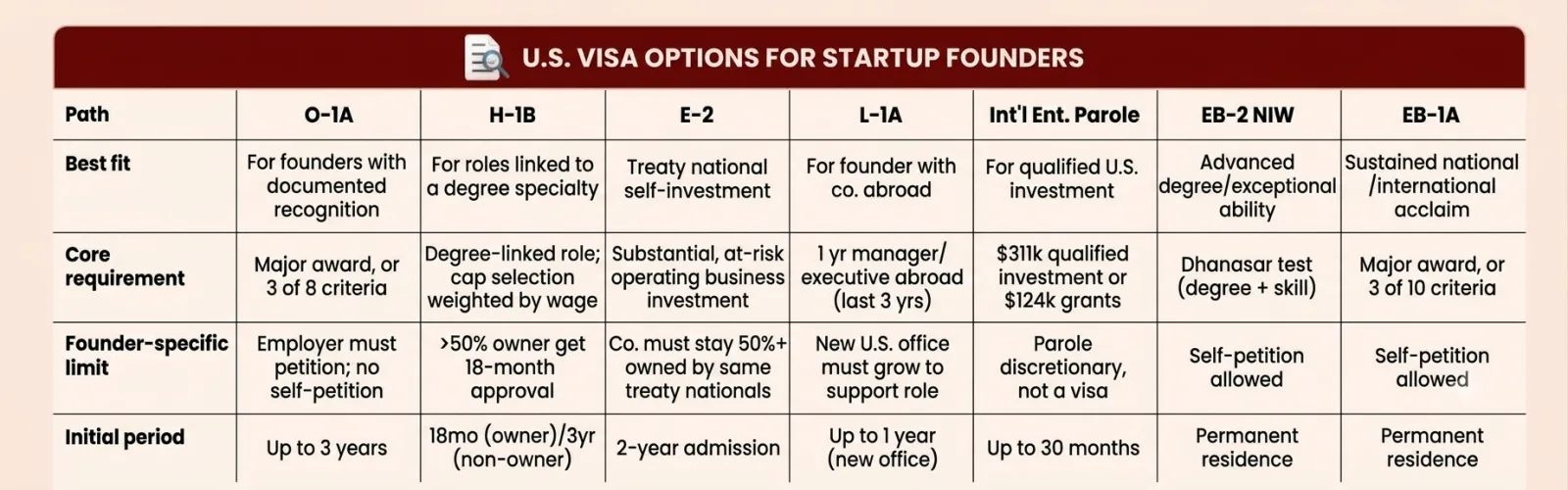
Thresholds and fees change. Figures in this guide are current as of October 30, 2026, and each section names the source to check before filing.
O-1A for fintech founders
The O-1A fits a fintech founder whose record already shows extraordinary ability in business or the sciences, documented through third-party evidence. It is a temporary classification, with an initial period of up to three years and extensions in increments of up to one year.
A founder cannot file an O-1A as an individual. The petition must come from a U.S. employer or a U.S. agent, and founders commonly petition through their own U.S. company or through an agent. The petition also needs a written advisory opinion from a peer group or other qualified expert in the field.
The evidentiary threshold is a major internationally recognized award, or at least three of eight regulatory criteria. Meeting three criteria is the first step, not the finish line. USCIS then weighs the full record to decide whether it shows sustained national or international acclaim and a place among the small percentage at the top of the field.
For fintech founders, the criteria that tend to carry weight are:
- Critical or essential role for a distinguished organization. An early-stage company must prove its own distinguished reputation, through investor quality, regulatory approvals, partner banks, or independent coverage.
- Original business contributions of major significance. A payments rail, underwriting model, or fraud system works best when adoption, licensing, or third-party reliance is documented, not just described.
- Judging the work of others. Selection panels for accelerators, grant programs, or peer-reviewed fintech conferences can qualify when the founder’s role is documented.
- High remuneration. Founders who defer salary often cannot use this criterion, which makes the remaining criteria carry more weight.
Consider the contrast. A founder with a $4 million seed round, two state money transmitter licenses, and a trade-press profile may have a coherent O-1A record. A founder with a larger round but no independent documentation of their own role may not, because funding alone describes the company, not the individual.
Premium processing is available for O-1 petitions. As of March 1, 2026, the premium processing fee for Form I-129 is $2,965, and it buys USCIS action (approval, denial, or a request for evidence) within 15 business days, not a guaranteed approval.
H-1B through your own fintech startup
A founder can hold H-1B status through a company they control, but the role must be a specialty occupation and the cap lottery still applies. Since January 17, 2025, the H-1B modernization rule has expressly allowed a beneficiary who owns more than 50% of the petitioner, or holds majority voting rights, to be sponsored by that company.
Three conditions shape every founder H-1B:
- The work itself. The founder must spend the majority of their time on specialty occupation duties, such as engineering or quantitative risk work. Fundraising, contract negotiation, and other ownership duties are permitted alongside that work.
- Shorter approvals. For a controlling owner, the initial petition and the first extension are each limited to 18 months. Later extensions can return to the standard period if the company and role remain eligible.
- Real payroll. The company must pay the required wage through payroll. Equity does not substitute for it, which matters for founders who planned to defer salary until the next round.
Cap selection is no longer purely random. A final rule effective February 27, 2026 weights registrations by wage level for the FY 2027 season onward: Level IV receives four entries, Level III three, Level II two, and Level I one. A cash-constrained startup that offers a Level I salary enters the pool with the lowest weight.
The $100,000 proclamation fee is not being collected, but it remains in litigation. The fee, created by a September 2025 proclamation and extended on September 18, 2026, applied to certain new petitions for workers outside the United States. A Massachusetts federal court vacated the implementing policy in June 2026, and on September 30, 2026 a Northern District of California court enjoined enforcement of the policies under both the original proclamation and its extension. The government has appealed, so this can change.
A separate $103,265 fee is proposed, not final. DHS published a proposed rule on August 25, 2026 that would add that fee to cap-subject H-1B petitions, including advanced degree exemption cases. It is not in effect unless and until DHS issues a final rule.
E-2 treaty investor
The E-2 works for a founder who is a national of a treaty country and has invested their own capital in a U.S. company they develop and direct. It is unavailable to founders whose only nationality is a non-treaty country; India and China, for example, do not have E-2 treaties with the United States. The State Department’s treaty country list controls.
The investment must be substantial relative to the cost of the business, actually committed, and at risk. Funds parked in an account and not yet committed to the business generally do not count. The enterprise must also be a real, operating business rather than a marginal one that only supports the founder.
E-2 admissions run for up to two years, with extensions available in two-year increments. Visa validity varies by country under reciprocity schedules.
The fintech-specific risk is the cap table. The company must remain at least 50% owned by nationals of the founder’s treaty country. A priced round led by U.S. venture funds can shift majority ownership away from treaty nationals, and with it the company’s eligibility to support E-2 status. Model that outcome before the term sheet is signed, not after.
E-2 also requires an intent to depart when status ends. A founder planning a green card petition should map how that filing interacts with future E-2 visa renewals at a consulate.
L-1A new office for founders with a company abroad
The L-1A fits a founder who already runs an operating fintech company outside the United States and is opening a U.S. parent, branch, subsidiary, or affiliate. For a new office, the founder must have worked for the foreign company for at least one continuous year within the three years before filing, in an executive or managerial capacity, and must come to the U.S. company in an executive or managerial role.
A new-office petition carries two extra requirements. The U.S. company must have secured physical premises, and the record must show the office will support an executive or managerial position within one year. Initial approval for a new office is limited to one year.
The extension is where many founder cases meet friction. At the one-year mark, USCIS looks for evidence that the U.S. operation grew: staff who handle day-to-day functions, revenue or funding, and a founder who directs the business rather than performing its routine tasks. A payments company that spent its first U.S. year waiting on state licensing approvals may need to document that delay and the operational build-out that happened in parallel.
The L-1A also connects to a green card route. Multinational executives and managers may qualify for EB-1C, which does not require labor certification, once the U.S. company has been doing business for at least one year.
International Entrepreneur Parole
International Entrepreneur Parole remains available as of October 2026, and it fits a founder whose startup has raised money from qualified U.S. investors but who lacks the personal record for an O-1A. DHS withdrew its 2018 proposal to remove the program in 2021, and USCIS continues to accept Form I-941.
For applications filed on or after October 1, 2024, the startup must show one of the following:
- At least $311,071 in qualified investment from qualified U.S. investors with a track record of successful startup investment.
- At least $124,429 in qualified federal, state, or local government grants or awards.
- Partial satisfaction of either threshold, plus other reliable and compelling evidence of potential for rapid growth and job creation.
The founder must hold at least a 10% ownership interest at the initial application and play a central and active role in the business. Up to three entrepreneurs per startup may receive parole.
Parole is not a visa or a nonimmigrant status. It is granted case by case, permits work only for the startup, and runs up to 30 months initially, with one possible re-parole period of up to 30 months if growth benchmarks are met. It does not by itself lead to a green card, so founders who use it typically plan a separate permanent residence route.
Green card routes: EB-2 NIW and EB-1A
Both the EB-2 NIW and the EB-1A let a founder self-petition for permanent residence on Form I-140, without a job offer or labor certification. They test different things, and the choice usually turns on whether the record shows a nationally important venture or individual acclaim at the top of the field.
EB-2 NIW. The founder must first qualify for EB-2, through an advanced degree or exceptional ability. Only then does USCIS apply the three-part test from Matter of Dhanasar, 26 I&N Dec. 884 (AAO 2016): the proposed endeavor has substantial merit and national importance, the founder is well positioned to advance it, and on balance waiving the job offer and labor certification benefits the United States.
USCIS guidance issued in January 2025 states plainly that not every entrepreneur qualifies, and that general claims about economic benefit and job creation will not establish national importance.
For a fintech founder, “expanding access to credit” is a theme. A specific endeavor, such as an underwriting model for borrowers without credit files, supported by pilot data and lender adoption, is a record.
EB-1A. The founder must show a one-time major internationally recognized award, or meet at least three of the ten criteria in 8 CFR 204.5(h)(3). USCIS then makes a final merits determination of whether the whole record shows sustained national or international acclaim and standing among the small percentage at the very top of the field, the two-step approach from Kazarian v. USCIS, 596 F.3d 1115 (9th Cir. 2010).
Timing and backlogs. Premium processing for an I-140 costs $2,965 as of March 1, 2026, with a 45-business-day action window for NIW petitions and a shorter window for EB-1A. An approved I-140 does not end the process: founders born in countries with high demand, including India and China, often wait years for a visa number.
Pairing with a temporary visa. O-1, H-1B, and L-1 status generally accommodate a pending green card petition. E-2 status requires an intent to depart, so the timing of a green card filing deserves review in advance.
Where fintech founders face issues other startups do not
Regulated financial businesses generate a parallel paper trail, and immigration filings have to agree with it. That trail can strengthen a petition or undercut it, depending on whether the two records tell the same story.
| Fintech event | Immigration consequence | What to document |
| State money transmitter or lending license filings name the founder as a control person | Officer, ownership, and role descriptions must match the petition | Licensing applications, NMLS disclosures, and the org chart filed with each |
| Sponsor bank or BaaS partnership signed | Can support a distinguished-reputation or original-contribution argument | Executed agreement summary, partner diligence letters, launch metrics |
| SAFE converts or a priced round closes | Can move a founder across the 50% H-1B owner line or break E-2 treaty-national majority | Pro forma cap table before signing, voting agreements |
| Founder defers salary to extend runway | Weakens O-1A and EB-1A remuneration evidence; H-1B still requires the required wage on payroll | Payroll records, board-approved compensation |
| Launch waits on regulatory approval | Can stall L-1A new-office growth evidence or International Entrepreneur Parole benchmarks | Application dates, regulator correspondence, parallel hiring and build-out |
Consistency carries real consequences. A petition that describes the founder as a hands-on engineer, filed months after a license application that describes the same person as chief executive with no technical duties, can prompt a request for evidence. Reconciling those descriptions before filing is simpler than explaining them afterward.
Nationality can also affect timing. USCIS paused adjudication for nationals of certain travel-ban countries in late 2025 and early 2026; federal courts vacated or enjoined those holds in June and August 2026, while the underlying travel restrictions on visa issuance remain. Founders from affected countries should confirm current status before planning international travel or consular steps.
How SiliconPath Law works through a founder’s options
SiliconPath Law starts a founder engagement with the documents that already define the company, not with a visa category. That means the current and pro forma cap table, licensing and bank partner filings, payroll, and the founder’s independent record.
From there, the review follows a fixed sequence:
- Eligibility map. Each realistic path is tested against the founder’s actual facts, with gaps named plainly.
- Timeline gates. Hard dates are placed on one calendar: the March H-1B registration window, status expiration, financing close, and licensing milestones.
- Evidence plan. Every exhibit is matched to the specific criterion or Dhanasar prong it supports, so gaps surface before filing rather than in a request for evidence.
- Consistency check. Role, ownership, and compensation descriptions are reconciled across immigration, licensing, and corporate records.
Frequently asked questions
1. Can a founder sponsor their own visa through their startup?+
Yes, for some categories, but never as an individual. A U.S. company the founder owns can petition for an O-1A, and since January 2025 it can petition for an H-1B even when the founder holds a controlling interest. The EB-2 NIW and EB-1A are true self-petitions filed by the founder.
2. Is the $100,000 H-1B fee in effect for startups?+
As of October 30, 2026, USCIS is not collecting it. Federal courts in Massachusetts and California have blocked the policies implementing the fee, including the September 2026 extension, but the government’s appeals are pending. A separate $103,265 fee for cap-subject petitions has been proposed and is not final.
3. Does raising a priced round affect a founder’s visa?+
It can. Dilution below 50% changes which H-1B owner rules apply, a shift to majority non-treaty ownership can end E-2 eligibility, and new investors can change who controls the company for L-1A purposes. Reviewing the pro forma cap table against the founder’s status before closing avoids surprises.
4. Can a founder apply for a green card while on an O-1A or H-1B?+
Generally, yes. Both classifications accommodate a pending immigrant petition. The E-2 is different, because it requires an intent to depart when status ends, so green card timing for E-2 founders deserves advance planning.
5. How fast can a founder get a decision?+
Premium processing ($2,965 as of March 1, 2026) requires USCIS to act within 15 business days for O-1 and H-1B petitions and within 45 business days for EB-2 NIW petitions. Action can mean an approval, a denial, or a request for evidence, so premium processing shortens the wait without predicting the result.