 SiliconPath Law
A permanent residence in the United States is usually the key for many global entrepreneurs. It allows for the necessary stability required to scale a venture, fundraise from institutions, and develop revolutionary technology without worrying about temporary visas and restrictions due to the limitations of being tied down to one’s employer.
But the problem of typical employment-based green cards is that, by definition, employment-based green cards are supposed to be sponsored by a U.S. employer in the sense of proving that the labor market is tested and showing an arm’s length between employer and employee. This is a very problematic requirement for a founder with a majority stake in the company.
This then leads to a very important question for any international entrepreneur out there: Is it possible to self-petition through a green card founder pathway without any traditional employer sponsor?
The quick answer to that would be yes. You can self-petition through avenues such as EB1A without employer sponsor to get full ownership of your green card process.
Here is a legal breakdown of each criterion involved in self-petitioning as per immigration criteria, what makes the EB-1A visa category relevant to venture-backed founders, how it differs from an employer-sponsored one, and the exact evidentiary requirements needed for a case.
Can You Self-Petition Without an Employer?
As per the traditional U.S. immigration system, employment-based green cards (like EB-2 or EB-3) require a petition from the U.S. employer who fills out form I-140 on behalf of the applicant. The process involves filling out the PERM Labor Certification procedure which is a long drawn one because the sponsoring corporation needs to demonstrate to the DOL that there is no qualified U.S. citizen for that job.
In the case of a founder green card without sponsor procedure, conventional PERM Sponsorship does not make sense anymore. As USCIS and DOL rules are very strict about the control of the corporation. In case the founder owns a substantial stake in the company and is a member of the board or is not independent enough to be hired and fired by another board, it is self-employment.
Fortunately, Congress established specific self-petition pathways that bypass the need for an employer sponsor, job offer, or labor certification entirely:
- The EB-1A Visa (Extraordinary Ability): Designed for individuals who have risen to the very top of their field endeavor. It explicitly permits self-petitioning, allowing founders to file directly on their own behalf regardless of their corporate equity structure or employment status.
- The EB-2 NIW (National Interest Waiver): Allows individuals with advanced degrees or exceptional ability to waive the job offer and PERM requirement if their proposed endeavor holds substantial merit and national importance for the United States.
While both serve as viable founder immigration options, the EB-1A stands as the premier self sponsor green card choice for high-profile tech founders due to its lack of backlogs for most countries and its direct alignment with venture-backed, high-growth achievements.
Why Doesn’t EB-1A Require a Sponsor?
The statutory framework behind the EB-1A visa is rooted in a clear policy goal: attracting global talent of national interest to the United States without imposing administrative friction.
When Congress established the EB-1A classification under the Immigration Act of 1990, it understood that people of extraordinary ability – pioneers, great researchers, top engineers, and great entrepreneurs – are the driving force of innovation and economic development. Requiring the world’s best talent to go through a labor market test by a sponsoring company would hinder innovation.
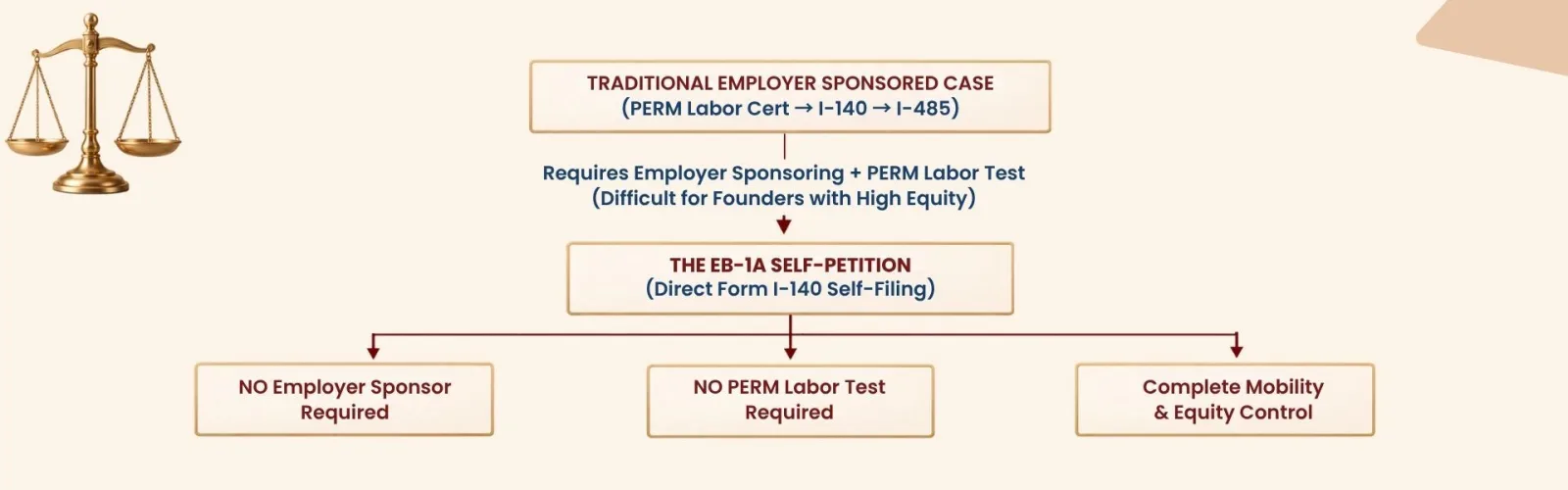
This is why the EB-1A founder green card sponsor petition is one where your personal accomplishments and international recognition in your extraordinary ability are evaluated and not any particular job in the corporation.
All you need to do is ensure that you continue working in your area of expertise in the United States, and you are legally allowed to sign and file the EB-1A petition yourself.
How Is This Different From Employer-Sponsored Cases?
Understanding the differences between the EB1A self petition process and traditional employer-sponsored pathways is essential for mapping out a multi-year immigration strategy.
| Case Feature | EB-1A Self-Petition | Standard EB-2 / EB-3 (Employer-Sponsored) |
| Petitioner / Sponsor | You (The Founder) | A U.S. Employer / Entity |
| PERM Labor Certification | Waived — No labor market test needed | Required — Lengthy DOL recruitment process |
| Founder Equity & Control | No restriction; high equity is often an advantage | Strictly scrutinized; high equity invalidates PERM |
| Career Mobility | Total flexibility; you own the priority date | Tied to sponsoring employer until green card final stage |
| Evidentiary Standard | Sustained national or international acclaim | Standard degree/experience requirement for the role |
| Premium Processing | Available (15-day USCIS initial response) | Varies (PERM step cannot be expedited) |
By opting for an EB1A without employer sponsor, founders eliminate the regulatory minefield of trying to prove that their own startup isn’t favoring them over a U.S. worker during a PERM recruitment cycle. You maintain full corporate control, complete professional autonomy, and an expedited runway toward permanent residence.
What Evidence Do You Need?
In order to file a successful EB-1A self-petition as a founder, one needs to fulfill the two-prong legal test devised by the USCIS (also known as the Kazarian framework).
The first step involves satisfying at least 3 out of 10 regulatory requirements. The second part involves passing a “Final Merits Determination,” which shows that you have achieved sustained recognition nationally or internationally, and that you fall within that small percent of people who are at the top of their game.
For tech founders, AI researchers, and startup executives, constructing a regulatory evidence portfolio entails converting your achievements into regulatory categories.
Key Regulatory Benchmarks for Startup Founders
- Original Contributions of Major Significance: Evidence: Proprietary algorithms, patented technologies, or open-source infrastructure created by your firm that has been broadly adopted within the industry, incorporated by corporations, or cited in academia.
- Critical or Essential Role in Distinguished Organizations: Evidence: Being a Founder, Chief Technology Officer, or CEO of a firm which has gained distinction through funding by leading venture capital companies (such as Y Combinator, Andreessen Horowitz, Sequoia), technology grants from major governments, or sizable recurring revenue.
- High Compensation / Remuneration: Evidence: Providing evidence that your total compensation – including your base salary, performance bonuses, and the market-value of equity – puts you in the top income brackets of founders or tech leaders in your geographical region.
- Published Media About Your Work: Evidence: In-depth articles, interviews, or profiles of you and your venture in respected tech trade press or general media outlets (TechCrunch, Forbes, Wired, Bloomberg).
- Judging the Work of Others: Evidence: Acting as a judge for hackathons, peer reviewer of papers for leading conference proceedings (NeurIPS, IEEE), or as an evaluator for venture grants.

Legal Strategy Note: One such evidentiary deficiency is the inclusion of company-wide achievements, like venture capital raised, without demonstrating the involvement of the founder in bringing about these achievements. An evaluation conducted by an attorney guarantees that every document presented is in compliance with the relevant regulations.
FAQ
1. Can a founder self-petition for a green card?+
Yes, a startup founder can self-petition for a green card through specific employment-based categories like the EB-1A (Extraordinary Ability) or the EB-2 NIW (National Interest Waiver). Neither category requires an employer sponsor or a PERM labor certification.
2. Do you need an employer to file EB-1A?+
No. The EB-1A category explicitly permits self-petitioning. You do not need a U.S. employer, a formal job offer, or an employer-employee relationship to submit Form I-140. You simply need to demonstrate that you will continue working in your area of extraordinary expertise within the United States.
3. What is the difference between EB-1A and employer-sponsored green cards?+
The primary difference lies in sponsorship and labor certification requirements. Employer-sponsored green cards (like standard EB-2 or EB-3) require a U.S. entity to file on your behalf and complete a PERM labor market test. The EB-1A is self-filed, skips PERM entirely, and offers complete career mobility without tying your legal status to a single employer.
4. What evidence does a self-petition require?+
An EB-1A self-petition requires providing documented proof satisfying at least 3 of the 10 USCIS criteria—such as evidence of critical leadership roles, major technical contributions, high salary/equity valuation, media coverage, or judging peer work—alongside expert advisory letters confirming your standing at the top of your field.
Mapping Your Self-Petition Strategy
For international founders to navigate the immigration process in the United States, they need an objective assessment of their case readiness instead of assuming the likely outcome. Through self-petition processes such as EB-1A, you maintain all of your equity and company control while at the same time developing an evidence-based record.
Determining whether your record qualifies according to the stringent evidentiary requirements of the EB-1A begins with a candid go/no-go assessment. In a nutshell, attorneys at SiliconPath Law do granular evidence review per criterion to assess whether your case is truly ready for filing.