
 SiliconPath Law
Learning how to comment on a DHS proposed rule involves identifying the rule’s docket number in the Federal Register, navigating to the docket on Regulations.gov, selecting “Comment,” and knowing how to submit a public comment on an immigration rule prior to the published deadline (11:59 p.m. Eastern Time). Check the specific USCIS proposed rule comment deadline before submitting. While drafting a substantive comment requires careful analysis, completing the portal submission itself typically takes approximately 10 minutes.
The most immediate rulemaking development affecting international students and institutions is the Department of Homeland Security’s Optional Practical Training (OPT) fee proposal. On October 8, 2026, DHS—acting through U.S. Immigration and Customs Enforcement (ICE)—published a Notice of Proposed Rulemaking (NPRM) titled Optional Practical Training Fees. Under the proposed framework, SEVP-certified institutions would be required to pay a $70,000 fee prior to recommending a student for initial OPT, and a $30,000 fee for any subsequent OPT recommendation, including STEM OPT extensions.
Public comments on the proposed OPT fee rule must be submitted by November 9, 2026. As an NPRM, this proposal does not constitute active law and has no current effect on pending or existing OPT applications. Crucially, public comments serve to inform agency policy and administrative records; submitting a comment does not constitute an adjudication request or expedite an individual case.
Can Visa Holders Comment on Proposed Rules?
Yes. Notice-and-comment rulemaking under the Administrative Procedure Act (APA), 5 U.S.C. § 553, is open to all interested persons without citizenship or immigration-status restrictions. The OPT NPRM explicitly solicits feedback, data, and legal arguments from all interested stakeholders.
Eligible commenters include F-1 students, OPT/STEM OPT workers, H-1B visa holders, sponsoring employers, academic institutions, Designated School Officials (DSOs), and U.S. workers. Comments may be submitted individually, on behalf of an entity or organization, or anonymously.
Commenters should note two key administrative requirements: DHS publishes all submitted comments—including attached personal identification—to the public docket, and all submissions must be in English or accompanied by an accurate English translation.
Step 1: Find the Docket and Identify the Proposal
The docket identification number is specified in the Federal Register notice under the “ADDRESSES” header. The docket serves as the official public repository on Regulations.gov, containing the proposed rule, agency supporting analyses, and all public submissions.
DHS sub-agencies utilize distinct docket prefixes. While USCIS rulemakings typically feature a “USCIS” prefix, this specific OPT proposal is cataloged under an ICE docket prefix (“ICEB”). The procedural steps for comment submission remain consistent across all DHS components.
Key docket parameters to verify prior to drafting include:
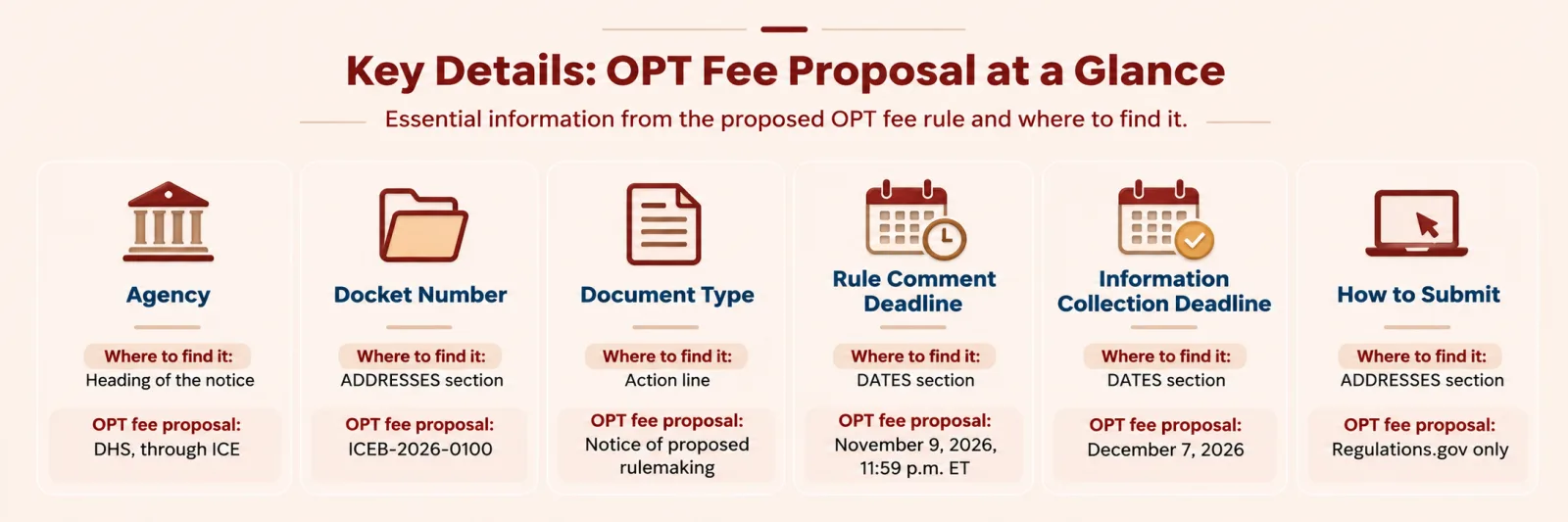
Note: The December 7, 2026 deadline applies specifically to the Paperwork Reduction Act (PRA) information collection requirements regarding SEVIS interface updates. Comments addressing the core fee structure must be submitted by the November 9, 2026 deadline.
Step 2: Read the Parts That Matter
Effective administrative advocacy does not require a comprehensive review of the entire preamble. Strategic focus should be directed toward the executive summary, specific proposed regulatory text modifications, economic analyses, and targeted agency requests for public input.
For the OPT fee proposal, four key sections warrant detailed analysis:
- Section V (Discussion of Changes): Outlines the mechanism requiring fee payment by the institution prior to DSO recommendation in SEVIS, establishing that USCIS will not grant OPT employment authorization absent verification of payment.
- Agency Requests for Specific Input: DHS explicitly requests feedback on alternative structures, including whether to reassess the $70,000 initial fee when a student advances to a higher educational degree level.
- Section VI (Reliance Interests): Details the agency’s conclusion that stakeholder reliance interests are secondary to program integrity and labor market concerns. Empirical data regarding reliance on established OPT frameworks directly engages this legal standard.
- Regulatory Impact Analysis: DHS projects 10-year transfer payments from institutions to the federal government ranging between $74.6 billion and $144.3 billion (at a 3 percent discount rate). Quantitative data challenging these economic assumptions triggers mandatory agency consideration under the APA.
The proposed rule is structured to apply prospectively only to DSO recommendations issued on or after the effective date of a final rule (proposed as 60 days following final publication).
Step 3: Write a Specific, Evidence-Based Comment
Compelling public comments identify specific regulatory provisions, articulate proposed revisions, and support arguments with verifiable data. DHS explicitly notes in the NPRM that the most impactful submissions cite precise rule sections, justify recommended modifications, and provide supporting empirical or legal authority.
Administrative rulemaking is not a voting process. As reflected in federal guidance, a single data-driven, legally sound comment carries significantly greater evidentiary weight than high volumes of identical form submissions.
We recommend structuring public comments around five core elements:
- Stakeholder Standing & Identity: State your relationship to the proposed rule (e.g., “I am an F-1 graduate student in data science scheduled to apply for post-completion OPT in 2027”).
- Specific Provision Citation: Reference exact regulatory citations or preamble sections (e.g., “Proposed 8 CFR § 214.13(i)(1)” or “Section VI, Reliance Interests”).
- Substantive Impact Statement: Clearly articulate the direct operational, financial, or academic consequences of the proposal.
- Empirical Evidence: Incorporate concrete evidence, such as institutional tuition data, financial obligations, conditional employment offers, or industry impact metrics.
- Proposed Alternatives: Present actionable regulatory alternatives, such as fee recalibration, institutional exemptions, extended transition periods, or targeted compliance mechanisms.
Ensure all statements are accurate and verifiable, as submissions become permanent federal public records. Confidential personal identifiers—such as passport numbers, Alien Registration Numbers (A-Numbers), receipt numbers, SEVIS IDs, and dates of birth—should be omitted.
Step 4: Submit the Comment and Keep a Record
Submissions must be transmitted via Regulations.gov, the exclusive submission channel designated by DHS for this rulemaking. DHS has explicitly indicated that hard-copy letters, emails, and physical media will not be accepted or considered part of the administrative record.
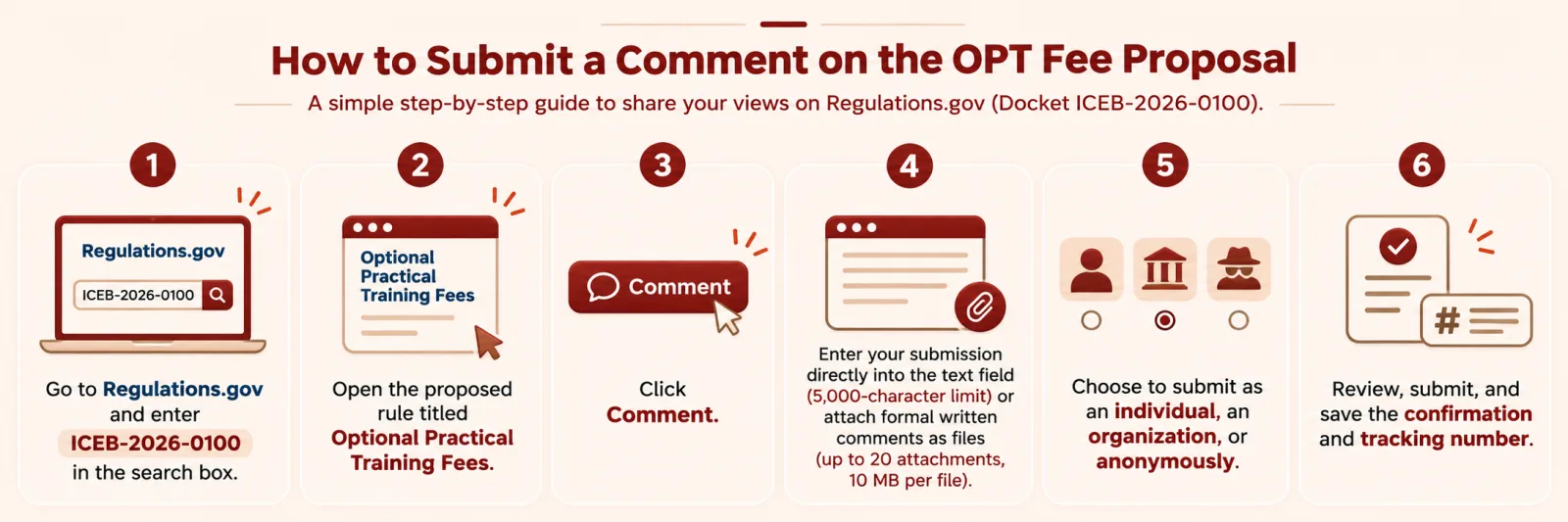
The submission window closes promptly at 11:59 p.m. Eastern Time on November 9, 2026 (corresponding to 10:29 a.m. IST on November 10, 2026). We advise submitting early to avoid potential portal congestion. Please note that public posting on the docket involves an administrative agency processing delay.
What Public Comments Can and Cannot Do
Public comments directly influence administrative records and final rule revisions, but they do not serve as adjudication requests for individual immigration benefits. Under the APA, DHS is required to evaluate all substantive public comments received during the comment period prior to promulgating a final rule.
| A public comment can | A public comment cannot |
| Become part of the official rulemaking record | Decide, approve, or deny your OPT, H-1B, or any other application |
| Raise facts, costs, or alternatives the agency must weigh | Pause the rule or extend the deadline on its own |
| Lead the agency to revise or withdraw parts of a proposal | Guarantee any change, since the agency makes the final decision |
| Form part of the record a court may review if a final rule is challenged | Replace advice from an attorney about your own situation |
Public comments do not form part of an individual’s USCIS petition, SEVIS record, or visa application. They represent policy-level advocacy intended to shape agency regulations across the immigration system.
Following the comment period closure, DHS will review public submissions and may issue a Final Rule accompanied by responses to significant public comments. Until a final rule is published and reaches its effective date, existing OPT regulations and procedures remain fully in effect.
How SiliconPath Law Can Help
SiliconPath Law specializes in high-impact employment-based immigration strategies for technology professionals, researchers, founders, and corporate entities. When regulatory shifts threaten long-term immigration trajectories, our legal team provides comprehensive risk assessments and strategic counsel.
Our firm provides targeted legal services, including:
- Strategic Timeline Mapping: Analyzing the potential impact of proposed rulemakings on OPT, STEM OPT extensions, H-1B cap filings, and permanent residency pathways.
- Alternative Path Evaluations: Identifying alternative nonimmigrant and immigrant options—such as O-1A extraordinary ability status, EB-2 National Interest Waivers (NIW), or EB-1A classification.
- Administrative Advocacy & Drafting: Assisting corporate clients, academic institutions, and industry associations in preparing formal substantive public comments and empirical impact data.
- Regulatory Monitoring: Tracking agency updates, litigation challenges, and implementation timelines to ensure proactive compliance.
To evaluate your immigration strategy under evolving agency rules, contact SiliconPath Law to schedule a formal legal consultation.
FAQs
1. Can visa holders comment on proposed rules?+
Yes. Administrative rulemaking under the APA allows participation by any interested person, regardless of nationality or visa status, including F-1 students and nonimmigrant workers.
2. How do I submit an immigration rule comment?+
Locate the docket number in the published Federal Register notice, navigate to Regulations.gov, select “Comment,” and submit before the published deadline (11:59 p.m. ET). For the OPT fee NPRM, the docket number is ICEB-2026-0100.
3. Does a comment affect my case?+
No. Public comments contribute strictly to the administrative record of the proposed rulemaking. DHS does not adjudicate individual visa applications or petitions through public comment dockets. Submissions are publicly accessible, so personal identifying information should be excluded.
4. What is the USCIS proposed rule comment deadline?+
Comment deadlines are specified in the “DATES” section of each Federal Register notice. For the OPT fee NPRM, public comments on the core rule are due November 9, 2026, while comments on the PRA information collection component are due December 7, 2026.
5. Can I comment anonymously?+
Yes. Regulations.gov supports anonymous submissions. However, any personal identifying data included within the body of the comment or attached documents will be published to the public docket.
6. Should I sign a form letter or write my own comment?+
While both options are permissible, customized comments supported by specific factual data, legal citations, and tailored regulatory alternatives carry substantially more weight in agency evaluations than standardized form letters.
Legal Disclaimer: This article provides general informational analysis regarding federal administrative rulemaking as of November 2, 2026. It does not constitute formal legal advice, nor does its review establish an attorney-client relationship. The OPT fee NPRM remains a proposed rule; any final rule issued by the agency may incorporate modifications.
For specific guidance regarding OPT filings, status maintenance, or employment-based visa strategies, consult with your Designated School Official (DSO) and a qualified immigration attorney.