 SiliconPath Law
For the accomplished professional whose record is being evaluated against the extraordinary ability standard, the central inquiry is rarely whether the achievements exist. The operative question is whether those achievements can be organized, documented, and presented in a manner that satisfies the regulatory criteria and the final merits determination.
The EB-1A application process, when directed by counsel, is structured to answer that question before any filing is made. What follows is a stage-by-stage process of how to apply for EB-1A with a lawyer, with attention to the EB-1A steps that are taken, the EB-1A timeline with the attorney that is typically observed, and the communication that should be expected throughout.
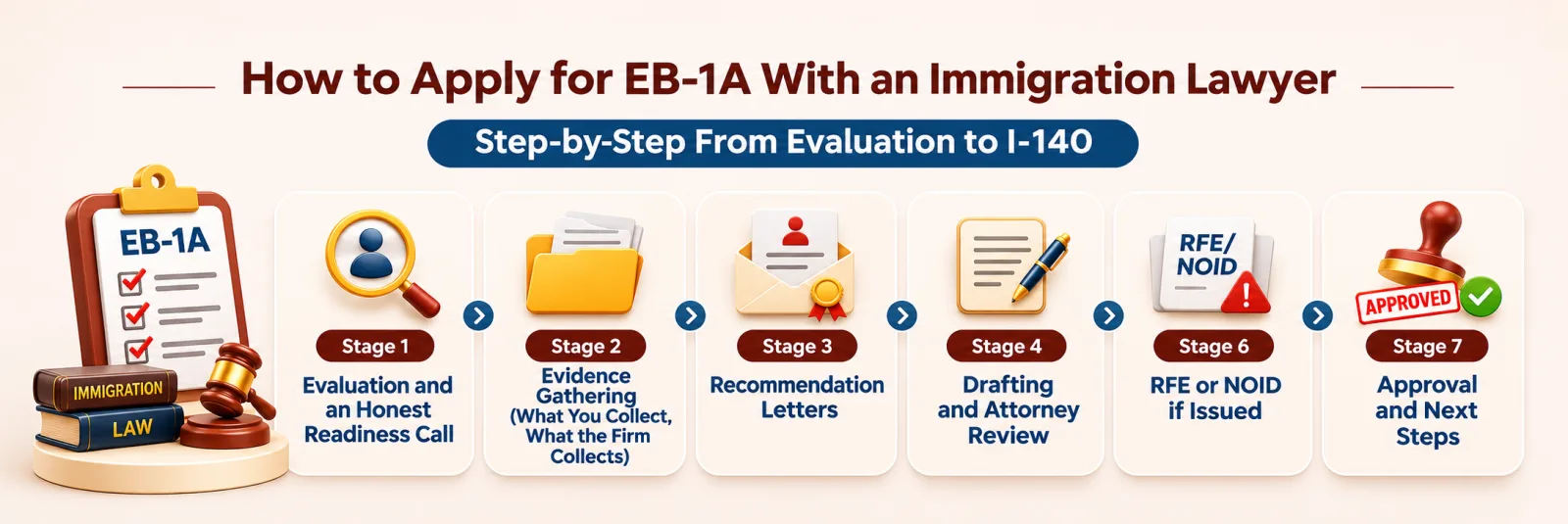
Stage 1: Evaluation and an Honest Readiness Call
Every engagement begins with an evaluation that is designed to produce a candid assessment rather than an encouraging one. The record is measured against the regulatory criteria at 8 C.F.R. § 204.5(h)(3), and consideration is given to whether the evidence, taken as a whole, supports the final merits determination required under the Kazarian framework.
Where the record is not yet sufficient, that conclusion is stated plainly, and the alternatives, including an EB-2 National Interest Waiver or a delayed filing strategy, are discussed. The purpose of this stage is to ensure that a petition is not filed until the evidentiary foundation can withstand adjudicative scrutiny.
After the free evaluation, a written assessment is typically provided, identifying which criteria are likely to be argued and where documentation gaps exist.
Stage 2: Evidence Gathering (What You Collect, What the Firm Collects)
The division of labor at this stage is deliberate. The client is responsible for producing the raw materials that only the client can access: award certificates, media coverage, citation reports, employment verification letters, and documentation of original contributions.
The firm is responsible for organizing those materials against the specific criteria, identifying which exhibits require certified translation, and determining whether comparable evidence may be appropriate where a listed criterion does not readily apply to the client’s occupation.
A claim-to-proof structure is maintained so that every assertion in the petition is tied to a specific exhibit, and every exhibit is tied to a regulatory criterion. This stage is frequently the longest in the EB-1A application process, and the firm’s role is to ensure that it is not prolonged by uncertainty about what is needed.
Stage 3: Recommendation Letters
Recommendation letters are treated as corroborative evidence, not as the foundation of the case. Letters are solicited from experts who can speak to the significance of the client’s contributions with specificity, and independent experts without a prior relationship to the client are prioritized where the record permits.
The firm typically provides drafting support and structural guidance to letter writers, ensuring that the letters address the legal criteria rather than offering general praise. Each letter is reviewed for consistency with the documentary record; a letter that asserts a contribution not supported by exhibits is of limited value and may create an inconsistency that requires explanation.
The EB-1A steps involving letters therefore require coordination between the client, the recommenders and counsel, and this stage is managed with an awareness of the time required for signatures and institutional letterhead.
Stage 4: Drafting and Attorney Review
The petition brief is drafted by counsel and is the document through which the record is translated into a legal argument. The brief identifies the field of endeavor with the specificity required for the final merits analysis, walks through each criterion argued with citations to the regulatory standard and the supporting exhibits and includes a standalone final merits section that addresses the totality of the record .
A petition that simply lists criteria without a comparative analysis of the client’s position within the field is vulnerable at the second step of adjudication. During this stage, the client should expect to hear from the attorney regarding the drafting timeline, any remaining evidentiary questions, and the points at which client review will be requested.
The EB-1A i-140 filing is not made until the brief and exhibit package have been reviewed internally and by the client.
Stage 5: Filing the I-140 (Premium Processing Option; Concurrent I-485 Where Available)
The I-140 petition is filed by counsel on the client’s behalf; the client does not file the petition personally when represented. Premium processing may be elected through Form I-907, which obligates USCIS to take adjudicative action within fifteen business days for the additional fee.
Where the client is physically present in the United States and the priority date is current under the applicable Visa Bulletin chart designated by USCIS for that month, concurrent filing of Form I-485 may be considered. It should be noted that the November 2026 Visa Bulletin reflects the Dates for Filing chart being used by USCIS, with the EB-1 category current for all countries other than China and India, for which the Dates for Filing are July 1, 2024.
The decision to file concurrently is made on a case-specific basis, with attention to the risks of committing to adjustment of status before the petition has been adjudicated .
Stage 6: RFE or NOID if Issued
A Request for Evidence or Notice of Intent to Deny is not treated as an adverse outcome but as an invitation to supply the record that the adjudicator has found insufficient. The response is prepared by counsel within the deadline stated in the notice, which is commonly thirty to ninety days, and is directed at the specific deficiencies identified.
The EB-1A timeline with an attorney must account for this possibility, and clients should understand that an RFE adds time to the adjudication but does not by itself determine the outcome. The response is drafted with the same attention to the regulatory criteria and the final merits standard as the original petition, and the client’s role is limited to providing any additional documentation requested.
Stage 7: Approval and Next Steps
Upon approval of the I-140, the path forward depends on the client’s location and visa availability. For clients outside the United States, consular processing is initiated through the National Visa Center. For clients within the United States with a current priority date, the I-485 may be filed or, where concurrently filed, may proceed to adjudication.
The firm’s responsibility at this stage includes confirming that the priority date remains current, advising on the timing of any I-485 filing, and preparing the client for the possibility that adjustment of status is adjudicated as a discretionary matter.
What happens after approval is therefore not a single event but a sequence that is managed in accordance with the Visa Bulletin and the client’s circumstances.
What You Should Hear at Each Stage
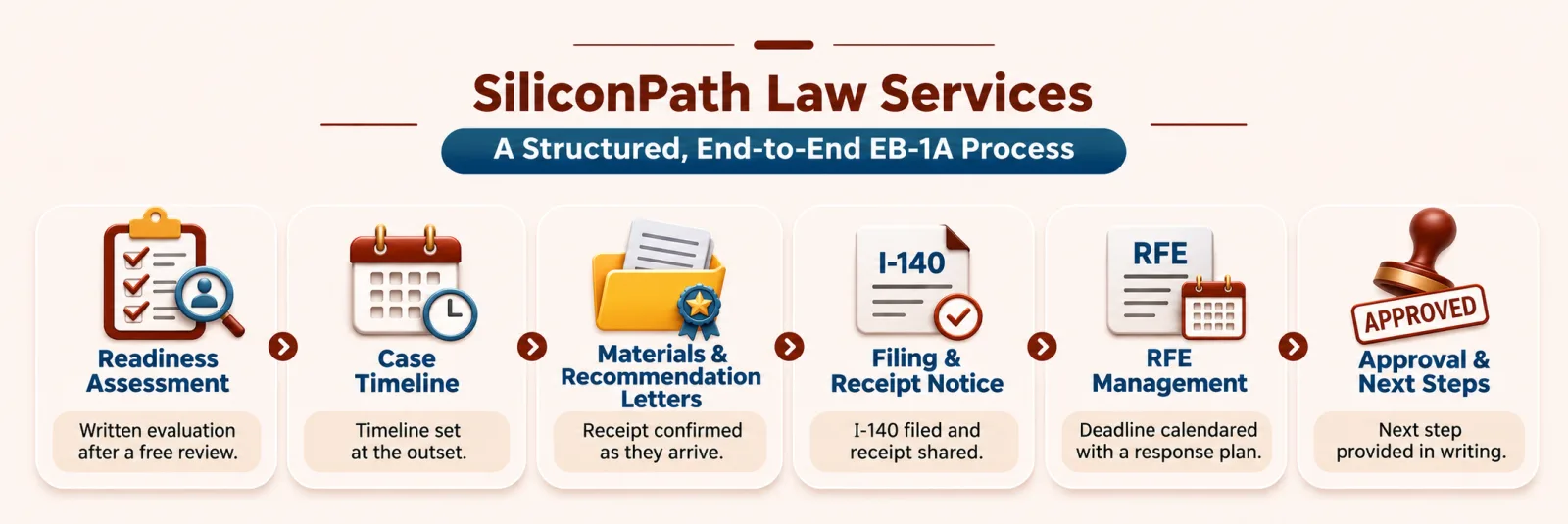
At the evaluation stage, a written assessment is provided. During evidence gathering, the firm confirms receipt of materials and identifies outstanding items.
Recommendation letters are confirmed as they are received and reviewed. At the drafting stage, a timeline for review is provided and any changes to that timeline are communicated. Upon filing, the receipt notice is forwarded and the premium processing clock, where elected, is tracked.
If an RFE is issued, the deadline is calendared and the response strategy is explained. At approval, the next procedural step is identified in writing. This cadence is maintained so that the client is not required to inquire about the status of the case.
Conclusion
The EB-1A process, when directed by counsel, is not a single filing event but a sequence of deliberate stages, each designed to test the record against the regulatory criteria and the final merits standard before adjudicative scrutiny is invited. Because the standard is qualitative rather than quantitative, the outcome is determined less by the volume of achievements than by the coherence with which they are documented and argued.
At SiliconPath Law, that structure is made visible: a written readiness assessment follows the free evaluation, a case timeline is established at the outset, receipt of materials and recommendation letters is confirmed as they arrive, the receipt notice is forwarded upon filing, any RFE deadline is calendared with the response strategy explained, and the next procedural step is identified in writing at approval.
To initiate a review of the record, contact SiliconPath Law to schedule an evaluation.
FAQs
1. What are the steps to apply for EB-1A with an immigration lawyer?+
The engagement proceeds through evaluation, evidence gathering, recommendation letters, drafting and review, I-140 filing, response to any RFE or NOID, and post-approval processing. Each stage is managed by counsel with defined client inputs.
2. What happens after the free evaluation?+
A written readiness assessment is provided, identifying the criteria that can be argued and any documentation that must be obtained before drafting begins.
3. How long does each stage take?+
Evidence gathering varies with the client’s record; drafting and review typically require several weeks; premium processing yields a USCIS action within fifteen business days, while standard adjudication may take several months . The EB-1A timeline with attorney is therefore case-specific and is communicated at the outset.
4. Who files the I-140?+
The petition is prepared and filed by counsel on the client’s behalf. The client signs the Form I-140 and the accompanying G-28.
5. What happens after approval?+
Consular processing or adjustment of status is initiated, depending on the client’s location and visa availability, and the priority date is monitored against the Visa Bulletin.