
 SiliconPath Law
While your I-485 is pending, you can usually keep working, travel, and change jobs, but each depends on its own document and deadline. The I-485 is Form I-485, the application to adjust status to permanent resident inside the United States. The rules on all three topics changed between late 2025 and October 2026, so check the date on anything you read about them, including this article.
What Does “Pending” Mean?
Pending means U.S. Citizenship and Immigration Services (USCIS) has accepted your I-485 and has not yet decided it. A pending I-485 lets you apply for a work permit and travel permission, and after 180 days it may let you change jobs. Each of those depends on its own document and deadlines, and you are responsible for keeping each one current.
Can You Change Jobs While Your I-485 Is Pending?
In many cases, yes, under AC21 job portability. AC21 job portability is the rule in INA section 204(j) that lets an employment-based applicant move to a new job without losing a pending I-485.
Who qualifies for AC21 job portability?
You generally qualify when three conditions are met:
- Your I-485 has been pending for at least 180 days.
- Your I-140 has been approved, or is still pending and is later approved.
- The new job is in the same or a similar occupational classification as the job in your labor certification or I-140.
“Same or similar” is a factual comparison of duties, level of responsibility, and field, not just job title. A comparable role at a different employer usually supports AC21 job portability. A materially different function may not, and that weakness can surface if USCIS reviews the file later.
Do you need Form I-485 Supplement J?
Yes. To use AC21 job portability, you file Form I-485 Supplement J describing the new job offer. USCIS accepts it only once your I-485 has been pending 180 days or more, and uses it to decide whether the new job is the same or similar.
What to document before you move
Before you change jobs, confirm two things:
- Supplement J and the offer letter. The new employer’s offer letter should describe the duties in enough detail to support the same-or-similar comparison. Get it at the time of the move, because it is hard to reconstruct years later.
- I-140 status. If your original employer has withdrawn your I-140, or USCIS has revoked it, have an attorney review the timing before you move.
Can You Travel While Your I-485 Is Pending?
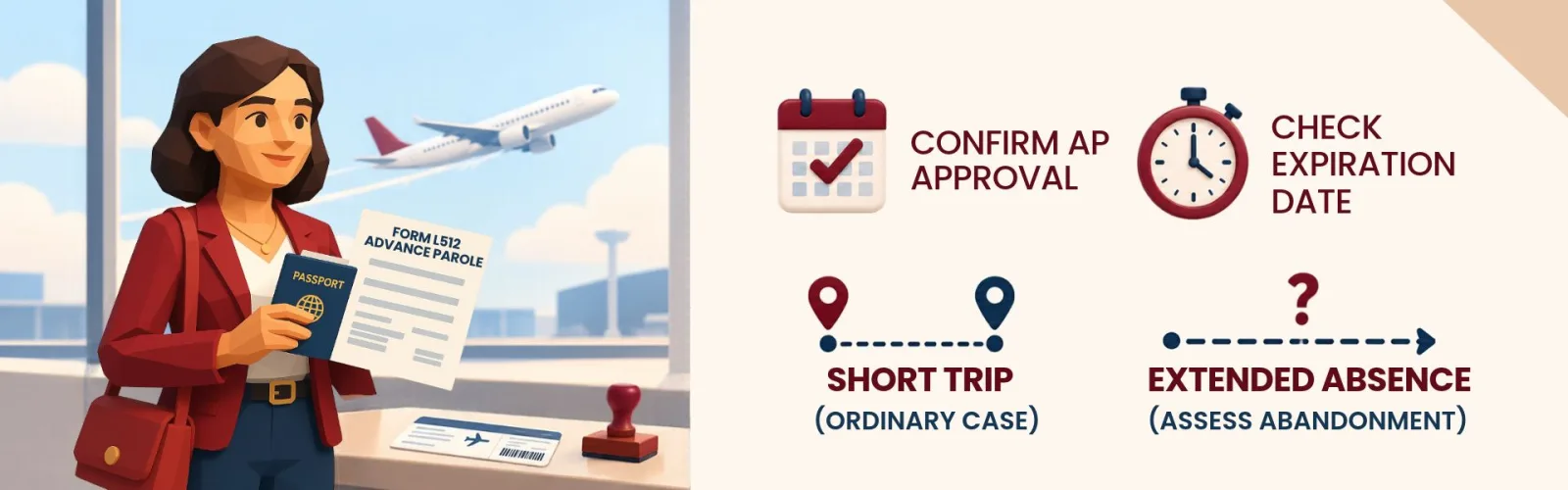
Generally yes, if you hold an approved advance parole document, or if you maintain H-1B or L-1 status and return on a valid H or L visa. Leaving without either generally causes USCIS to treat your I-485 as abandoned.
Advance parole is a travel document that lets you ask the U.S. Customs and Border Protection (CBP) to parole you back into the United States after a trip abroad. It does not guarantee your return: a CBP officer decides at the port of entry. Do not leave before your advance parole is approved, and make sure it stays valid through your return date.
New risk: unlawful presence and advance parole
Since August 13, 2026, a trip on advance parole can count as a departure that triggers the 3-year or 10-year unlawful presence bars under INA section 212(a)(9)(B). The Board of Immigration Appeals (BIA) held this in Matter of Delcarmen-Lara, 29 I&N Dec. 830 (BIA 2026), overruling earlier precedent. If you have ever been out of status in the United States, have an attorney review the trip before you book it.
Nationals of countries under the USCIS processing hold
USCIS has placed a hold on final decisions for most benefit applications filed by nationals of the countries listed in the December 16, 2025 travel Proclamation, including I-485 and advance parole applications. See USCIS Policy Memorandum PM-602-0194 for the current list. If you are a national of one of those countries, do not travel without an attorney’s review.
Long trips
A long trip carries practical risks even without these issues. Your advance parole may expire while you are abroad, you may miss a USCIS notice or appointment, and CBP still decides whether to let you back in. Before booking, check your advance parole expiration date and build the renewal timeline into the travel decision.
How Do You Renew Your EAD While Your I-485 Is Pending?
File your renewal as early as USCIS allows, up to 180 days before your current card expires. An EAD (Employment Authorization Document) is the work permit card USCIS issues to adjustment applicants.
There is no automatic extension anymore
EAD renewals filed on or after October 30, 2025 do not receive an automatic extension. If your card expires before USCIS approves the renewal, your EAD-based work authorization stops on the expiration date, even though the renewal is still pending. DHS adopted this change as a final rule on October 14, 2026 (USCIS announcement).
EADs now last a maximum of 18 months
EADs issued to adjustment applicants are now valid for a maximum of 18 months, down from five years. Plan on renewing roughly every year and a half, and put the 180-day filing window on your calendar the day each new card arrives.
Renew advance parole on the same calendar
You can file your advance parole renewal together with your EAD renewal. Track both expiration dates on the same calendar so a gap in one does not catch you by surprise.
FAQs
1. Can you change jobs while your I-485 is pending?+
Yes, in many cases, under AC21 job portability, once your I-485 has been pending at least 180 days and the new job is in a same or similar occupational classification. You request it by filing Form I-485 Supplement J with a detailed description of the new job.
2. What is AC21 job portability?+
AC21 job portability is the rule in INA section 204(j) that lets an employment-based adjustment applicant move to a new job in a same or similar occupation without losing the pending I-485. The I-485 must have been pending 180 days or more, and the I-140 must be approved or later approved.
3. Can you take a promotion with your current employer?+
The same test applies to a new role with the same employer: the new job must be in a same or similar occupational classification. A promotion within the same field often meets that test, but compare the duties before you accept.
4. Can you travel while your I-485 is pending?+
Generally yes, with approved advance parole, or with valid H-1B or L-1 status and a valid H or L visa. Since August 13, 2026, advance parole travel can trigger unlawful presence bars, so anyone who has ever been out of status should have an attorney review the trip first.
5. Can you travel on your H-1B or L-1 visa instead of advance parole?+
Yes, if you are maintaining H-1B or L-1 status and return on a valid H or L visa, travel generally does not abandon your I-485. You still need to remain eligible for that status when you return.
6. How do you renew your EAD while your I-485 is pending?+
File your renewal up to 180 days before your current card expires. Renewals filed on or after October 30, 2025 receive no automatic extension, so file as early as you can.
7. What happens if your EAD expires before the renewal is approved?+
Your EAD-based work authorization stops on the expiration date, even if the renewal is pending. Talk to your employer and an attorney well before that date about any other basis you may have to keep working.
Next Step
If your I-485 has been pending for a long time, review your job situation, travel plans, and document expiration dates together. Silicon Path Law handles these reviews. Bring your receipt notices, offer letters, and travel dates, and we will assess where your case stands.
Disclaimer: This article is general information, not legal advice. Reading it does not create an attorney-client relationship. Outcomes depend on individual facts, no result is guaranteed, and immigration rules can change after the date above; for guidance on your case, speak with a licensed attorney.