
 SiliconPath Law
For high-skilled visa holders, remaining on an H-1B visa during periods of heightened regulatory scrutiny creates operational and professional uncertainty. While ongoing litigation leaves policy enforcement fluid; such as pending federal appeals regarding presidential proclamation fee structures—relying solely on employer-managed renewals exposes career trajectories to sudden policy shifts. Transitioning to an Employment-Based First Preference (EB-1) green card provides a direct path to permanent residency that eliminates reliance on labor certifications and significantly reduces visa queue times.
H-1B status explicitly permits dual intent, allowing professionals to pursue immigrant petitions without jeopardizing their temporary work authorization or international travel permissions. The primary structural advantage of the EB-1 category is its exemption from the Program for Electronic Review Management (PERM) labor certification—a multi-step Department of Labor process that routinely adds twelve to twenty-four months to standard EB-2 and EB-3 filings.
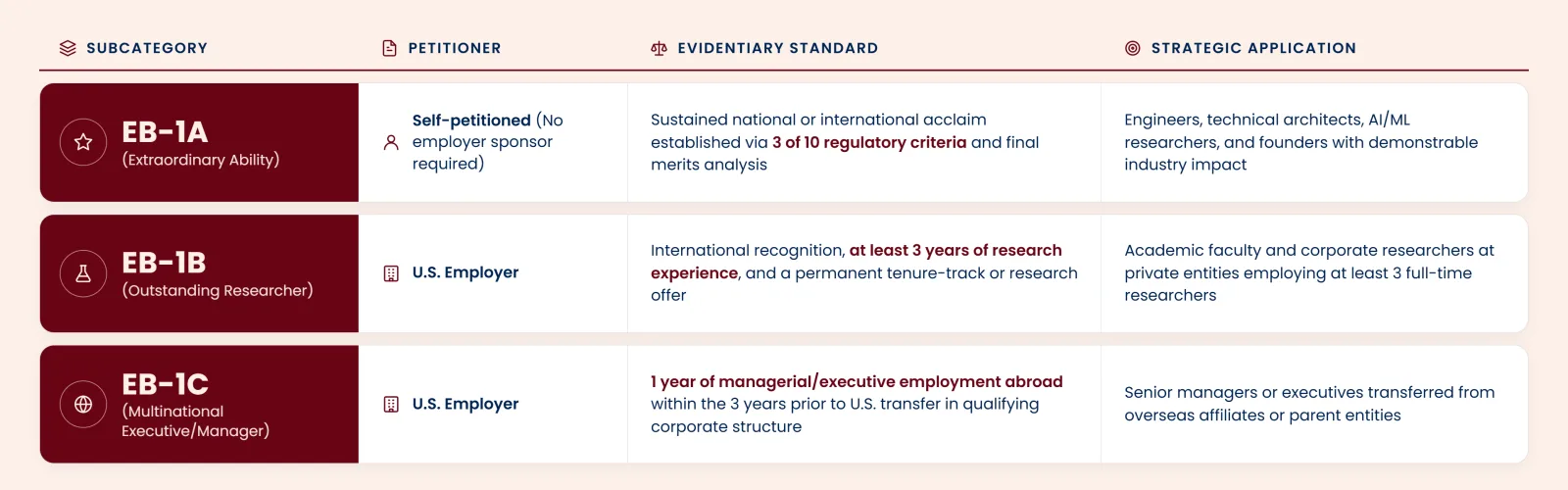
Petitioners file under one of three distinct EB-1 subcategories: Extraordinary Ability (EB-1A), Outstanding Professors and Researchers (EB-1B), or Multinational Managers and Executives (EB-1C). Selecting the optimal subcategory requires matching an individual’s evidentiary record with regulatory thresholds and filing requirements.
Evaluating EB-1 Subcategories for H-1B Professionals
Choosing the appropriate EB-1 classification depends on petitioner ownership, professional qualifications, and prior international employment structure.
Strategic Flexibility of the EB-1A Self-Petition
The EB-1A self-petitioning framework confers complete procedural autonomy. Because the filing is independent of employer sponsorship, an unexpected corporate restructuring or layoff does not invalidate the underlying I-140 petition. While maintaining underlying nonimmigrant status remains mandatory during petition pendency—typically utilizing the statutory 60-day H-1B grace period following employment termination—the immigrant visa process remains intact.
Employer-Sponsored EB-1B and EB-1C Considerations
Conversely, EB-1B and EB-1C petitions require an ongoing job offer from a qualifying employer who acts as the petitioner and must establish ability to pay the offered wage. A change in employer prior to final adjustment of status necessitates a complete re-filing by the new sponsoring entity.
Procedural Advantages: Timelines and Priority Date Retention
The EB-1 preference category accelerates permanent residency timelines primarily through PERM elimination and superior Visa Bulletin final action dates. For individuals born in India or China facing decades-long backlogs in the EB-2 and EB-3 categories, EB-1 offers substantially earlier priority date availability.
By bypassing the prevailing wage determination and recruitment mandatory under PERM, applicants reduce pre-filing preparation timelines significantly.
Priority Date Porting Under 8 CFR 204.5(e)
Applicants with an approved EB-2 or EB-3 Form I-140 retain their original priority date pursuant to 8 CFR 204.5(e). Upon approval of a subsequent EB-1 I-140, USCIS applies the earlier priority date to the new filing, enabling immediate adjustment of status if the ported date is current under the active Visa Bulletin.
Legal Criteria and Evidentiary Framework for EB-1A
Under 8 CFR 204.5(h)(3), qualifying for EB-1A classification requires documenting either a major internationally recognized award (such as a Nobel Prize) or satisfying at least 3 of 10 regulatory criteria. Meeting three criteria satisfies the initial threshold but does not guarantee approval.
The ten regulatory criteria evaluate technical and professional distinction across specific indicators:
- Prizes/Awards: Receipt of lesser nationally or internationally recognized prizes or awards for excellence.
- Membership: Membership in associations requiring outstanding achievements of their members, as judged by recognized experts.
- Published Material: Published material about the alien in professional or major trade publications or major media.
- Judging: Participation as a judge of the work of others in the same or an allied field.
- Original Contributions: Original scientific, scholarly, artistic, athletic, or business-related contributions of major significance.
- Authorship: Authorship of scholarly articles in professional journals or major media.
- Exhibitions: Display of work at artistic exhibitions or showcases.
- Critical Role: Performance in a leading or critical role for organizations with a distinguished reputation.
- High Salary: Command of a high salary or significantly high remuneration relative to others in the field.
- Commercial Success: Commercial success in the performing arts.
The Two-Step Final Merits Determination
Adjudication follows the two-step analytical framework established in Kazarian v. USCIS (9th Cir. 2010) and reinforced in policy guidance. First, USCIS determines whether the petition contains evidence satisfying three criteria. Second, the officer conducts a final merits determination evaluating whether the cumulative record demonstrates sustained national or international acclaim and establishes that the applicant belongs to the small percentage at the top of the field.
Translating Corporate Technical Contributions into Objective Proof
Engineers and tech professionals working in private industry frequently face challenges establishing public acclaim due to proprietary constraints. Overcoming this barrier requires converting internal enterprise achievements into verifiably documented evidence, including granted patents, citation metrics, open-source adoption statistics, peer review logs, conference presentations, and objective wage benchmarking. Independent expert letters from neutral industry leaders serve to contextualize the significance of proprietary work within the broader discipline.
End-to-End Procedural Roadmap
Executing an H-1B to EB-1 transition involves five distinct operational stages:
- Objective Profile Assessment: Rigorous legal evaluation of professional achievements against statutory criteria to determine eligibility across EB-1A, EB-1B, or concurrent EB-2 National Interest Waiver (NIW) backup strategies.
- Evidentiary Compilation: Gathering verifiable documentation, structured wage comparisons, citation reports, media coverage, and independent recommendation letters from authoritative figures.
- Petition Submission: Filing Form I-140 accompanied by organized exhibit indexes and a comprehensive legal brief detailing regulatory compliance. Sponsoring optional Premium Processing via Form I-907 where applicable.
- RFE/NOID Management: Responding to Request for Evidence (RFE) or Notice of Intent to Deny (NOID) issuances within mandated statutory windows with targeted supplemental documentation.
- Adjustment of Status or Consular Processing: Submitting Form I-485 upon priority date currency, or completing immigrant visa processing abroad at a designated U.S. Embassy or Consulate.
While an I-485 application is pending, applicants may obtain ancillary benefits including Employment Authorization Documents (EAD) and Advance Parole (AP) travel authorization. Maintaining nonimmigrant H-1B status throughout adjustment pendency remains recommended to preserve lawful status in the event of an unexpected administrative denial.
Premium Processing and Fee Structures
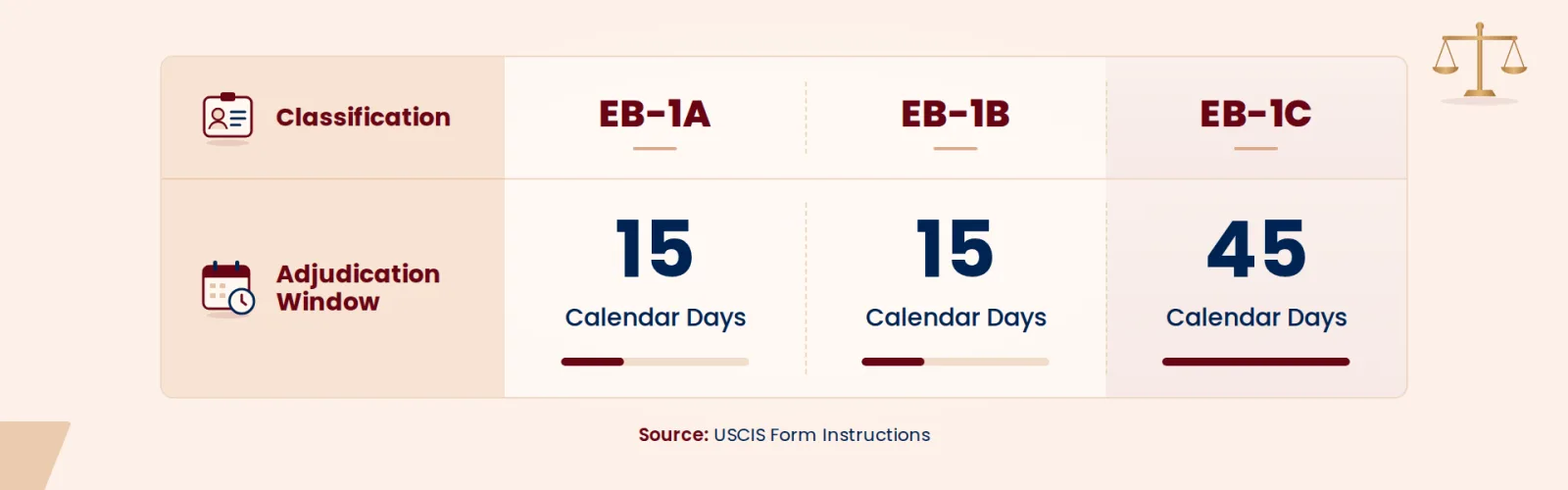
Under Form I-907, Premium Processing guarantees administrative action on EB-1A and EB-1B I-140 petitions within 15 calendar days (45 calendar days for EB-1C). Action constitutes approval, denial, RFE issuance, or NOID notification. Premium processing accelerates adjudication velocity but does not alter underlying evidentiary evaluation standards.
Filing Fee Schedules and Compliance Verification
Filing fees must strictly conform to current USCIS Fee Schedule (Form G-1055) regulations. lStatutory I-140 filing fees are subject to Asylum Program Fee surcharges depending on petitioner size. The optional Premium Processing fee is $2,965. Remittances must be submitted as separate payment instruments for each form; improper fee combinations trigger automatic rejection of the complete filing package.
Submissions must be verified against the official USCIS fee schedule immediately prior to filing to prevent procedural rejections based on adjusted fee structures.
Overall processing timelines remain dictated by priority date availability listed in the Department of State Visa Bulletin.
Maintaining Nonimmigrant Status and AC21 Provisions
Maintaining valid H-1B nonimmigrant status remains critical until adjustment of status is fully approved, providing essential legal protection if adjustment proceedings encounter issues.
H-1B Extensions Beyond the Six-Year Statutory Cap
The American Competitiveness in the Twenty-First Century Act (AC21) permits H-1B extensions beyond six years under specific conditions:
- AC21 §104(c) Three-Year Extensions: Available to individuals with an approved Form I-140 in EB-1, EB-2, or EB-3 who are prevented from adjusting status due to per-country immigrant visa backlogs.
- AC21 §106(a) One-Year Extensions: Available if a PERM application or Form I-140 was filed at least 365 days prior to reaching the six-year statutory limitation.
Because EB-1 filings bypass the lengthier PERM stage, applicants achieve I-140 approval faster, securing AC21 §104(c) eligibility well before reaching the six-year H-1B ceiling.
Portability and Career Mobility
Self-petitioned EB-1A approvals remain entirely valid across changes in employment, requiring only that the applicant continues working in the same field of extraordinary ability in the United States. Sponsoring under EB-1B or EB-1C requires strategic employer-coordination before executing career transitions.
Mitigating Common Evidentiary Pitfalls and RFEs
Requests for Evidence (RFEs) in EB-1 adjudications typically arise when evidence documents ordinary professional activity rather than national or international acclaim.
| Evidentiary Defect | Adjudicative Impact | Corrective Strategy |
| Relying solely on meeting 3 initial criteria | Petition fails the Kazarian step-two final merits analysis | Structure legal argument to explicitly demonstrate top-tier industry standing throughout the brief |
| Submitting standard job descriptions | Establishes routine duties rather than widespread impact | Supply objective metrics: product adoption scales, revenue figures, technical benchmarks, or industry standards set |
| Exclusive reliance on internal co-workers for letters | USCIS discounts testimonial probative weight due to perceived bias | Secure independent expert opinion letters from recognized authorities outside the applicant’s direct network |
| Unsubstantiated compensation claims | Salary figures lack comparative context showing top-tier compensation | Provide official labor market statistics (e.g., OES wage data) establishing high remuneration relative to geographic/role standards |
| Fee calculation errors | Immediate administrative rejection at receipt | Verify active fee schedules (Form G-1055) prior to submission and issue discrete checks per form fee |
| Allowing nonimmigrant gap periods | Leaves candidate without underlying status if adjustment fails | Maintain continuous nonimmigrant validity through regular H-1B extensions |
FAQs
1. Is it permissible to pursue an EB-1A self-petition while an employer PERM is pending?+
Yes. Applicants may concurrently pursue an independent EB-1A self-petition alongside an employer-sponsored PERM or EB-2 process without violating regulations or creating procedural conflicts.
2. Can an applicant file EB-1A and EB-2 NIW petitions simultaneously?+
Yes. Filing both EB-1A and EB-2 NIW petitions provides a multi-tiered strategy. The EB-2 NIW carries a lower evidentiary threshold, establishing an earlier approved I-140 backup while the EB-1A petition progresses.
3. How does a pending EB-1 I-140 impact international travel on an H-1B visa?+
Because the H-1B status explicitly recognizes dual intent, filing Form I-140 does not restrict international travel or visa renewal. While Form I-485 is pending, you must have either a valid H-1B visa or approved Advance Parole to travel.
4. Does EB-1A eligibility require an advanced academic degree or Ph.D.?+
No. The EB-1A category imposes no degree requirements. Eligibility centers entirely on demonstrating sustained national or international acclaim and significant impact within the field of expertise.
5. What distinguishes the adjudication standard of EB-1A from EB-1B?+
EB-1A requires demonstrating top-of-field standing with sustained national or international acclaim without an employer sponsor. EB-1B evaluates international recognition as an outstanding researcher within a specific academic or research discipline and requires a qualifying permanent job offer.
Strategic Consultation and Representation
Navigating the transition from H-1B nonimmigrant status to permanent residency under the EB-1 preference category requires precision, strategic evidence framing, and meticulous regulatory compliance.
Ready to transition from H-1B to an EB-1 green card? Contact SiliconPath Law today to schedule a consultation and have our immigration team evaluate your eligibility.
Attorney Advertising. This article provides general legal information and does not constitute formal legal advice or create an attorney-client relationship. Prior results do not guarantee similar outcomes. Statutory fees, regulations,Visa Bulletin and dates remain current as of October 2026.