
 SiliconPath Law
Several crucial measures taken in recent times have generated as much uncertainty as the $100,000 H-1B fee. In a span of a single, it has been announced, paused, appealed, extended and then halted once again. In fact, many employers have postponed their hiring decisions considering the uncertainty of the law being completely enforced or fully stopped. Beneficiaries have deferred travel and attorneys have fielded the same question from every direction: what is actually required of us right now?
The answer deserves a clear response, and more precisely, it deserves one final verdict grounded in the court record rather than the headlines. What follows is our assessment of where the fee stands today, why the courts have intervened and what employers and foreign nationals should be doing in the meantime as their safety measure.
What Actually Happened?
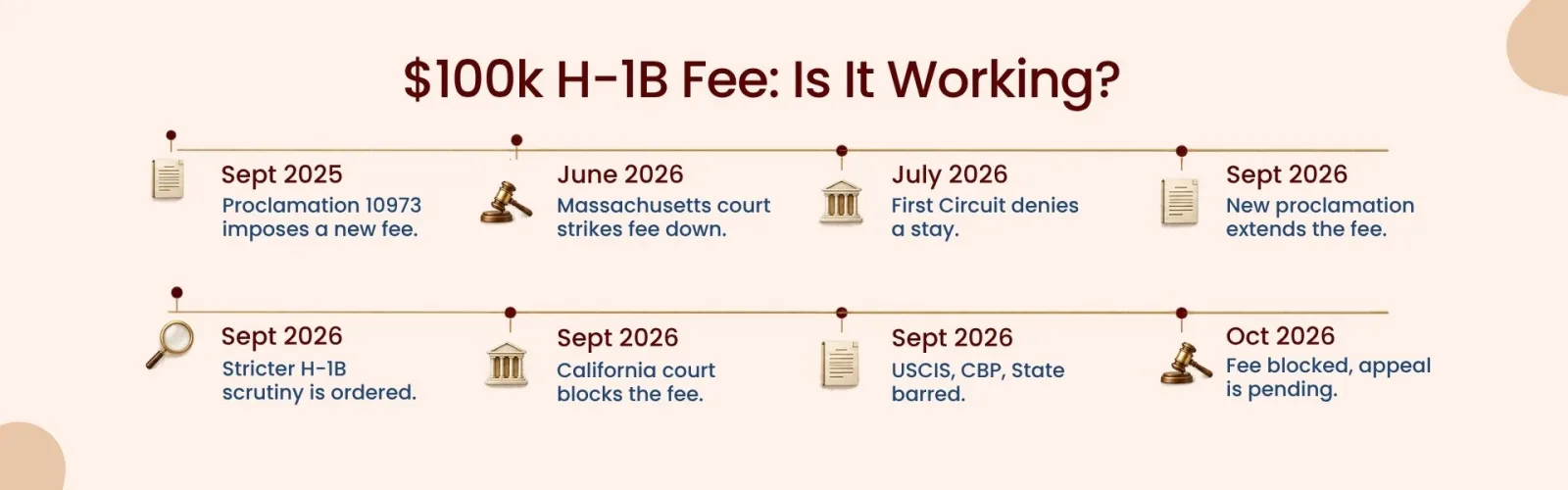
In September 2025, the President issued Proclamation 10973 which proposed imposing a $100,000 payment rule on certain new H-1B petitions. It stated that this rule primarily applied to beneficiaries abroad, who would need consular processing or admission at a port of entry to activate their status.
The proclamation was immediately challenged by the U.S. District Court of Massachusetts. The court held that the fee functioned as an unlawful tax and that it had violated the Administrative Procedure Act (APA). It found that the agency had failed to follow the rulemaking procedure the statute requires, and it vacated the policy nationwide.
The government appealed. In July 2026, the First Circuit declined to stay the district court’s ruling, and therefore, the vacatur remained in effect while the appeal moved forward.
Then, on September 18, 2026, within just days before the original proclamation was set to expire; the President issued a new proclamation, extending the $100,000 fee framework through September 21, 2027. A separate Executive Order followed, directing agencies to take a closer look at H-1B petitions, especially those filed by companies with recent layoffs.
On September 30, 2026, a second federal court, the Northern District of California, issued its own ruling regarding the H1B fee block, wherein it barred the USCIS, CBP and the State Department from enforcing or implementing the payment requirement until proper rulemaking is completed.
Why A Court Blocked It
The judicial reasoning against the fee has been consistent and it has proven difficult for the government to answer at this stage. Both the Massachusetts and California courts found that the administration treated the payment as a legislative rule; a substantive regulatory requirement which was being implemented without following the APA’s mandatory notice-and-comment procedures.
Under the APA, agencies must publish proposed rules, invite public comment, and consider relevant alternatives before issuing any binding requirement.
The courts also found that the agencies failed to engage in reasoned decision-making. They did not adequately consider alternatives to the fee, nor the reliance interests of employers and beneficiaries who had structured their hiring and immigration strategies around the pre-existing system.
Most fundamentally, the Massachusetts court characterized the $100,000 payment as an unlawful tax; more of a revenue-raising measure that only Congress has the constitutional authority to impose. At the same time, the executive branch, the court reasoned, cannot unilaterally create a payment obligation of this magnitude without legislative authorization.
These are not procedural technicalities. They concern the separation of powers and the limits of executive authority over the immigration system.
Why It Was Extended Anyway
The September 2026 extension is best understood not as a new enforcement mechanism, but as litigation positioning.
By extending the proclamation through September 2027, the administration preserves the legal framework so that, if it prevails on appeal, the fee can be reinstated without beginning anew. The extension signals that the administration has not abandoned the policy. It is waiting for the courts to rule on whether it ever had the authority to impose it.
The proclamation does not reference the ongoing litigation, and USCIS has not updated its guidance to suggest the fee is now collectible. The agency’s published position continues to acknowledge that the fee is not owed while the court order stands.
In practical terms, the extension changes nothing about the current legal obligations of H-1B filers. It is a placeholder; a signal of intent rather than an enforceable requirement.
Is It Being Collected Right Now?
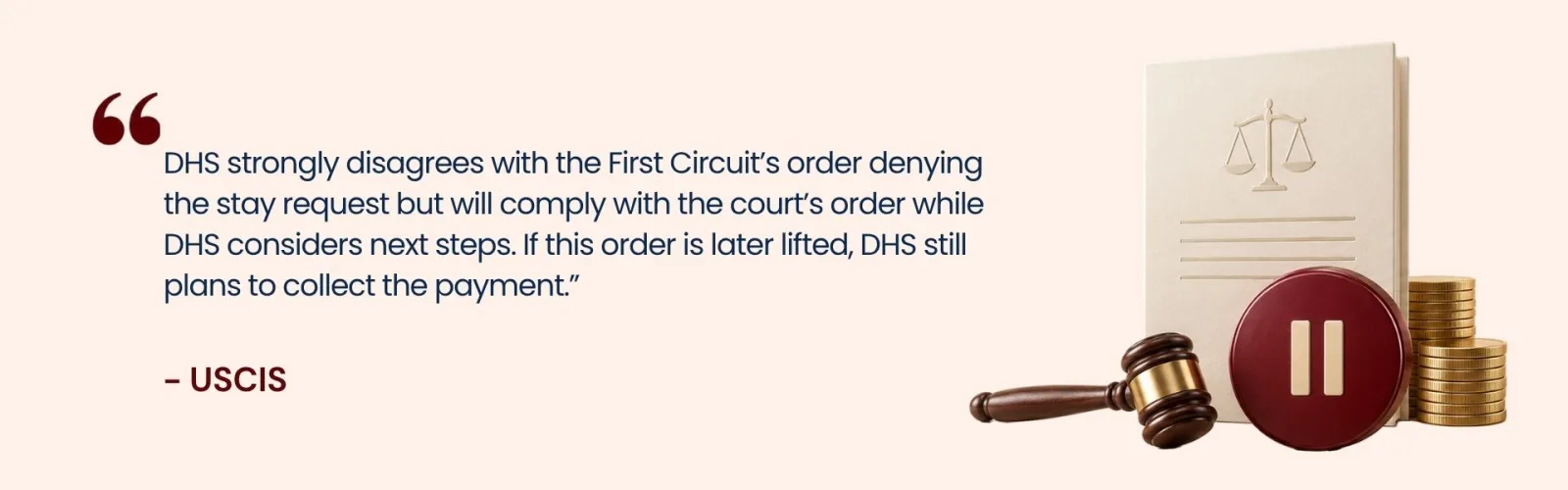
The $100,000 H-1B fee is not currently being collected or enforced. Employers filing H-1B petitions, including those requiring consular processing or admission from abroad, are not required to submit the $100,000 payment at this time.
USCIS has confirmed that it will comply with the court orders while it considers its next steps, though the agency has made clear that it intends to collect the payment if the orders are later lifted.
One distinction warrants emphasis. The proclamation-based $100,000 fee is not the same as the proposed $103,265 fee that DHS introduced through formal rulemaking in August 2026. That proposed fee would apply to all H-1B cap-subject petitions, is unaffected by the court orders blocking the proclamation fee, and is not yet in effect. DHS must complete the rulemaking process, including reviewing public comments, before it could become final.
What Filers Should Actually Do
For employers and foreign nationals working to understand the implications of this uncertainty, several practical considerations are worth considering:
- File under the current fee structure. The $100,000 payment is not required at this time. It should not be included, nor should it be assumed as a necessary budget item. The H-1B filing fees currently in effect is typically approximately $3,380 in mandatory government fees for most employers, depending on employer size and other factors remain the only applicable costs at the moment.
- Monitor the appeals process closely. The First Circuit is still considering the government’s appeal of the Massachusetts ruling. A decision in the government’s favor could lift the vacatur and potentially reinstate the fee, while an affirmation would further reinforce the block. The California case is also proceeding, with a case management conference scheduled for late October 2026.
- Consult immigration counsel before filing consular-processing petitions. Petitions that would have been subject to the fee, that is, those filed for beneficiaries outside the United States or requiring consular notification, carry the greatest exposure to a potential shift in the legal landscape. Filing strategy should account for both the current regulatory reality and the possibility of a change mid-stream.
Finally, the two fees should not be conflated. The proclamation-based $100,000 fee and the proposed $103,265 cap fee are legally distinct, procedurally distinct and advancing on separate tracks. The court orders blocking the former have no bearing on the latter, and the proposed fee will undergo its own regulatory process and, in all likelihood, with its own litigation.
Secure Your Path Before the Rules Shift Again
The $100,000 H-1B fee is vacated today but a Supreme Court order could bring it back again.
If you’re a tech professional or a founder confused amidst this uncertainty, Silicon Path Law helps you build a self-petition strategy that does not depend on employer sponsorship or a lottery you can’t control.
FAQs
1. Is the $100,000 H-1B fee still in effect?+
No. The fee is currently not in effect due to a federal court vacating the policies that implemented it. The September 2026 proclamation extended the framework on paper, but it remains blocked.
2. Did a court block the H-1B fee?+
Yes. Two federal district courts, oagne in Massachusetts and one in California, have ruled against the fee. The First Circuit declined to reinstate it pending appeal, so the block remains in effect nationwide.
3. Is it being collected right now?+
No. USCIS is not collecting the $100,000 payment. The agency has stated it will comply with the court orders while it pursues its appeal.
What happens next?
The First Circuit will rule on the government’s appeal of the Massachusetts decision. The California case will proceed through the district court. The administration has signaled it will continue defending the fee. If the government prevails, the fee could be reinstated, potentially retroactively for pending petitions. If it loses, the block becomes more permanent. In the meantime, DHS is pursuing the separate $103,265 fee through rulemaking, which will face its own comment period and almost certainly its own legal challenges.