
 SiliconPath Law
Key Takeaways
- The FY2027 H-1B lottery moved to a wage-weighted selection system, and new petitions for workers outside the U.S. may carry a $100,000 fee. Both changes make the H-1B harder to get for early-career professionals.
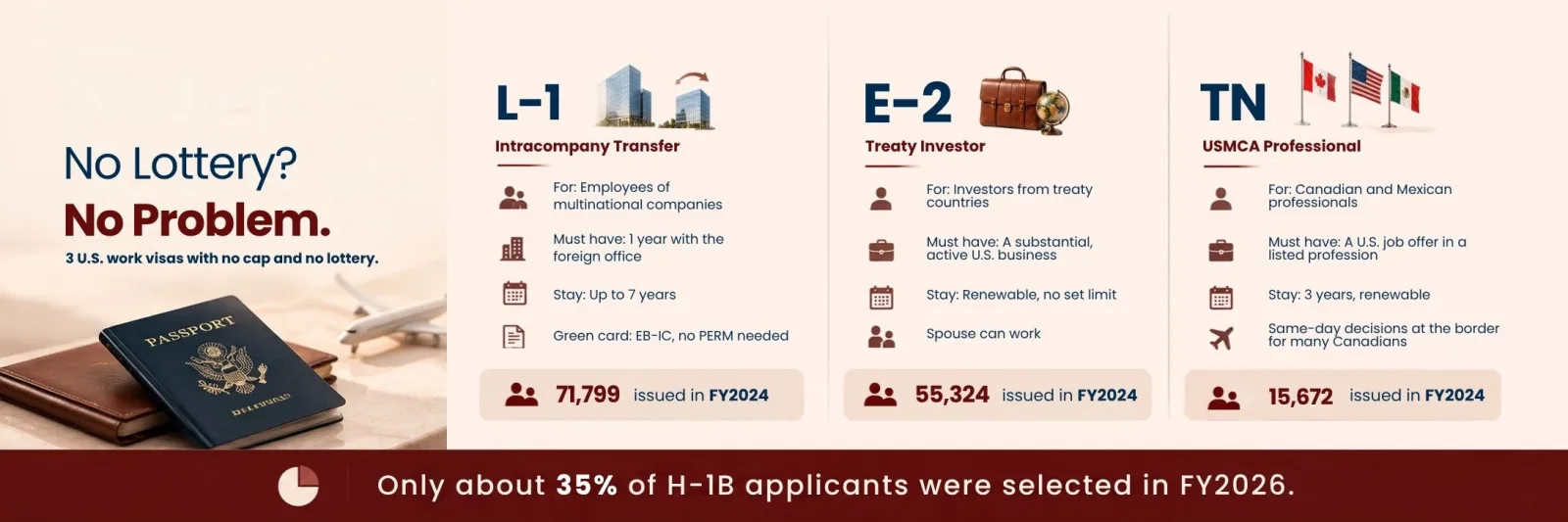
- The L-1, E-2, and TN visas have no annual cap and no lottery.
- In FY2024, the U.S. Department of State issued 71,799 L-1 visas, 55,324 E-2 visas, and 15,672 TN visas.
- The L-1A leads to one of the fastest green card routes available: EB-1C, which does not require PERM labor certification.
If you want to work in the United States, the conversation usually starts and ends with two visas, the H-1B and the O-1A. They are popular for good reason, but they are not the only options, and in 2026 they are often not the most practical ones.
The H-1B now comes with a new selection system and, in some cases, a six-figure fee. The O-1A asks you to prove extraordinary ability, which takes a strong and well-documented record. Meanwhile, three lesser-discussed visas quietly move tens of thousands of professionals into the U.S. every year without any lottery at all.
This guide explains how the L-1, E-2, and TN visas work, who qualifies, what the government data shows, and how to decide which one fits you. It uses official statistics and the governing regulations throughout, so you can check every claim yourself.
Why Look Beyond the H-1B in 2026?
Before comparing alternatives, it helps to see why so many professionals are rethinking the H-1B.
Registrations are falling. According to USCIS, eligible H-1B registrations dropped from 470,342 in FY2025 to 343,981 in FY2026, a decline of roughly 27 percent. USCIS selected about 35 percent of unique beneficiaries in FY2026, which means nearly two out of three registered candidates still missed out.
Selection is no longer purely random. DHS published a final rule in the Federal Register on December 29, 2025, replacing the random lottery with a weighted selection process starting with FY2027. Each beneficiary is entered once for Wage Level I, twice for Level II, three times for Level III, and four times for Level IV. DHS’s own analysis estimated that selection odds rise to over 61 percent for Level IV and over 45 percent for Level III beneficiaries, compared with just under 30 percent under the old random system. That shift pushes odds lower for entry-level and early-career applicants.
Costs have jumped for some petitions. Under a September 2025 Presidential Proclamation, certain new H-1B petitions for workers outside the United States require a $100,000 payment unless an exception applies.
USCIS confirmed in 2026 that the FY2027 cap was reached with no second selection round. If you were not selected, or you are an early-career professional facing weighted odds, the visas below deserve a serious look.
L-1 Visa: Intracompany Transfers Explained
What is an L1 visa? The L-1 visa lets multinational companies transfer employees from a foreign office to a related U.S. office. The relationship can be parent, branch, subsidiary, or affiliate. It is governed by INA § 101(a)(15)(L) and 8 CFR § 214.2(l).
By the numbers: The State Department issued 71,799 L-1 visas in FY2024 and 76,671 in FY2023. It also recorded one of the lowest refusal rates among work visas, with 2,914 refusals in FY2024, or about 3.9 percent of adjudicated cases.
L-1 Visa Requirements
- One continuous year of full-time employment with the related foreign company within the three years before the petition
- A qualifying relationship between the foreign and U.S. entities, based on ownership and control
- A U.S. role that is managerial, executive, or involves specialized knowledge
- Continued business operations in the U.S. and at least one other country for the duration of your stay
L-1A vs. L-1B
| L-1A | L-1B | |
| Who it is for | Managers and executives | Employees with specialized knowledge |
| Maximum stay | 7 years | 5 years |
| Green card path | EB-1C (no PERM required) | Usually PERM-based EB-2 or EB-3 |
Features Most People Miss
- New office L-1A. A company that does not yet operate in the U.S. can send an executive or manager to open one. The initial approval is limited to one year under 8 CFR § 214.2(l)(7), and the extension depends on showing real business growth.
- Blanket L petitions. Large employers that meet regulatory thresholds, such as at least 10 L-1 approvals in the prior 12 months, U.S. sales of $25 million, or a U.S. workforce of 1,000, can file a blanket petition. Employees can then apply directly at a U.S. consulate, which often speeds things up considerably.
- Spousal work rights. L-2 spouses are employment authorized incident to status.
- Dual intent. You can pursue a green card while in L-1 status without jeopardizing your visa.
Expert insight: The L-1A is one of the most underused green card strategies we see. Managers and executives of multinational companies may qualify for EB-1C under INA § 203(b)(1)(C). EB-1C skips labor certification, which can shave a year or more off the typical H-1B to PERM timeline.
E-2 Visa: For Treaty-Country Investors
What is an E2 visa? The E-2 visa is for nationals of countries that hold a qualifying treaty of commerce and navigation with the United States. It allows them to invest in and actively run a U.S. business. It is governed by INA § 101(a)(15)(E)(ii) and 8 CFR § 214.2(e).
By the numbers: The State Department issued 55,324 E-2 visas in FY2024, up from 54,812 in FY2023, with a refusal rate of about 9.9 percent. Demand has stayed steady even as other categories have fluctuated.
E-2 Visa Requirements
- Citizenship of an E-2 treaty country. Canada, the United Kingdom, Japan, Germany, France, and many others qualify. India and China do not, although applicants with a second citizenship from a treaty country may qualify through it.
- A substantial investment that is irrevocably committed and at risk
- A real, operating enterprise. Passive investments such as rental real estate or stock portfolios do not qualify.
- A non-marginal business that can do more than support you and your family, usually shown through job creation and growth projections
- At least 50 percent ownership by treaty nationals, and a role where you develop and direct the business
What “Substantial” Actually Means
There is no fixed minimum investment in the regulations. The State Department’s Foreign Affairs Manual applies a proportionality test: the lower the total cost of the business, the higher the percentage of it you are expected to invest. A service business with modest startup costs may qualify with a smaller investment than a manufacturing company would.
Strengths and Limits
- Initial admission of up to two years, with extensions available without a set limit as long as the business keeps qualifying
- Spouses can work incident to E-2 status
- No dual intent. You must intend to leave when your status ends, so green card planning requires strategy. Many E-2 investors later file an EB-1A or EB-2 NIW petition once their business and record have grown.
TN Visa: Fast Path for Canadians & Mexicans
What is a TN visa? The TN classification lets Canadian and Mexican citizens work in the U.S. in listed professional occupations under the United States-Mexico-Canada Agreement (USMCA). It is governed by INA § 214(e) and 8 CFR § 214.6.
By the numbers: The State Department issued 15,672 TN visas in FY2024. That figure mainly reflects Mexican nationals, since Canadians are visa-exempt and usually apply for TN status directly at the border rather than through a consulate. The same data shows 11,645 TN refusals in FY2024. Consular refusal counts can include cases put on temporary administrative hold that are later approved, but the number is a clear signal that documentation quality matters.
TN Visa Requirements
- Canadian or Mexican citizenship. Permanent residents of those countries do not qualify.
- A profession on the USMCA list. Examples include engineer, computer systems analyst, scientist, accountant, management consultant, economist, and registered nurse.
- The credentials the profession requires, typically a bachelor’s degree or a specific license
- A job offer from a U.S. employer in that profession. Self-employment does not qualify.
Why Professionals Choose TN
- Speed. Canadians can often apply at a port of entry or pre-clearance location and get a decision the same day. Mexican citizens apply at a U.S. consulate first.
- No cap, no lottery, and no Labor Condition Application.
- Admission for up to three years at a time, renewable indefinitely.
The main limitation is that the TN is not a dual intent visa, and TD spouses cannot work. If a green card is the goal, the timing of any immigrant petition needs careful planning to protect future TN entries.
Side-by-Side: Eligibility, Speed, Green Card Path
| L-1 | E-2 | TN | H-1B | |
| Who qualifies | Employees of multinationals | Treaty-country investors | Canadian and Mexican professionals | Specialty occupation workers |
| Cap or lottery | No | No | No | Yes (weighted from FY2027) |
| FY2024 visas issued | 71,799 | 55,324 | 15,672* | 219,659 |
| FY2024 refusal rate | ~3.9% | ~9.9% | ~42.6%* | ~2.8% |
| Maximum stay | 7 yrs (L-1A), 5 yrs (L-1B) | Renewable, no set limit | Renewable, no set limit | 6 yrs, extensions possible |
| Spouse can work | Yes | Yes | No | Only in limited cases |
| Dual intent | Yes | No | No | Yes |
| Green card path | Strong, via EB-1C (L-1A) | Needs separate strategy | Needs careful timing | Common, via PERM or self-petition |
*TN consular figures mostly reflect Mexican nationals. Most Canadian TN applicants are processed at the border and are not counted here. Refusal rates are calculated from State Department FY2024 workload data.
How to Know Which Fits You
Start with four questions.
- Do you already work for a company with offices in the U.S.? If you have been with a multinational employer abroad for at least a year, the L-1 may be the most direct route. If you are a manager or executive, it can also set up an EB-1C green card.
- Are you building or buying a business? If you are a citizen of a treaty country and ready to invest in a company you will actively run, the E-2 lets you control your own status.
- Are you Canadian or Mexican with a professional degree? If your job is on the USMCA list and you have a U.S. offer, the TN is hard to beat for speed and cost.
- Do you have a record of achievement? If you have awards, publications, press coverage, judging experience, or critical leadership roles, an O-1A or even an EB-1A green card may be the stronger long-term play. For comparison, the State Department issued 19,457 O-1 visas in FY2024.
In practice, the strongest strategy often combines two tracks: a work visa that gets you to the U.S. now, and a self-petition like the EB-1A or NIW that keeps you there permanently.
FAQs
1. What is a TN visa?+
The TN is a USMCA work classification for Canadian and Mexican citizens in listed professional occupations. It has no cap or lottery and can be renewed in increments of up to three years.
2. What is an L1 visa?+
The L-1 lets multinational companies transfer managers, executives (L-1A), and specialized knowledge employees (L-1B) to a related U.S. office. You need at least one continuous year of employment with the foreign entity in the past three years.
3. What is an E2 visa?+
The E-2 is for nationals of treaty countries who make a substantial, at-risk investment in a U.S. business they will develop and direct.
4. Does TN require sponsorship?+
You need a job offer from a U.S. employer, but there is no H-1B style sponsorship process, no lottery, and no Labor Condition Application. Canadians typically present an employer support letter at the border.
5. TN visa vs H1B: which is better?+
For eligible Canadians and Mexicans, the TN is usually faster, cheaper, and free from lottery risk. The H-1B allows dual intent, which makes green card planning simpler. The better choice depends on your long-term goals.
6. Can Indian nationals get an E-2 visa?+
Not on Indian citizenship alone, because India is not an E-2 treaty country. Indian nationals holding citizenship of a treaty country, such as through investment programs, may qualify on that basis.
7. Can I get a green card on an L-1 visa?+
Yes. The L-1 permits dual intent, and L-1A managers and executives may qualify for EB-1C, which does not require PERM labor certification.
Ready to Find Your Best Path?
The H-1B lottery does not have to decide your future. Whether an L-1, E-2, TN, or a self-petition fits you best, the right strategy starts with a clear look at your background, your employer, and your goals.
Schedule a consultation with SiliconPath Law today for a case evaluation built around where you want to be in five years, not just next year.
This article is for general information only and is not legal advice. Immigration rules change frequently. Consult a licensed immigration attorney about your specific situation.