
 SiliconPath Law
The Family- Sponsored vs Employment-Based Green Card 2026 decision is a choice between two audition formats, one where a relationship gets you through the door and one where your résumé does, and this Green Card Path Comparison sets out both plots so the choice is not a blind guess.
In each fiscal year, a total of 226,000 family-sponsored preference visas and 140,000 employment-based preference visas are made available, depending on statutory provisions and spill-over, according to the USCIS guidance on Visa Availability and Priority Dates. The immediate relatives of U.S. citizens are exempt from annual numerical limitations. Both can provide a path to lawful permanent residence but differ greatly when it comes to eligibility, availability, procedure, fees, and adjustment of status.
Read More: O-1A for Business Consultants: Extraordinary Ability Beyond Tech
Green Card Path Comparison: Quick Overview
| Factor | Family-Sponsored Immigration | Employment-Based Green Card |
| Who files | Usually a qualifying U.S. citizen or lawful permanent resident relative files Form I-130; limited statutory self-petition exceptions exist | Usually an employer files Form I-140; EB-1A and EB-2 NIW allow self-petition |
| Core requirement | Qualifying family relationship, plus all admissibility and procedural requirements | Qualifying employment category, credentials, or investment, plus all admissibility and procedural requirements |
| Annual limit | Immediate relatives of U.S. citizens are not numerically limited; family preference categories are capped | Generally 140,000 employment-based preference visas annually, subject to allocation rules and country limits |
| Typical driver of delay | Family preference Visa Bulletin backlog, I-130 processing, and adjustment or consular-processing steps | Labor certification where required, I-140 processing, Visa Bulletin backlog, and country-of-chargeability limits |
This table is only the beginning, not an ending; it represents the USCIS’ advice regarding visa availability. Ultimately, the correct choice will depend upon the individual situation, which will be explained further in the coming two paragraphs.
Understanding Family-Sponsored Immigration
The family sponsored category of immigrants can be broken down into two types: immediate relatives and family preference. Immigrants who belong to the immediate relatives of an American citizen, such as spouses, unmarried minor children and even parents when the citizen petitioners are aged 21 and above, do not have any restrictions in numbers.
All others belong to one of the categories with yearly maximums and a country quota limit, thus Visa Bulletin applies to them:
- F1: Unmarried adult sons and daughters of U.S. citizens.
- F2A: Spouses and minor children of lawful permanent residents.
- F2B: Unmarried adult sons and daughters of lawful permanent residents.
- F3: Married sons and daughters of U.S. citizens.
- F4: Siblings of U.S. citizens (petitioner must be at least 21).
Most family-based applications will start with the Form I-130, Petition for Alien Relative filed by the qualified relative. However, there are some very limited exceptions, under which certain spouses, children, and parents who are victims of abuse can file their own applications on Form I-360 (VAWA Self-Petition). The same form is used by some widow(er)s of U.S. citizens.
In most family-based cases, the applicant will also have to file Form I-864, Affidavit of Support, which would prove that they are meeting income levels as per the Federal Poverty Guidelines, unless they qualify for any statutory exceptions, including those immigrants who have at least 40 qualifying quarters of work experience. For more details on such immigrants, refer to USCIS.
Employment Based Green Card Categories Explained
Green card categories based on employment are divided into five different preferences depending on the skill, credentials, or capital:
- EB-1: Individuals with extraordinary ability (EB-1A), outstanding professors or researchers (EB-1B), and multinational executives or managers (EB-1C). All three sub-categories under EB-1 are exempt from labor certification requirement. However, only EB-1A is eligible for self-petitioning whereas EB-1B and EB-1C sub-categories are employer petition categories.
- EB-2: Professionals holding advanced degree or individual possessing exceptional ability. The majority of EB-2 applications would need to provide evidence of a job offer as well as labor certification, but the National Interest Waiver allows eligible candidates to apply without a job offer and labor certification requirement.
- EB-3: Skilled workers, professionals, and other workers. The normal process for EB-3 category would include obtaining a job offer and labor certification. However, Schedule A occupations follow a different procedure within the Department of Labor process instead of PERM recruitment.
- EB-4: Special Immigrants, which include religious workers and other special groups.
- EB-5: Immigrant investors putting their money (at least $800,000 to invest in a targeted employment area, otherwise $1,050,000 in other areas) in a new business enterprise creating 10 full time jobs in USA.
The majority of EB-2 and EB-3 cases start with labor certification under PERM where the employer needs to establish a good faith recruitment attempt proving that there is no qualified and willing US worker other than Schedule A occupations that have a separate process within the Department of Labor.
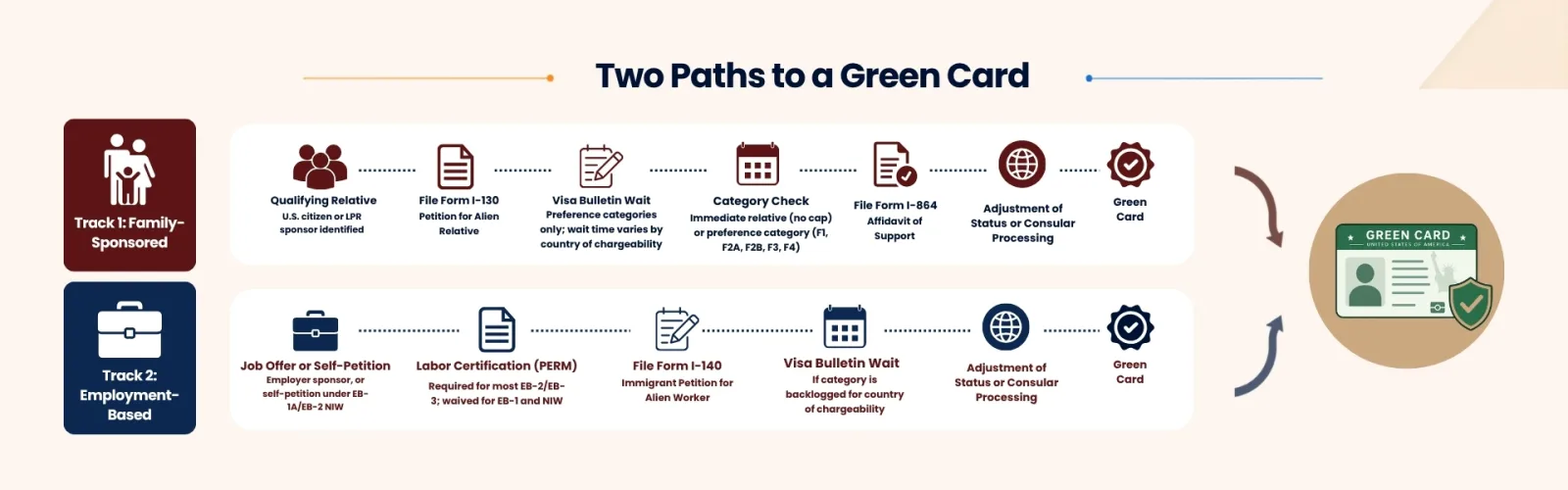
Processing Times and Costs in 2026
Processing time relies on the category and country of chargeability, the former being the applicant’s birthplace country, much more than on the general category chosen – either family or employment. Immediate relatives do not experience any delays due to quotas; likewise, EB-1 category may be considered quick if the category is current, yet processing time, visa availability, and country of chargeability determine the overall processing period. Family preference categories F4 and employment categories EB-2 or EB-3 are likely to be characterized by the longest wait periods when the applicants belong to countries where the corresponding category is oversubscribed, namely India and/or China in most cases.
The cost varies from category to category and depends on whether the application is made using an online form or regular one. The cost of filing I-130 petition is $675 and $625 correspondingly; the standard Form I-485 fee is $1,440 for all applicants above 14 years old; there is no filing fee for Form I-864.
Regarding employment-based applications, Form I-140 is priced at $715, but in addition, there is also an Asylum Program Fee of $600, which most for-profit filers are supposed to pay on Form I-140; this applies only to those with lower volume, nonprofit organizations, and some self-petitioners. Premium processing of eligible Form I-140 is priced at $2,965 for applications postmarked on or after March 1, 2026. Additionally, filing fees may apply for Form I-765, Form I-131, medical examinations, translation, lawyer assistance, and PERM recruitment.
Premium processing simply ensures that the USCIS processes your eligible Form I-140 more quickly. It doesn’t do anything else other than making sure that USCIS takes their first step in processing your case.
Can You Pursue Both Paths at the Same Time?
Absolutely. One who is eligible under both the family relationship classification as well as an employment-based one can file for both petitions simultaneously and can proceed based on whichever classification becomes eligible for issuance of an immigrant visa first, given that the petition can be approved and he or she is otherwise eligible for adjustment of status/consular processing. Nothing in the law prevents a person from filing both petitions simultaneously, as long as all petitions are genuine and valid. Whether the requirement of having lawful status applies to an adjustment in the U.S. would depend on which particular classification the applicant is using.
The above is how most applicants proceed who are in the United States on a work visa with a family relationship classification as well.
Which Green Card Path Fits Your Situation?
Sponsored immigration by family is likely to suit well the applicant if he or she has an eligible close U.S. citizen or LPR relative who is ready to sponsor him or her, especially in the unrestricted immediate relatives group. This option will also serve applicants who have not yet acquired the necessary qualifications for any employment-based option.
Green card through employment will most likely be applicable to the candidate if he or she is in possession of a suitable job offer or is qualified to petition himself or herself under the extraordinary ability or national interest waiver under EB-1A or EB-2 NIW category. It can also suit temporary workers in need of permanent residence through the occupation path.
Talk to SiliconPath Law About Your Options
Deciding whether to apply for family sponsored immigration or green card through employment depends on statutory time frames, per country wait times, and documentation that is not difficult to misunderstand. Silicon Path Law will examine your particular situation whether its employment or the relationship you have and will give advice about the best way forward. Contact Silicon Path Law to schedule a consultation before filing.
FAQs
1. What’s Different: Family vs Employment Green Cards?+
In order to apply for a green card via family sponsorship, you need to have an eligible family relationship to a US citizen or a LPR, but for an employment-based green card application, a job offer, extraordinary ability, or eligible investment is required. In most family cases, an eligible petition is started using the Form I-130, with the exception of some special cases like VAWA or widow/widower self-petition. An employment green card application usually starts with an employer filling out Form I-140.
2. Which path is typically faster in 2026?+
Neither one of these options is generally faster than the other, as this depends on which particular category the individual applies for and the country of chargeability. While immediate relatives are usually not subject to quotas and therefore usually avoid waiting for a visa, and EB-1 is relatively fast if the category is current, the entire process is controlled by the USCIS process and visa availability. Preference categories such as F4 and employment categories such as EB-2 or EB-3 usually have the longest waiting times, particularly where the individuals are chargeable to countries with an oversubscribed category.
3. Can I pursue both paths at the same time?+
There is nothing wrong with filing for both the petition if an individual meets the criteria in both. He/she would file both family and employment petition and would proceed under that category whichever becomes available, providing that he/she meets the criteria for adjustment of status. Both of the applications must be genuine and correct and whether the individual needs to maintain lawful status in order to adjust in the US is determined by the particular category and an exception, if any.
4. Which categories allow self-petition?+
EB-1A and EB-2 NIW (national interest waiver) both make self-petition possible without an employer, and the NIW also eliminates the requirement of having a job offer and obtaining labor certification. EB-1B and EB-1C (executives and managers of multinational companies), although under EB-1, still require an employer sponsor, as do EB-3 and regular EB-2. All family-sponsored categories require sponsorship by a relative, who needs to be either a U.S. citizen or a LPR, except for some limited types, such as the VAWA and widow(er) self-petitions.
5. How do processing times compare?+
Processing time is mostly dependent on which category and which country of chargeability is used. Unrestricted immediate relative petitions usually do not face visa backlogs, and EB-1 can be relatively fast when current, but the processing by USCIS and visa availability do determine the total amount of time needed. Restricted family preference and EB-2 or EB-3 types of petitions, if the person is chargeable to a country that experiences backlog issues, might take several years, and Visa Bulletin will provide the best information on what to expect.
Disclaimer: This article provides general information and does not constitute legal advice. Immigration outcomes depend on individual facts. Consult a licensed immigration attorney before making filing decisions.