
 SiliconPath Law
The O-1A visa is associated with engineers, researchers in artificial intelligence, and founders of startups. This is a somewhat misleading notion since the USCIS defines eligibility for O-1A for occupations that include science, education, business, and athletics. Business consultants have their own field. A consultant contributing to success for clients, creating techniques, or getting acknowledged could satisfy the criteria of “extraordinary ability” just like scientists do. The following article explains how the requirements of O-1A can be applied to consulting. This overview of O-1A for Business Consultants breaks down how the standard eight criteria translate into consulting-specific evidence.
Talk to an Immigration AttorneyWhat Is the O-1A Visa?
The O-1A is a non-immigrant work visa available to individuals who have proven to have outstanding ability in their field. Unlike the O-1B, which is for the art and film/TV industry, the O-1A applies to sciences, education, business, and sports.
To qualify, the petitioning party must prove one of the following:
- That the individual has won a major internationally recognized award, or
- That the individual meets three of the eight criteria set out under 8 CFR 214.2(o), or
- That there is comparable evidence where the normal criteria are not applicable.
According to USCIS, extraordinary ability means that the applicant is among the top experts in his/her field.
Read More: What Is Extraordinary Ability Immigration? Everything You Need to Know About EB-1A & O-1A
Why Business Consultants Are Often Overlooked
Careers in consulting do not fit well into the criteria described here, resulting in some misunderstandings:
- “Extraordinary ability” seems to suggest an emphasis on STEM fields. Much of the discussion of O-1A focuses on papers, inventions, and references.
- Consulting does not have an equivalent of a Nobel Prize. Accomplishments in the business world are not usually acknowledged by one recognized award.
- Client work is often confidential, creating difficulties in making findings known.
None of these points affect eligibility. USCIS considers the impact and significance of the work rather than whether an award structure similar to that in science exists. This is why the case for O-1A Outside Tech and Science rests on demonstrating comparable impact rather than replicating academic benchmarks.
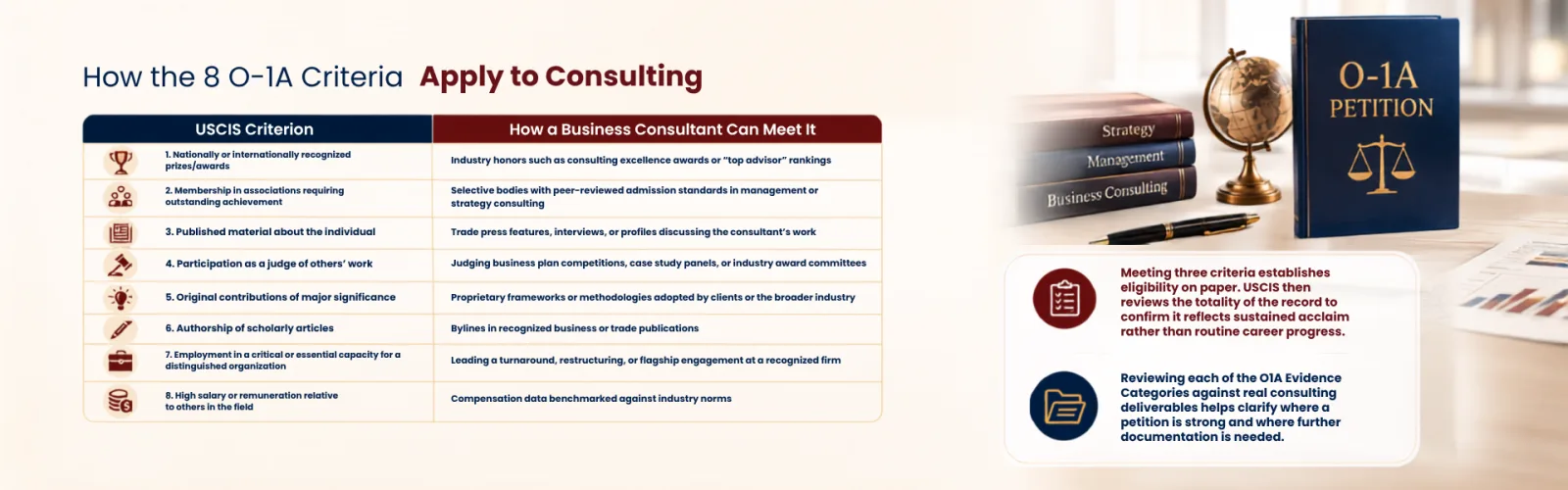
How the 8 O-1A Criteria Apply to Consulting
| USCIS Criterion | How a Business Consultant Can Meet It |
| Nationally or internationally recognized prizes/awards | Industry honors such as consulting excellence awards or “top advisor” rankings |
| Membership in associations requiring outstanding achievement | Selective bodies with peer-reviewed admission standards in management or strategy consulting |
| Published material about the individual | Trade press features, interviews, or profiles discussing the consultant’s work |
| Participation as a judge of others’ work | Judging business plan competitions, case study panels, or industry award committees |
| Original contributions of major significance | Proprietary frameworks or methodologies adopted by clients or the broader industry |
| Authorship of scholarly articles | Bylines in recognized business or trade publications |
| Employment in a critical or essential capacity for a distinguished organization | Leading a turnaround, restructuring, or flagship engagement at a recognized firm |
| High salary or remuneration relative to others in the field | Compensation data benchmarked against industry norms |
Meeting three criteria establishes eligibility on paper; USCIS then reviews the totality of the record to confirm it reflects sustained acclaim rather than routine career progress. Reviewing each of the O-1A Evidence Categories against real consulting deliverables helps clarify where a petition is strong and where further documentation is needed.
Building the Evidence Package
A well-structured consulting proposal generally includes:
- Quantified results: revenues, cost savings, volume of transactions, or turnaround performance directly related to the work.
- Letters of recommendation from top management officials, clients, or notable industry representatives who can confirm the consultant’s authority in the industry
- Media, speaking opportunities: conference appearances, podcasts, and speaking engagements
Common Pitfalls for Consultants
- Trusting non-public client achievements without any third-party validation
- Providing generalized recommendation letters that talk about skills rather than anything special
- Not converting business results to the language that USCIS expects to be used within their criteria
- Seeing career advancement or promotions as proving extraordinary ability by themselves
Conclusion
Exceptional ability is not limited to laboratories or engineering groups. Business consultants able to cite quantifiable effects on customers, respect of the industry, and third-party recognition have a true route to O-1A qualification. The crucial factor is to rephrase your successes in specific terms that USCIS uses in evaluating applications – a job where effective case preparation makes the difference. Silicon Path Law cooperates with consultants in creating the correlations between their record of success and the USCIS-defined criteria and preparing petitions based on proof.
Start Your O-1A Case TodayFAQ
1. Can business consultants qualify for O-1A?+
Indeed, business is undeniably recognized as an O-1A field in addition to the fields of science, education, and sports. USCIS extraordinary ability visas aren’t just limited to the technical fields. An applicant can qualify as long as he/she satisfies at least three of the eight criteria required for the purpose or submits comparable evidence. Qualification depends on a measurable impact and recognition, not the job title. Examples of qualifying evidence include client results, industry association memberships, and media mentions. The same rationale that is used in EB-1A green card cases is used in this instance. Framed correctly, this is a clear case of O-1A Business Achievement meeting the same evidentiary bar as scientific or academic distinction.
2. What evidence works for business achievement instead of scientific research?+
The success of business is manifested in its results, reputation, and influence on the market rather than in articles and citations. While scientists provide citation scores, business consultants select results for clients’ effects on revenue and case studies. Letters of recommendation provided by executives are equivalent to academic letters of recommendation. A history of receiving media coverage and giving speeches replaces traditional publishing experience. The use of proprietary methods adopted across the entire industry serves as evidence of innovation. The USCIS assesses whether the evidence presented demonstrates the highest rank in the professional field. This is the core distinction behind Extraordinary Ability Business cases, where impact and recognition substitute for citation-based metrics.
3. How is business acclaim measured by USCIS?+
The USCIS gauges acclaim via recognition by peers instead of self-reported accomplishments. Accolades require independent confirmation from outside entities such as awards, media endorsements, memberships in credible professional organizations, and testimonies from eminent clients. A personal description of accomplishments is insufficient for USCIS. Moreover, USCIS expects multiple acknowledgments over time rather than only a single achievement. The evidentiary standard is in line with the EB-1A requirement, as the same 8 CFR 214.2(o) applies to O-1A and EB-1A visa petitions alike.
4. Is O-1A harder to prove outside tech and science?+
It is not strictly true to say that the business field is more bounded, but one has to put evidence into business language. For STEM applicants, there are more standardized ways of proving themselves, like citation counts and patents, which simplify the gathering of evidence. On the other hand, business consultants have to prove their accomplishments, like client results, methodology applications, and leadership positions, against eight fixed points. In other words, one has to prove themselves in different fields where the standard criteria cannot easily be applied.
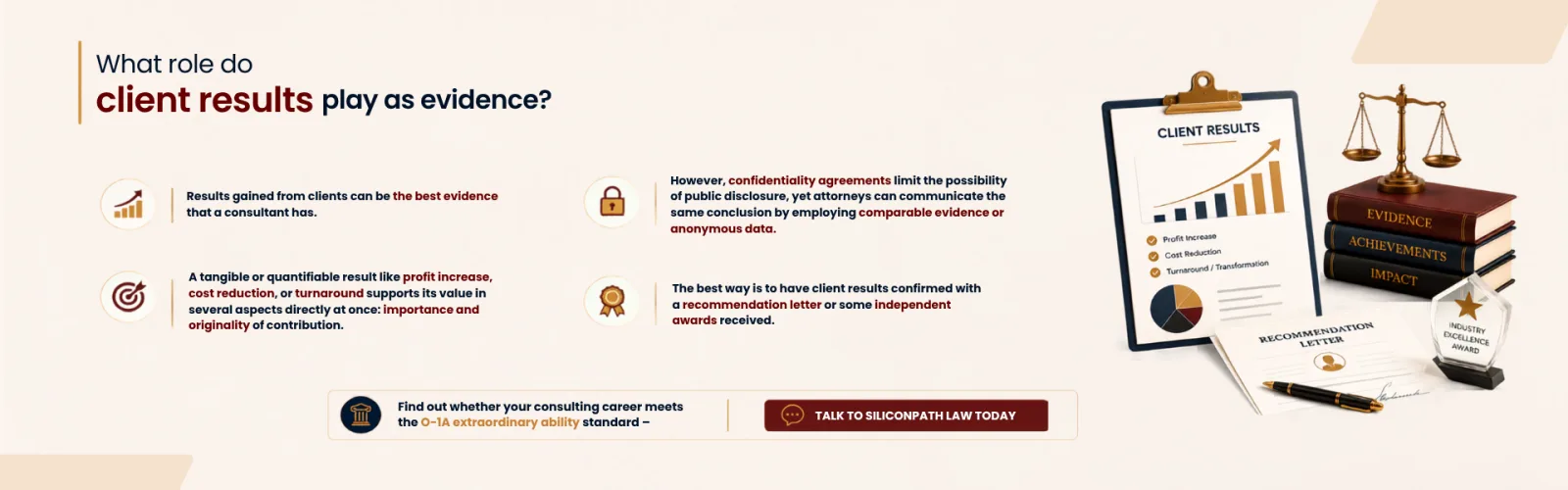
5. What role do client results play as evidence?+
Results gained from clients can be the best evidence that a consultant has. A tangible or quantifiable result like profit increase, cost reduction, or turnaround supports its value in several aspects directly at once: importance and originality of contribution. However, confidentiality agreements limit the possibility of public disclosure, yet attorneys can communicate the same conclusion by employing comparable evidence or anonymous data. The best way is to have client results confirmed with a recommendation letter or some independent awards received.
Find out whether your consulting career meets the O-1A extraordinary ability standard – talk to SiliconPath Law today.