
 SiliconPath Law
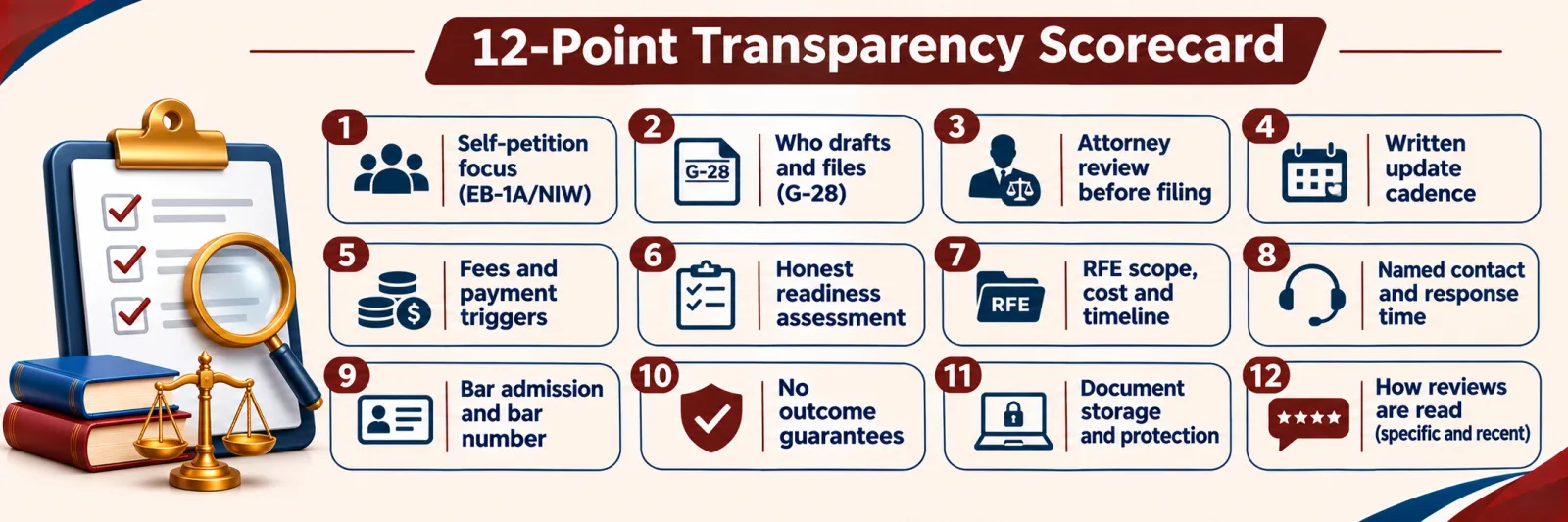
The selection of an EB-1A attorney or EB-2 NIW attorney should be based on verifiable operational facts rather than reputation claims. A 12-point transparency scorecard is provided below to evaluate specialization, fee triggers, RFE handling, and document custody before any engagement is signed.
What an EB-1A or NIW Attorney Does, and When Self-Petitioning Is Permitted
An EB-1A or EB2 NIW lawyer translates a professional record into a legal argument that maps evidence to specific regulatory criteria. The work is argumentative rather than procedural, requiring the construction of a narrative that an adjudicator can follow under the applicable standard.
- EB-1A requires evidence of at least three of ten regulatory criteria, or a one-time major internationally recognized award, followed by a final merits determination.
- EB-2 NIW requires an advanced degree or exceptional ability, plus satisfaction of the three-prong framework set forth in Matter of Dhanasar, 26 I&N Dec. 884 (AAO 2016) .
- Self-petitioning is permitted for EB-1A without a job offer or labor certification, provided the petitioner establishes intent to continue work in the area of extraordinary ability .
- Self-petitioning is permitted for EB-2 NIW when the job offer and labor certification requirements are waived in the national interest under INA § 203(b)(2)(B)(i) .
- Filing without counsel is permitted, though the burden of establishing eligibility by a preponderance of the evidence remains with the petitioner .
The 12-Point Transparency Scorecard – Explained
- Specialization in self-petitions: The proportion of the firm’s docket devoted to EB-1A and NIW matters should be stated directly. A firm whose practice is dominated by employer-sponsored filings may lack the narrative depth these categories require.
- Who prepares and who files: The drafting attorney should be identified, and a Form G-28 should be filed so that representation is recognized by USCIS . If no G-28 will be filed, the basis for that decision should be explained.
- Attorney review before filing: The petition should be reviewed by a licensed attorney prior to submission. Review by paralegals or external contractors alone is not equivalent.
- Written update cadence: The engagement letter should specify when written updates will be provided. A defined cadence creates an auditable record of communication.
- Fee structure and payment triggers: Each payment should be tied to a deliverable or milestone. The government filing fee is separate from legal fees and is set by regulation (8 CFR 106.1(a)) .
- Honest readiness assessment: A weak record should be identified as weak. The assessment should distinguish between evidence that exists and evidence that must be developed.
- RFE handling and pricing:The scope and cost of responding to a Request for Evidence should be established before filing. The response period cannot exceed twelve weeks (8 CFR 103.2(b)(8)(iv)) .
- Reachable contact between updates: A named contact and a response time standard should be provided. A general intake channel is insufficient for a pending petition.
- Bar admission verification: The attorney’s licensing jurisdiction and bar number should be disclosed so that standing can be verified independently.
- Outcomes described without guarantees: No attorney can guarantee an approval. A practitioner before DHS may not make a false or misleading communication about services (8 CFR 1003.102(f)(2)) .
- Document storage and protection: The firm’s practices for storing, accessing, and retaining client documents should be described in writing.
- How reviews are read: Reviews should be assessed for specificity and recency. A pattern of detailed accounts carries more weight than an aggregate star rating.
Also Check: 7 Questions to Ask Before Choosing an Immigration Law Firm
Red Flags to Look
- Approval guarantees: No lawful basis exists for a guarantee of a discretionary adjudication.
- No G-28 filing: Representation without a G-28 limits accountability and may indicate that the preparer is not an attorney.
- Opaque fee triggers: A single upfront payment with no milestone breakdown obscures what work has been purchased.
- RFE costs disclosed only after issuance: RFE pricing revealed post-filing suggests the original quote did not reflect the full scope.
- Template recommendation letters: Generic letters that repeat regulatory language are generally unpersuasive (6 USCIS-PM F.2) .
- No named attorney: A firm that will not identify who will draft and sign the brief cannot be held to a standard of specialized competence.
- Statistics without methodology: A success rate presented without a defined denominator and time period cannot be evaluated.
A Comprehensive Look at The Fee Models
Flat fees are the prevailing structure for EB-1A and NIW attorney engagements, though the scope of what is included varies materially. Some firms publish tiered flat fees with RFE response as an add-on, while others include RFE and NOID responses within the base fee . Hourly billing is uncommon for the petition itself but may appear for ancillary matters such as consular processing or appeals.
The government filing fee for Form I-140 is separate and is paid to USCIS, not to an attorney or firm. Premium processing, if elected, requires an additional fee and obligates USCIS to act within fifteen business days, not to approve .
Remote vs. Local Representation
Physical proximity to a law office is not a legal requirement for representation before USCIS. All filings are submitted electronically or by mail, and attorney-client communications are conducted remotely in most self-petition engagements. The relevant variable is operational accessibility, not geography. A firm’s response time standard and written update cadence are more reliable indicators of accessibility than a local address.
Why SiliconPath Law as Your EB-1A and EB-2 NIW Attorney
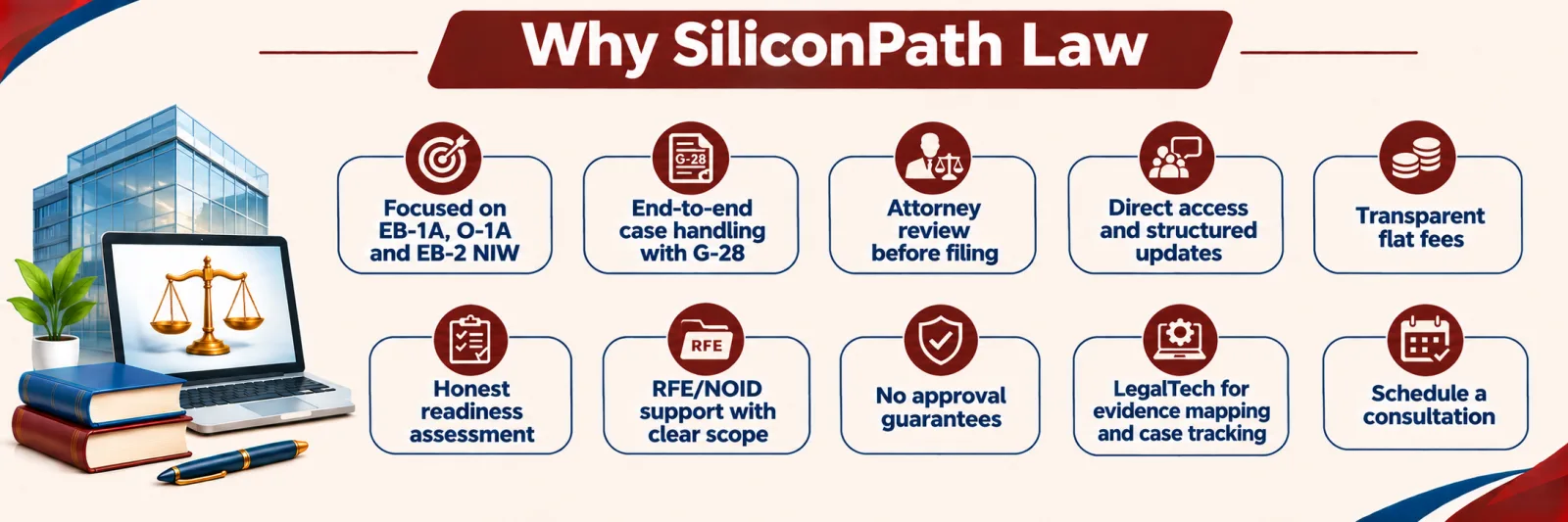
SiliconPath Law is a boutique EB-1A law firm and EB2 NIW law firm whose practice is structured around self-petition categories for technology professionals, researchers, and founders . The firm’s operational model is described below against each scorecard dimension.
Specialization: The core practice is EB-1A, O-1A, and EB-2 NIW, with individual and corporate immigration services supported as ancillary matters . The firm does not present itself as a general immigration practice.
Preparation and filing: A highly experienced consultant leads each case from evaluation through final decision, and a Form G-28 is filed for representation . Drafting is performed by legal staff, not outsourced to non-attorney contractors.
Attorney review: Every petition is reviewed by an attorney before filing, and a technical review is available for cases that require an adjudicator’s perspective on the evidence architecture .
Update cadence and contact: Direct consultant access is maintained, and case strategy is documented at the evaluation stage with a roadmap that identifies criteria to target and evidence to gather. The engagement structure is designed to provide a defined point of contact rather than a general intake channel.
Fee structure: Flat fees are published as the firm’s standard model, described as transparent and disclosed before engagement.
Readiness assessment: The initial evaluation is framed as an honest assessment that identifies the strongest pathway and, where applicable, the gaps that require development . Cases are not described as viable without a substantive review of the record.
RFE handling: The RFE and NOID support are offered as part of the firm’s advisory services, with scope and pricing established in the engagement terms.
Outcomes and guarantees: No approval is guaranteed. The firm’s public descriptions of its work emphasize evidence architecture and narrative cohesion rather than outcome promises .
Technology integration: SiliconPath Law is a LegalTech firm built at the intersection of law and technology, combining legal expertise with technology to support case management and strategy. This is reflected in the firm’s structured approach to evidence mapping and case tracking.
A consultation may be scheduled to review a specific profile against these criteria. No assessment of eligibility is made without a substantive review of the record.
FAQs
1. Can an EB-1A petition be filed without an attorney?+
Yes. Self-petitioning is permitted without a firm, and the petitioner bears the burden of establishing eligibility by a preponderance of the evidence . The decision to proceed without representation should account for the argumentative nature of the final merits determination under Kazarian v. USCIS.
2. Does premium processing improve the likelihood of approval?+
No. Premium processing requires USCIS to act within fifteen business days but does not alter the evidentiary standard or the adjudicator’s discretion (8 CFR 106.4) . It accelerates the timeline, not the outcome.
3. What is the difference between EB-1A and EB-2 NIW for a researcher with citations?+
EB-1A requires a showing of sustained national or international acclaim and placement among the small percentage at the top of the field . EB-2 NIW requires a showing that the proposed endeavor has substantial merit and national importance, that the petitioner is well positioned to advance it, and that a waiver would benefit the United States . Citation counts may support either category but do not substitute for the legal argument.
4. How should a firm’s success rate be interpreted?+
A success rate should be evaluated with its denominator and time period. A rate calculated only on cases that reached a final decision excludes cases that were withdrawn or abandoned, and a rate that includes cases filed years ago may not reflect current adjudication patterns.
5. What happens if the attorney and the client disagree on the strength of the case?+
The attorney’s obligation is to provide an assessment grounded in the record and the applicable standard. If the assessment is that the record does not support filing, that conclusion should be documented and the evidence gaps identified. Filing against an attorney’s recommendation is a decision reserved to the client, but the risks should be stated in writing.
Disclaimer: Attorney Advertising. This content is provided for informational purposes only and does not constitute legal advice. No attorney-client relationship is created by the reading of this material or by any communication directed to the firm without a signed engagement agreement.