
 SiliconPath Law
Do You Need a Nobel Prize To Get EB-1A Approval?
If you've been looking into U.S. immigration options, chances are you've heard of the EB-1A Extraordinary Ability Green Card. You've probably also heard that it's strictly reserved for Nobel Prize winners, Olympic gold medalists, or celebrity founders. Here's the reality: that's a complete myth.
To qualify, you simply need to meet at least 3 out of 10 regulatory USCIS criteria (or present a single major international award) and pass a two-step Kazarian final merits review.
Evaluate Your EB-1A ProfileUnited States Citizenship and Immigration Services (USCIS) built these ten criteria to be flexible enough for corporate executives, startup founders, software engineers, AI researchers, and creative specialists alike. Better yet, you don't need a U.S. employer to sponsor you or a lengthy PERM labor certification process to get started.
Let's dive into how the entire process works and how both business leaders and individual contributors can strategically build an unbeatable petition.
The EB-1A Myth vs. Reality
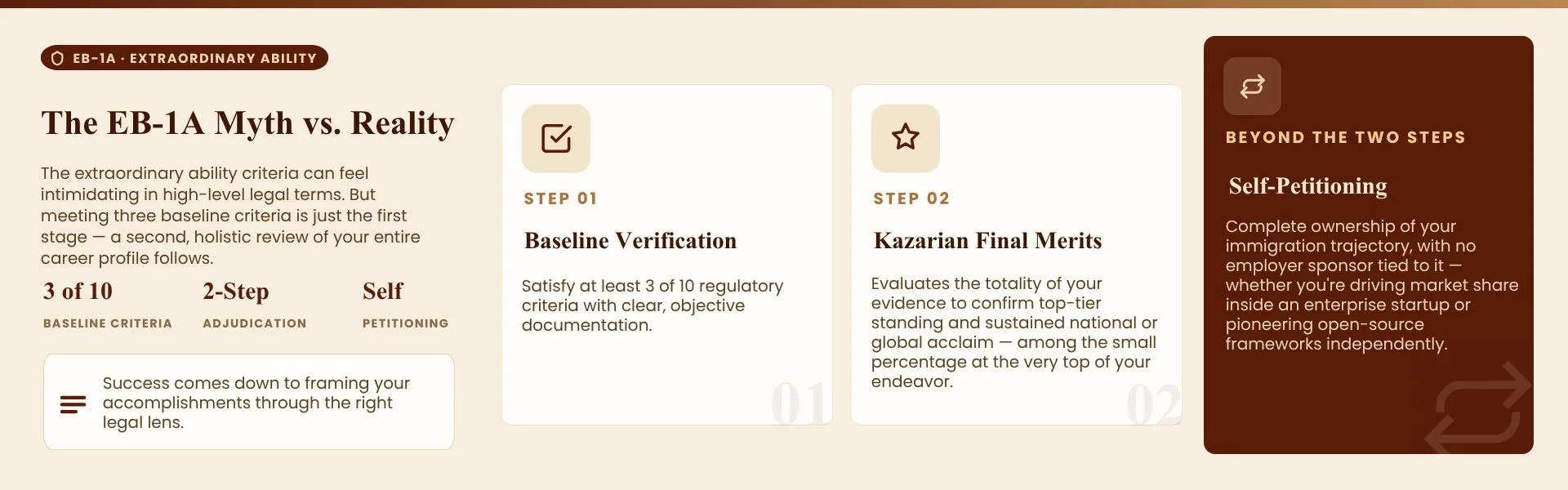
When applicants review the Extraordinary Ability Criteria, it's easy to feel intimidated by the high-level legal terminology. However, meeting three baseline criteria is actually just the first stage of the journey.
Once you establish that baseline, your petition undergoes a second, more holistic evaluation: the Kazarian two-step final merits review. During this review, USCIS officers examine your entire career profile to determine whether your achievements demonstrate sustained national or international acclaim and place you among the small percentage at the very top of your endeavor.
The Two-Step Adjudication Process
- Step 1: Baseline Verification: Satisfy at least 3 of 10 regulatory criteria with clear, objective documentation.
- Step 2: Kazarian Final Merits: Evaluates the totality of your evidence to confirm top-tier standing and sustained national or global acclaim.
The real beauty of the EB-1A visa is its self-petitioning capability. You hold complete ownership of your immigration trajectory without being tied to a specific company or employer sponsor. Whether you are driving market share inside an enterprise startup or pioneering open-source frameworks as an independent developer, success comes down to framing your accomplishments through the right legal lens.
The 10 EB-1A Criteria: Categorized & Translated
To make this EB-1A Eligibility Deep Dive actionable, we can group the ten regulatory benchmarks into three intuitive EB-1A Evidence Categories: Recognition & Reputation, Impact & Authority, and Stature & Commercial Standing.
Here is how business leaders and individual technical contributors can map their real-world achievements to each category.
Category A: Recognition & Reputation
1. Nationally or Internationally Recognized Awards
This criterion requires evidence that you have received national or international prizes or awards for excellence in your field.
- Business Track: Forbes 30 Under 30 recognition, Inc. 5000 leadership honors, major startup pitch competition victories, or recognized industry awards like the Stevie Awards.
- Individual Track: Best Paper awards at tier-1 conferences (e.g., NeurIPS, IEEE, ACM), highly competitive research fellowships, or national scientific grants.
2. Selective Association Memberships
USCIS looks for membership in professional associations that require outstanding achievements of their members, as evaluated by recognized national or international experts.
- Business Track: Invitational executive communities with strict revenue or valuation thresholds, such as the Young Presidents' Organization (YPO) or invitation-only networks like the Forbes Business Council.
- Individual Track: Senior or Fellow grade status in premier professional bodies (such as IEEE Senior Member or the National Academy of Sciences) where entry depends on rigorous peer review.
3. Published Material About You in Major Media
You must show published material about you and your work in professional journals, major trade publications, or mainstream media outlets.
- Business Track: In-depth feature profiles in outlets like TechCrunch, The Wall Street Journal, or major industry trade journals covering company milestones achieved under your leadership.
- Individual Track: Dedicated articles, podcast interviews, or technical journalism highlighting your specific software breakthroughs, patents, or scientific discoveries.
Category B: Impact & Authority
4. Judging the Work of Others
This criterion requires proof that you have evaluated the work of peers in your field, either individually or as part of a panel.
- Business Track: Serving as an invited judge for venture pitch competitions, startup hackathons, accelerator selection panels (such as Y Combinator), or industry award committees.
- Individual Track: Peer-reviewing papers for academic journals, sitting on conference program committees, or reviewing grant proposals for scientific foundations.
5. Original Contributions of Major Significance
You need to prove that you have made original contributions (whether scientific, scholarly, or business-related) that significantly influenced your broader field.
- Business Track: Developing proprietary business frameworks, launching platforms adopted across an entire industry sector, or scaling a product that defined a brand-new market category.
- Individual Track: Authoring widely cited research papers, creating open-source libraries adopted by thousands of developers, or designing algorithms integrated into major commercial software.
6. Authorship of Scholarly Articles
USCIS requires evidence that you have authored scholarly articles in professional publications, trade media, or recognized journals.
- Business Track: Authoring technical white papers adopted by international standards groups, or writing thought-leadership articles published in recognized industry trade magazines.
- Individual Track: First-authored research papers in peer-reviewed journals, textbook chapters, or accepted papers at top-tier international conferences with strong citation metrics.
Category C: Stature & Commercial Standing
7. Leading or Critical Role in Distinguished Organizations
You must show that you held a leading or critical role for organizations or establishments that enjoy a distinguished reputation.
- Business Track: Serving as a Founder, C-suite executive, or VP at a well-funded startup or established company with strong market standing.
- Individual Track: Serving as a Principal Investigator (PI) leading a research lab, acting as Lead Architect on a major open-source project, or heading R&D for a key business division.
8. High Salary or Significantly High Remuneration
You can fulfill this criterion by proving that your compensation places you in the top tier of earners relative to others in your specific occupation and region.
- Business Track: Executive salary packages, substantial equity awards, or high consulting rates placing you in the top 1-5% compared to Bureau of Labor Statistics (BLS) benchmarks.
- Individual Track: Top-percentile research grants, high-value consulting contracts, or lucrative intellectual property licensing agreements.
9. Display of Work at Artistic Exhibitions or Showcases
For relevant fields, you must demonstrate that your work has been displayed at artistic exhibitions or public showcases.
- Business Track: Delivering flagship product keynotes or interactive technology demos at major international expos (such as CES or AWS re:Invent).
- Individual Track: Showcasing original design, artistic, or interactive installations at recognized galleries, museums, or curated design biennials.
10. Commercial Successes in the Performing Arts
This criterion requires documented evidence of commercial success in the performing arts through box office receipts, sales, or distribution data.
- Business Track: Driving record box office revenues, lucrative streaming deals, or high ticket sales for entertainment projects produced under your leadership.
- Individual Track: Documenting chart-topping album sales, high platform streaming numbers, or strong box office metrics for individual performances.
The Secret Weapon: The Kazarian "Final Merits" Analysis
Understanding the EB-1A Criteria for Business Owners and technical professionals is only half the puzzle. Simply checking three boxes on paper doesn't guarantee an automatic approval.
Ever since the 2010 landmark court ruling in Kazarian v. USCIS, adjudicators evaluate petitions using a clear two-stage framework:
- Step 1: The Baseline Test: Do you objectively satisfy at least 3 out of the 10 listed criteria?
- Step 2: The Final Merits Determination: Does the overall body of evidence prove sustained national or global acclaim? Does it demonstrate that you belong to the small top percentage of experts in your field?
During Step 2, the reviewing officer takes a step back from the individual checklists to evaluate your overall career story. They want to know: Does this applicant truly stand out as an extraordinary authority in their field?
Business applicants establish top-tier status by showing high company valuations, market dominance, industry adoption, and feature coverage in top financial media.
Individual applicants show it through strong citation records, global adoption of their software or methods, patents, and independent recommendation letters from global experts.
Actionable Next Steps
If you are ready to explore your EB-1A eligibility, here is a practical roadmap to get your journey underway:
- Audit Your Profile: Review all 10 criteria and identify 4 or 5 areas where your evidence is strongest. Aiming for more than three criteria gives you a comfortable cushion during review.
- Execute a Bridging Strategy: Spend the next 6 to 12 months proactively filling key gaps, whether that means accepting journal peer-review invitations, pitching media outlets for recent company milestones, or joining selective professional organizations.
- Partner with Specialized Counsel: Work with immigration professionals like SiliconPath Law who understand how to translate your technical or commercial successes into a compelling petition designed to pass final merits review.
Conclusion
The EB-1A green card process is far more accessible than popular myths suggest. Whether you are driving market growth in the boardroom or developing technical breakthroughs in a lab, success comes down to presenting a well-structured narrative. By looking past the surface checklist and leveraging the full breadth of the ten USCIS criteria, qualified business leaders and individual contributors can confidently map out a direct route to permanent residency.
Talk to an EB-1A Attorney