
 SiliconPath Law
When a business owner has no college degree but has built a business that is making gradual progress in terms of its success, has received some press coverage, and has managed to establish itself within a specific niche within the industry, he or she may think that EB-1A is not for them. The term “extraordinary” may give the impression that it comes from the academic sphere. However, EB-1A does not take education into account; it assesses accomplishments instead, and many of the applications that are granted are submitted by business owners who have never studied anywhere above high school. This is why many petitioners describe their path as EB-1A Without Academic Credentials, since USCIS looks at documented achievement rather than schooling.
Speak With an Immigration AttorneyQuick Answer:
Yes, EB-1A does not provide any educational requirements. USCIS evaluates individuals from the point of view of their extraordinary talent based on proof of being recognized in one’s field of expertise, which may be business or anything else as well. A small business owner who has documented achievements can qualify in the same way as an artist or a scientist. This makes the Small Business Owner EB-1A pathway a realistic option for founders who have built recognition through their work rather than their transcripts.
Why EB-1A Doesn’t Require a Degree
The EB-1A category was created by Section 203(b)(1)(A) of the Immigration and Nationality Act for individuals exhibiting extraordinary ability in arts, sciences, education, business, and athletics. In the law or accompanying regulations under 8 CFR 204.5(h), there are no references to a degree or university affiliation, or any research output.
This differentiates EB-1A from other categories centered on academic credentials, for example, EB-1B (professor or researcher of extraordinary ability) or the EB-2 advanced degree option. EB-1A places particular emphasis on whether the applicant fulfills at least three out of ten criteria and subsequently checks whether the applicant passes the merits test based on the Kazarian rule. This distinction is part of why EB-1A for Entrepreneurs has become a well-established route within employment-based immigration.
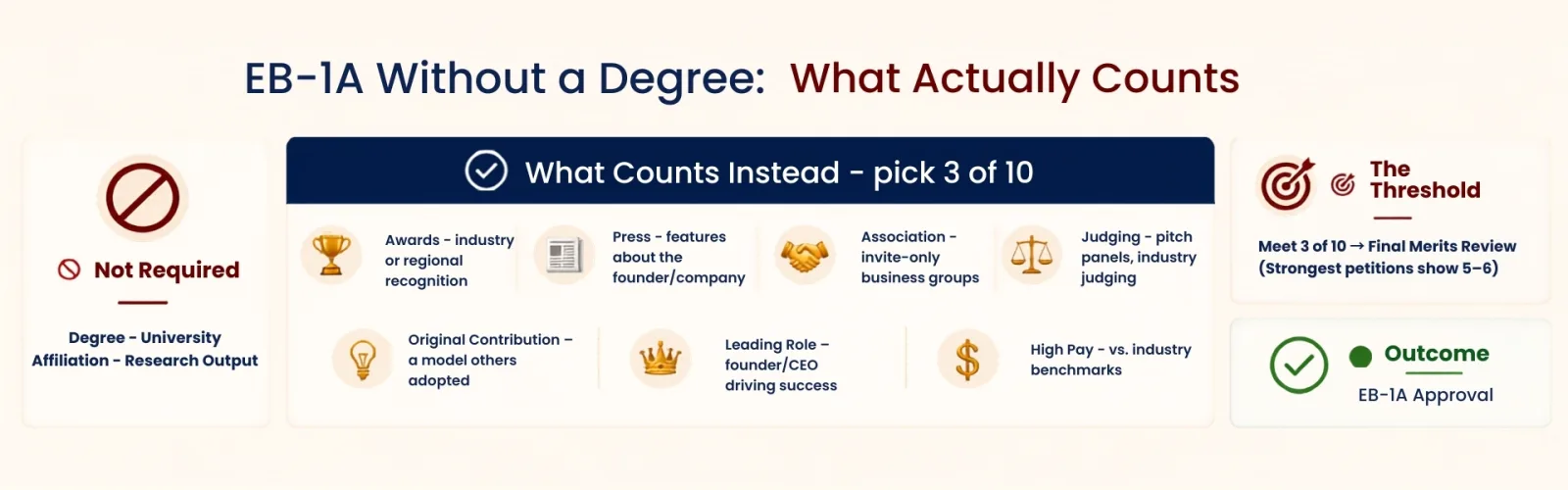
The Ten EB-1A Criteria and What They Look Like for Business Owners
| USCIS Criterion | Business Owner Equivalent |
| Nationally/internationally recognized awards | Industry or regional business excellence awards |
| Membership in selective associations | Invitation-only business or trade associations |
| Published material about the applicant | Press features about the founder or company |
| Judging the work of others | Judging pitch competitions or industry panels |
| Original contributions of major significance | A distinctive business model or proprietary process adopted by others |
| Authorship in professional/major media | Bylined columns in trade or business publications |
| Leading or critical role for a distinguished organization | Founder/CEO role driving the company’s recognized success |
| High salary or remuneration | Compensation benchmarked against industry data |
| Commercial success (performing arts) | Not applicable to most business owners |
| Display of work at exhibitions | Rarely applicable outside creative fields |
Most business-owner petitions rely on five or six of these criteria rather than all ten. Meeting three is the floor set by regulation: it does not guarantee approval on its own.
Does “Small” Disqualify a Business?
No, the assessment of distinction lies within the field and the market, not regarding the size or valuation of the business. A company that is a recognized leader in the region and has accolades, press coverage, and a record of growth can win an EB-1A approval even if the company is smaller than others. The applicant needs to prove that the accomplishments attained by him/her work are known beyond their own circles (the clients, competitors, or industry journalists). Founders exploring this option often work with firms such as Silicon Path Law to determine which criteria best reflect their company’s standing in its market.
Evidence That Substitutes for a Degree
- Media reports focused on startup founders
- Recorded revenue growth, market share increase, or development details
- Awards or shortlist mentions from industry or local institutions
- Speaking opportunities, invitations to panels, or podcast appearances as an expert
- Letters from leading figures in the industry explaining the applicant’s position against competitors
Each piece of proof must correspond to one of ten evaluative criteria, not merely a separate achievement.
Common Pitfalls for Non-Academic Applicants
- Generalized letters of recommendation. Letters extolling virtues without providing details about actual impact are not very helpful.
- Income without context. A figure reflecting growth means nothing to the reviewer without reference to industry standards and conditions.
- Lack of a coherent story. While meeting 3 criteria accomplishes the first step of Kazarian, there needs to be an effective argument for continued recognition.
EB-1A vs. O-1A for Business Owners
Business owners without academic credentials also consider the O-1A nonimmigrant visa, which shares similar extraordinary-ability language.
| Factor | EB-1A | O-1A |
| Visa type | Immigrant (green card) | Nonimmigrant (temporary work visa) |
| Sponsorship | Self-petition, no employer required | Requires a petitioner, though a business owner can petition through their own company with an agent |
| Standard | Sustained national/international acclaim; 3 of 10 criteria | Similar evidentiary criteria; sustained acclaim in the field |
| Duration | Permanent residency | Up to 3 years initially, renewable |
| Best fit | Applicants ready to document a full acclaim record now | Applicants building toward EB-1A or needing interim status |
Some business owners use O-1A as a bridge while continuing to build the evidentiary record needed for a stronger EB-1A filing later.
Conclusion
To qualify for the final merits determination, USCIS needs a minimum of three out of the ten conditions. The majority of business-person petitions can present five to six properly documented conditions which help in forming a solid case. Just meeting the minimum three requirements does not guarantee approval.
Evaluate your EB-1A eligibility todayFAQs
1. Do I need a degree to qualify for EB-1A?+
No. There is no academic criterion for the EB-1A visa. USCIS determines exceptional expertise via evidence of continued fame, without regard to the person’s education. People running businesses can be eligible for the EB-1A visa as long as they can provide evidence of their accomplishments, such as their income, the awards they have received, press about their work, and leading positions they have held. The visa is intended exclusively for those who can prove their exceptional gifts through their work. Academic degrees are relevant in some other categories, for instance, EB-1B, but not in EB-1A.
2. What evidence substitutes for academic credentials?+
The EB-1A petition is based on business evidence rather than academic foundations. This should include the acknowledgment of media publications, industry awards, high income levels, and letters from industry experts. Each piece of evidence provided should refer to the 10 regulatory criteria specified in 8 CFR 204.5(h)(3). USCIS, not its academic nature, evaluates the strength and specificity of the evidence. Organizing these materials around clear criteria is often described as building the EB-1A Evidence for Business Owners file.
3. Can business achievements alone meet the criteria?+
To qualify for the final merits determination, USCIS needs a minimum of three out of the ten conditions. The majority of business-person petitions can present five to six properly documented conditions, which help in forming a solid case. Just meeting the minimum three requirements does not guarantee approval.
4. What’s the biggest mistake non-academic applicants make?+
To qualify for the final merits determination, USCIS needs a minimum of three out of the ten conditions. The majority of business-person petitions can present five to six properly documented conditions, which help in forming a solid case. Just meeting the minimum three requirements does not guarantee approval. Avoiding these mistakes is central to any Extraordinary Ability Non Academic filing strategy.
CTA: Ready to explore your options? Talk to Silicon Path Law today.