
 SiliconPath Law
A Self-Petition Green Card Timeline for EB-1A Applicants
People inquiring about self-petition green card timeline invariably ask that first question: how long will it take? As someone who deals with such cases every day, they know that there’s no easy answer, as it mostly depends less on how long you have to wait in the USCIS process queue and more on how the petition has developed in the months prior to it being physically submitted.
Applicants usually come expecting just one number- "six months" or "a year"- yet the self-petition case does not take place according to just one timeline but instead progresses through different phases, each with its own length and chances to lose or make up time. Realizing this construction is generally more useful than any one number, as it allows us to understand exactly how preparedness can help make the process shorter rather than the time that is genuinely beyond everyone's control.
The post explains the set of estimates regarding the self-petition green card process based on the stages it undergoes- from case assessment to I-140 approval- for the two most common self-petition routes: EB-1A and EB-2 NIW.
What Is SiliconPath Law
SiliconPath Law is an immigration law firm that specializes in providing immigration services to technology professionals. The major focus of the firm is exceptional ability and national interest cases such as EB-1A, O-1A, and EB-2 NIW, in addition to providing immigration services to both individuals and companies. Every attorney is responsible for handling a matter starting from the initial evaluation of the case up until the final decision on the case, which plays an important role in a process where the strategy of storytelling is as important as the actual accomplishments.
Every attorney is responsible for handling a matter starting from the initial evaluation of the case up until the final decision on the case, which plays an important role in a process where the strategy of storytelling is as important as the actual accomplishments.
What Is a Self-Petition Green Card?
A self-petition green card is a green card type that enables a worker to apply for residency based on his/her personal credentials that do not require an employment offer or a PERM labor certification. The two main types include the following
- EB-1A: For individuals who have received national or international recognition in their field.
- EB-2 NIW: For individuals who have advanced education or extraordinary abilities that make their work of national interest to the country.
Since neither type requires a job offer or PERM labor certification, the self-petition green card is usually the fastest way to apply. However, the exact EB-1A processing time or EB-2 NIW processing time depends on case preparation, the USCIS workload, visa availability, and the processing option selected.
Stage 1: Case Evaluation
Every case begins with an honest understanding of what it entails. The EB-1A case evaluation process involves attorneys conducting research on publications, patents, media coverage, leadership positions, salaries, and industry acknowledgments.
Estimated duration: A few days to up to two weeks depending on how orderly the applicant's documents are arranged.
Result: A clear suggestion whether the profile is eligible for EB-1A or EB-2 NIW or whether it should be further worked on prior to filing.
Why Evaluation Accuracy Matters Long-Term
An overly optimistic evaluation produces immediate problems later on. Therefore, a comprehensive evaluation based on a clear set of criteria will help to build realistic expectations and correctly assess the upcoming self-sponsored green card steps.
Stage 2: Building the Immigration Roadmap
Once their strategy is solidified, the next step will be to match the applicant's actual accomplishments against US Citizenship and Immigration Services requirements set forth in the Kazarian process, ensuring the applicant first meets the legal requirements of the visa application and then demonstrates the applicant's actual distinction in the merit process.
This plan will make it easier to determine:
- Whether certain requirements are already met.
- What requirements may need additional evidence.
- What the timeline for filing looks like.
| Case Profile | Typical Roadmap Duration |
|---|---|
| Strong, well-documented profile | 1–2 weeks |
| Developing profile needing new evidence (letters, publications, awards) | 4–8 weeks |
This roadmap establishes the early stages of the extraordinary ability green card process and helps the applicant understand what must be completed before filing.
Stage 3: Evidence Gathering & Petition Drafting
Typically, this is the period in the overall self-petition immigration timeline that lasts the longest time in addition to being the most within the applicant's influence. This usually requires collecting letters of recommendations, assembling supporting documents, and composing a legal brief, which joins everything into a cohesive story.
Typical duration: from two to four months depending on the recommendation providers’ speed of responding and the amount of the new evidence collected.
The process of drafting is iterative. Attorneys typically review the evidence upon its reception, mark all gaps on the roadmap, and improve the legal brief for multiple times before filing the petition.
Common causes of examples:
In practice, delays are hardly ever caused by USCIS at this phase but rather arise from waiting for other parties: recommenders writing letters or educational institutions issuing verifications of the degree or employers validating previous positions.
Stage 4: Filing & I-140 Adjudication
Once the petition is complete, it's filed with USCIS using Form I-140. Applicants can choose standard processing or pay for premium processing, which guarantees a response within 15 calendar days.
| Standard Processing | Premium Processing | |
|---|---|---|
| Response time | Several months (varies by service center) | 15 calendar days |
| Additional cost | None | USCIS premium processing fee applies |
| Best for | Applicants without urgent timeline needs | Applicants needing faster certainty |
The EB-1A I-140 approval timeline may be substantially shorter with premium processing. However, the I-140 premium processing timeline covers the USCIS response to the petition rather than the complete green card process. The response may be an approval, denial, Request for Evidence, or Notice of Intent to Deny.
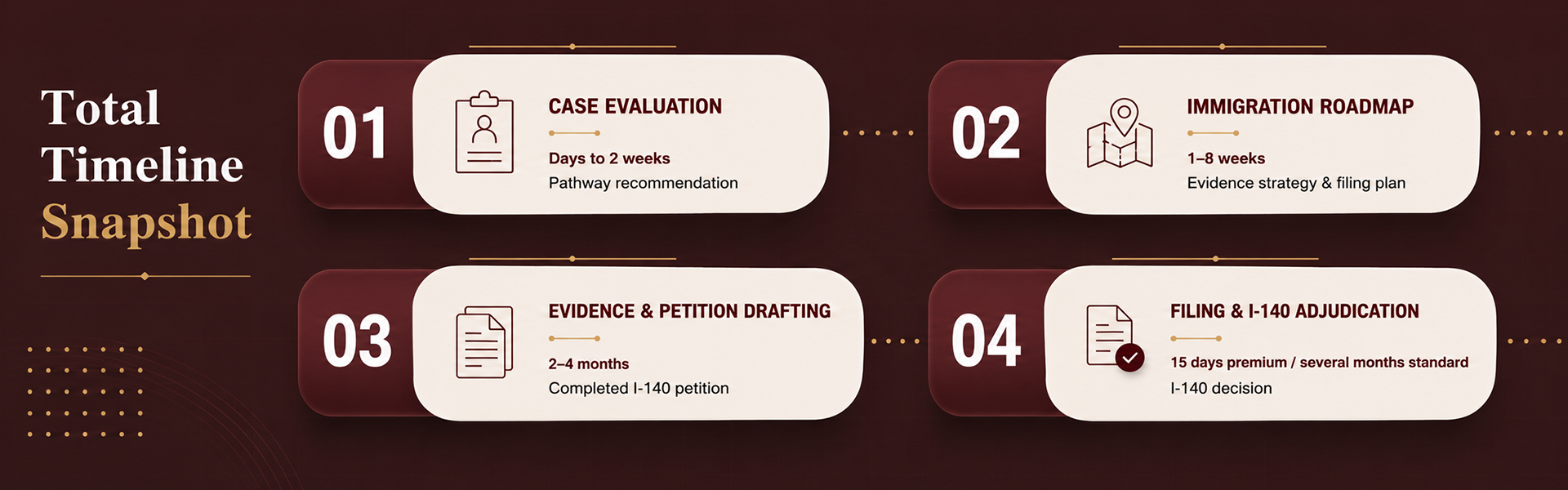
Total Timeline Snapshot
| Stage | Typical Duration | Key Deliverable |
|---|---|---|
| 1. Case Evaluation | Days to 2 weeks | Pathway recommendation |
| 2. Immigration Roadmap | 1–8 weeks | Evidence strategy and filing plan |
| 3. Evidence & Petition Drafting | 2–4 months | Completed I-140 petition |
| 4. Filing & I-140 Adjudication | 15 days (premium) to several months (standard) | I-140 decision |
Actual timelines vary based on case strength, service center workload, and whether an RFE or NOID is issued.
After I-140 Approval: What Comes Next
An I-140 approval is an achievement but is not equal to a green card. The approval confirms the priority date and that the USCIS recognizes the eligibility of the applicant for the petitioning category. After the approval, the process either moves forward with an adjustment of status or through consular processing, on the basis of the visa bulletin situation and the place from which the applicant submits the petition.
The I-140 to green card timeline may therefore vary significantly. An applicant with a current priority date may be able to move forward without a lengthy visa-number wait, while another applicant may need to wait for the applicable category and country to become current. This step of the process will be discussed in a further article.
FAQs
1. How long does a self-petition green card take? +
The preparation period may include evaluation, strategy development, evidence collection, and legal drafting. USCIS adjudication begins only after Form I-140 is filed. Premium processing can shorten the I-140 response period, but it does not accelerate every later green card stage.
2. What is the EB-1A processing timeline 2026? +
A well-documented profile may be prepared more quickly than one requiring new publications, letters, media coverage, or other evidence. Standard adjudication may take several months, while premium processing provides a USCIS response within the applicable expedited period.
3. What are the steps and timeline for an EB-1A green card? +
The preparation stages may take approximately two to six months depending on the applicant's readiness. The later permanent residency stage depends on priority-date availability, the Visa Bulletin, and where the applicant completes the process.
4. What is the I-140 premium processing timeline explained? +
That action does not always mean approval. USCIS may approve the case, deny it, issue an RFE, or issue a NOID. If USCIS requests additional evidence, the premium-processing clock generally follows the applicable rules after the response is received.
5. How long does EB-1A take from start to finish? +
Premium processing can reduce the time required for the I-140 decision, but it does not control the time needed to build the case or complete adjustment of status or consular processing.
6. What is the EB-1A timeline with premium processing? +
Before filing, applicants may still spend several weeks or months completing the evaluation, roadmap, evidence collection, recommendation letters, and legal brief. After approval, the applicant must separately complete the permanent residency stage.
7. How long does the evaluation phase take before filing EB-1A? +
During this stage, attorneys review the applicant's achievements, evidence, and possible EB-1A criteria. The evaluation helps determine whether the case is ready for filing or whether additional profile development is advisable.
8. How long after I-140 approval can I apply for a green card? +
I-140 approval alone does not determine when the green card application can move forward. The applicant's priority date, preference category, country of chargeability, Visa Bulletin, and location all affect the next step.
Conclusion
The timeline of the self-petition green card process is formed rather by preparation than by the time needed for the petition to be processed by the USCIS. Working with an attorney from the preparatory stage allows the applicants to avoid unnecessary delays due to missing documentation or incorrect initial evaluation.