

For professionals operating at senior levels in U.S. industry and academia, the labor certification process known as PERM is often the main source of delay and uncertainty in the employment-based immigration pathway. Several first-preference and second-preference classifications are structured so that a labor certification is not required, provided that the statutory and regulatory criteria are satisfied with precision. The distinctions among these categories are not merely procedural; they dictate who may file, which evidentiary standard governs, and whether an employer must serve as the petitioner. The following breakdown clarifies the operative legal standards.
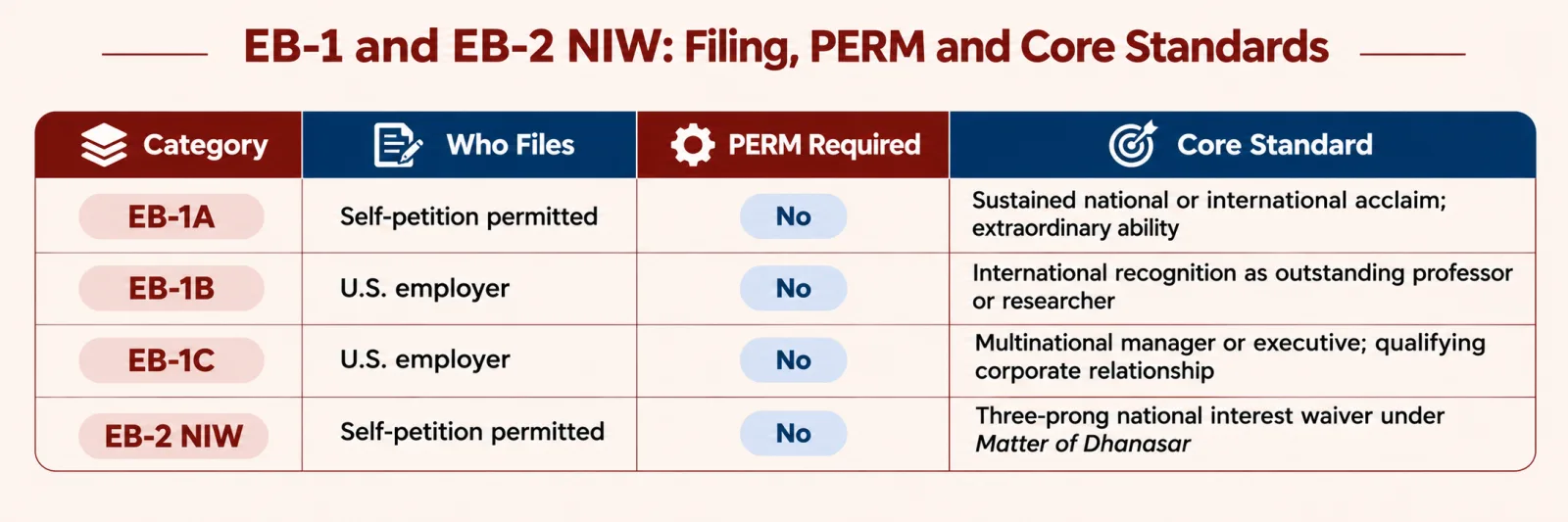
The EB-1A classification is reserved for that small percentage of individuals who have risen to the very top of their field of endeavor . Where a one-time major, internationally recognized award (such as a Nobel Prize or Olympic medal) has not been received, at least three of ten regulatory criteria must be satisfied through documentary evidence.
These criteria are: receipt of lesser nationally or internationally recognized prizes or awards for excellence; membership in associations in the field which demand outstanding achievement of their members; published material about the individual in professional or major trade publications or other major media; participation as a judge of the work of others; original scientific, scholarly, artistic, athletic, or business-related contributions of major significance to the field; authorship of scholarly articles; display of work at artistic exhibitions or showcases; performance of a leading or critical role for distinguished organizations; command of a high salary or significantly high remuneration relative to others in the field; and commercial successes in the performing arts.
Satisfaction of three criteria does not conclude the adjudication. A final merits determination is conducted to assess whether the record, viewed in its totality, establishes sustained national or international acclaim and demonstrates that the individual is among the small percentage at the very top of the field . The evidentiary bar is exacting; conclusory expert letters and general assertions of significance are routinely found insufficient to establish eligibility under the original contributions criterion.
EB-1B Outstanding Researcher or Professor Criteria
The EB-1B classification requires a petition filed by a qualifying U.S. employer. The beneficiary must demonstrate international recognition for outstanding achievements in a particular academic field and must possess at least three years of experience in teaching or research in that field . The offered position must be either a tenure or tenure-track teaching position at a university or institution of higher education, or a comparable permanent research position . Where the employer is a private entity, the department, division, or institute must employ at least three full-time researchers and have achieved documented accomplishments in the academic field.
At least two of six regulatory criteria must be met: receipt of major prizes or awards for outstanding achievement; membership in associations requiring outstanding achievement; published material in professional publications written by others about the individual’s work; participation as a judge of the work of others; original scientific or scholarly research contributions; and authorship of scholarly books or articles in internationally circulated journals . The employer must also be able to pay the offered wage from the priority date. No labor certification is required.
EB-1C Multinational Manager or Executive Requirements
The EB-1C Classification is employer-filed and depends on a qualifying relationship between the U.S. petitioning entity and the foreign employer. The eb1c requirements include that the beneficiary must have been employed abroad for at least one year in the three years preceding entry as a nonimmigrant, or preceding the filing of the petition if already in the United States, in a managerial or executive capacity . The U.S. employer must have been doing business for at least one year, defined as the regular, systematic, and continuous provision of goods or services
The role offered in the United States must be in a managerial or executive capacity. A job title alone is insufficient; the actual duties, authority, and position within the organizational structure are examined . For an **l1a to green card transition, the EB-1C pathway is frequently utilized, but an approved L-1A petition does not automatically establish eligibility for EB-1C, the corporate relationship, the one-year foreign employment requirement, and the executive or managerial nature of the role must be independently documented .
EB-2 NIW Three-Prong Test
The EB-2 National Interest Waiver is governed by the three-prong analytical framework set forth in Matter of Dhanasar. First, the proposed endeavor must possess both substantial merit and national importance. Second, the individual must be well positioned to advance the proposed endeavor. Third, on balance, it must be beneficial to the United States to waive the job offer and labor certification requirements. The January 2025 policy guidance has clarified that the specific endeavor, rather than the general occupation, is the subject of scrutiny, and that vague assertions of economic benefit are insufficient .
Who-Fits Matrix by Profile
Common Mistakes by Category
In EB-1A adjudications, submitting expert letters with conclusory statements unsupported by objective corroboration is a recurring deficiency. The criterion for original contributions of major significance demands evidence that the contribution has been widely implemented or has remarkably influenced the field, not merely that it exists .
In EB1 petitions, the qualifying nature of the private employer’s research department is frequently inadequately documented. The requirement that the department employ at least three full-time researchers and possess documented accomplishments is a threshold matter that is often addressed superficially .
In EB1-C petitions, the characterization of the beneficiary’s role as managerial or executive based on title rather than function is a persistent issue. USCIS examines whether the beneficiary directed the management of an organization or a major function, established goals and policies, and exercised wide latitude in discretionary decision-making . Additionally, the one-year foreign employment requirement cannot be satisfied by time physically spent in the United States, even if the foreign entity continues to pay the beneficiary.
How Siliconpath Law Helps
Our firm’s engagement model is structured around a legal bridge visibility protocol. Clients receive written case strategy memoranda identifying the specific regulatory criteria to be addressed and the evidentiary gaps requiring resolution before filing.
A communication cadence is established at the outset, with written updates issued at defined milestones: after the evidentiary audit, upon USCIS receipt of the petition, upon issuance of any Request for Evidence, and upon adjudicative action. We assist in preparing draft petition letters and exhibit indices for client review and written approval before submission.
We maintain this documentation trail to ensure the client retains a verifiable record of the case posture at every stage. Contact us to schedule a consultation and get more information.
FAQs
EB-1A, EB-1B, EB-1C, and EB-2 NIW are classified as green card pathways without PERM. Each is predicated on statutory or regulatory criteria that Congress or the agency has determined obviate the need for a labor market test.
EB-1A requires sustained acclaim and satisfaction of three of ten criteria. EB-1B requires international recognition, three years of experience, a qualifying employer, and satisfaction of two of six criteria. EB-1C requires one year of foreign managerial or executive employment, a qualifying corporate relationship, and a U.S. role in a managerial or executive capacity.
EB-1A and EB-2 NIW may be self-petitioned. EB-1B and EB1-C require a U.S. employer to file Form I-140.
An L-1A to green card transition through EB1-C is a recognized pathway, but USCIS assesses the EB-1C petition under its own regulatory criteria. The L-1A approval does not create a presumption of EB1-C eligibility .
In an EB1A vs EB1B vs EB1C comparison against NIW, the EB-1 categories do not require a labor certification and generally carry a higher evidentiary threshold regarding acclaim or managerial scope. NIW requires a showing of national importance of the specific endeavor and is not limited to a single employer, but the January 2025 guidance has heightened scrutiny on the nexus between the individual’s qualifications and the proposed work .
Processing times fluctuate with service center workloads and visa availability. EB1-C and EB-1A petitions may be eligible for premium processing of the Form I-140, which compresses the adjudicative phase, though the subsequent adjustment of status or consular processing timeline is dependent on visa bulletin priority dates.