
 SiliconPath Law
A proposed rule was published by the Department of Homeland Security on October 14, 2026. Through this, the regulatory provision directing that deference be given to prior approvals in certain Form I-129 extension proceedings would be removed (91 FR 65119).
The proposal is presently in the comment phase; written comments are required to be submitted by November 13, 2026, through regulations.gov under Docket No. USCIS-2026-0529. Until a final rule is published and made effective, 8 CFR 214.1(c)(5) remains in force, and adjudications are continued to be conducted under the existing deference framework.
For O-1A petitioners and beneficiaries, the interval before finalization is best treated as a preparation window rather than as a waiting period. The original petition by which the classification was secured should be reexamined with the same rigor that would be applied by an officer if no presumption of correctness were attached to the prior decision.
That exercise, referred to here as a pre-mortem audit, is regarded as the most direct method by which the questions likely to be raised in an O-1 extension RFE may be anticipated if removing deference to prior approvals is ultimately adopted.
What Deference Means Today Under 8 CFR 214.1(c)(5), in Plain Terms
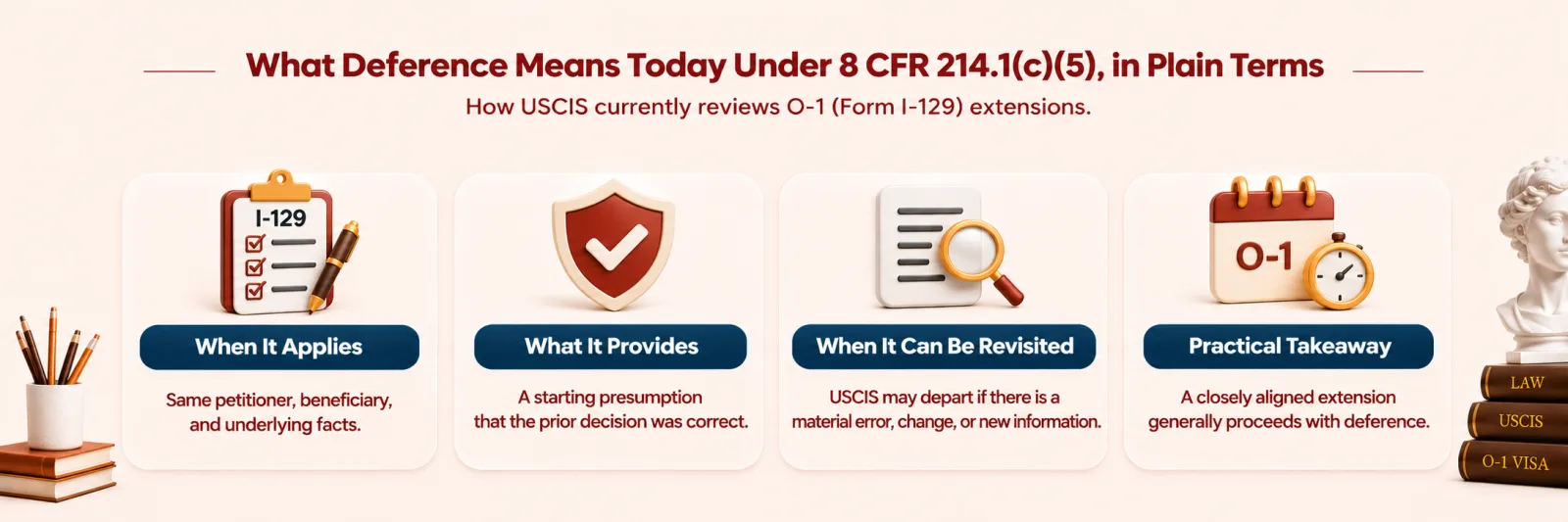
- Under the current regulation, when a Form I-129 extension request is filed by the same petitioner, for the same beneficiary, and on the same underlying facts, USCIS officers are instructed that deference is to be given to the prior eligibility determination unless a material error is found to have existed, a material change is found to have occurred, or new material information is found to adversely affect eligibility.
- Deference is not to be understood as automatic approval. The burden of establishing eligibility is retained by the petitioner, and the prior approval notice is not to be substituted for evidence by which the relevant criteria are shown to remain satisfied.
- What is provided by deference is a starting orientation: adjudication is begun by the officer from the premise that the earlier determination was correct, and that premise is departed from only upon identification of one of the enumerated exceptions.
- For O1 visa extension planning, the practical consequence is that a filing which is shown to track the original record closely, with no material drift in duties, recognition, or employment terms, is generally permitted to proceed with a presumption in its favor.
What the Proposal Would Change: No Deference, But Prior Approval May Still Be Considered
Under the proposed rule, 8 CFR 214.1(c)(5) would be deleted in its entirety. Adjudication would no longer be commenced by officers from a position of deference to the prior determination. A prior approval would be retained in the record and could be considered, but no presumptive weight would be accorded to it.
The eligibility criteria for the O-1A classification itself would not be changed. What would be changed is the adjudicative posture:
each O-1A extension evidence submission would be assessed as though a fresh eligibility determination were being made by the officer, with the burden resting squarely on the petitioner by whom every regulatory criterion must be shown to continue to be met by a preponderance of the evidence.
The view has been stated by DHS that deference has had the practical effect of discouraging thorough review, and data has been cited by DHS by which higher rates of noncompliance or fraud in certain extension populations are suggested to have occurred during periods when deference was in effect.
Whether that rationale is accepted or contested in comments, the operational implication for petitioners is the same: the original approval is to be treated as an exhibit that must be explained, not as a foundation upon which the extension is rested.
Why “Refresh, Don’t Rebuild” Advice May Not Hold if Deference Ends
Guidance commonly offered for extension filings, that the record should be refreshed rather than rebuilt, is depended upon implicitly by the continuing availability of deference.
By refreshment, it is presumed that the original petition remains the operative evidentiary baseline and that the extension filing need only be updated by the officer as to developments since approval. If removing deference to prior approvals is finalized, that presumption is lost as a matter of regulatory footing.
A refreshed record may still be adequate in substance, but it must be constructed as a self-contained demonstration of eligibility, not as a supplement to a prior finding to which presumptive force is no longer attached.
Officers would be free to reconsider issues previously resolved, including whether the beneficiary’s role is shown to satisfy the O-1A criteria, whether the employer’s attestations are shown to remain accurate, and whether the evidence of distinction and recognition is shown to remain current.
The distinction between refreshing and rebuilding is therefore rendered less a matter of preference and more a matter of risk allocation. A rebuilt record, organized around the regulatory criteria and supported by evidence of the beneficiary’s present stature, is regarded as the safer architecture if deference is eliminated.
The Pre-Mortem Audit: Re-Read the Original Petition as a First-Time Officer
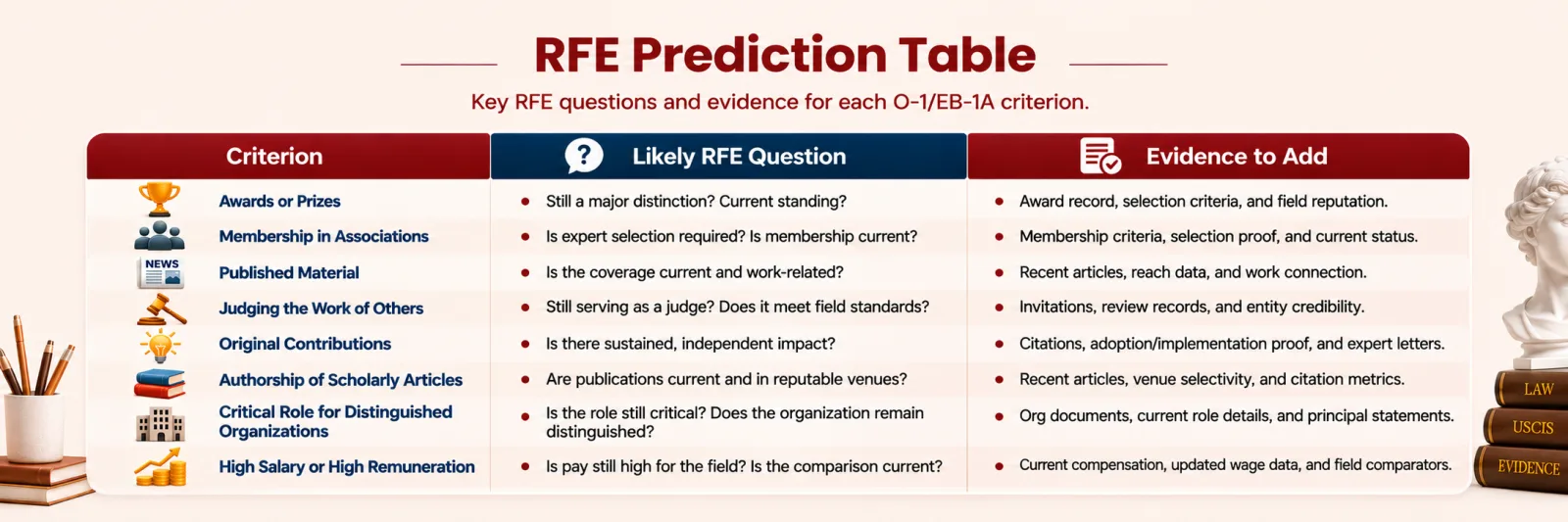
The audit begins with the criteria map. The original O-1A petition should be read against the regulatory criteria as they appear in 8 CFR 214.2(o)(3), with each criterion paired to the exhibit by which it was offered to be satisfied.
The question is not whether the criterion was accepted in the past, but whether the exhibit, when viewed without deference, would be found independently persuasive by a first-time officer today. Evidence age is treated as the second axis.
The probative value of awards, press coverage, judging invitations, and scholarly citations is degraded as they are made to recede from the present. Where an exhibit from the initial filing is relied upon as the sole support for a criterion, the question is invited as to what has occurred since.
Particular scrutiny is required by selectivity proof. Where selection rates, membership criteria, or institutional reputation were relied upon in the original record by which a distinction was to be shown to be significant, the underlying documentation should be verified as still accurate and as still applicable to the beneficiary’s current standing.
The final-merits narrative, often the most vulnerable component, should be examined for continuity. A narrative of extraordinary ability that culminated in the beneficiary’s arrival or engagement is likely to have been constructed in the original petition.
By an extension, it must be shown that the narrative has progressed, not merely that it has persisted. Petitioner or agent consistency is treated as the fourth checkpoint. The petitioner’s description of the beneficiary’s duties, the agent’s representations, and any third-party contracts or statements should be cross-read for inconsistencies.
Where a change in job title is used by which a change in substance is concealed, or where an agent arrangement has been quietly altered, it will be rendered more visible to an officer by whom the earlier record is not begun from the premise that it was correct.
Timing: When to Start
Preparation should be commenced no later than six months before the requested extension start date, which is the earliest point at which an extension petition is generally permitted to be filed.
If the proposed rule is finalized and made effective, an O-1 extension RFE would be made to add processing time; it has been estimated by DHS that petitions by which an RFE is received are made to take substantially longer to adjudicate, and several thousand additional RFEs annually across Form I-129 classifications are anticipated by DHS’s own projection.
For beneficiaries by whom status will be made to expire before a decision is expected, the 240-day automatic extension of work authorization for timely filed same-employer extension petitions remains available, but travel and planning are placed at risk by a prolonged adjudication.
The audit should therefore be made to precede the six-month filing window, so that any evidentiary gaps by which the record is affected may be addressed without the filing timeline being compressed.
If the beneficiary’s original petition is more than two years old, or if the petitioner’s structure or the beneficiary’s role has been changed in any material respect, an earlier start is regarded as prudent.
How SiliconPath Law Approaches This Transition
A document-driven visibility protocol for extension matters is maintained by SiliconPath Law. A written audit memorandum is prepared for each O-1A extension, by which the original petition’s exhibits are mapped against the regulatory criteria and evidence that has aged, weakened, or become inconsistent with the beneficiary’s present role is flagged.
Contemporaneous access to filing checklists, exhibit indices, and the audit memorandum itself is provided to the client through the Legal Bridge portal, so that the state of the record may be known before it is reviewed by an officer.
Milestones are communicated in writing at intake, audit completion, draft assembly, and filing, and a defined cadence for updates is observed if an RFE is issued.
Communication is conducted through a designated attorney and paralegal team, and responses to evidentiary requests are prepared against the audit framework rather than assembled from scratch.
The objective is not that the final rule be predicted, but that the extension record be ensured to be defensible under either the current deference standard or its absence.
FAQs
1. Is deference given by USCIS to my prior O-1A approval today?+
Yes. Under 8 CFR 214.1(c)(5), deference is continued to be given by USCIS to a prior approval involving the same parties and facts unless material error, material change, or new adverse information is found to be present. The proposed rule has not been made effective.
2. What would be changed if deference is removed?+
Adjudication would no longer be begun by officers from a presumption that the prior approval was correct. A prior approval could still be considered, but eligibility would need to be established anew by the petitioner with each O-1A extension evidence submission.
3. Would O-1 extensions be affected by the proposal?+
Yes. The proposed removal of 8 CFR 214.1(c)(5) would be applied to all Form I-129 classifications, including O-1A, H-1B, L-1, TN, and E petitions.
4. Is the proposed rule in effect?+
No. The comment period closes on November 13, 2026. The current regulation remains in force until a final rule is published and made effective.
5. How early should preparation for my extension be started?+
Filing may be begun up to six months before the requested start date. Because time is required by an audit of the original petition, and because substantial processing time may be added by an O-1 extension RFE if deference is removed, preparation should be commenced before that six-month window is opened.
6. Should my evidence be refreshed or should the petition be rebuilt?+
If deference is eliminated, a rebuilt record, organized as an independent demonstration of eligibility rather than as an update to a prior finding, is regarded as the more defensible approach. A refreshed record may be found sufficient in some cases, but it should be tested against the audit framework before filing is undertaken.