
 SiliconPath Law
The United States Department of State has released the November 2026 Visa Bulletin, establishing the priority date cutoffs that govern immigrant visa availability for the first month of the new fiscal year. For employment-based applicants, the Dates for Filing chart has been designated by USCIS as the operative chart for adjustment of status filings, a determination that carries distinct procedural consequences for corporate professionals and their dependents
The News: What Has Changed?
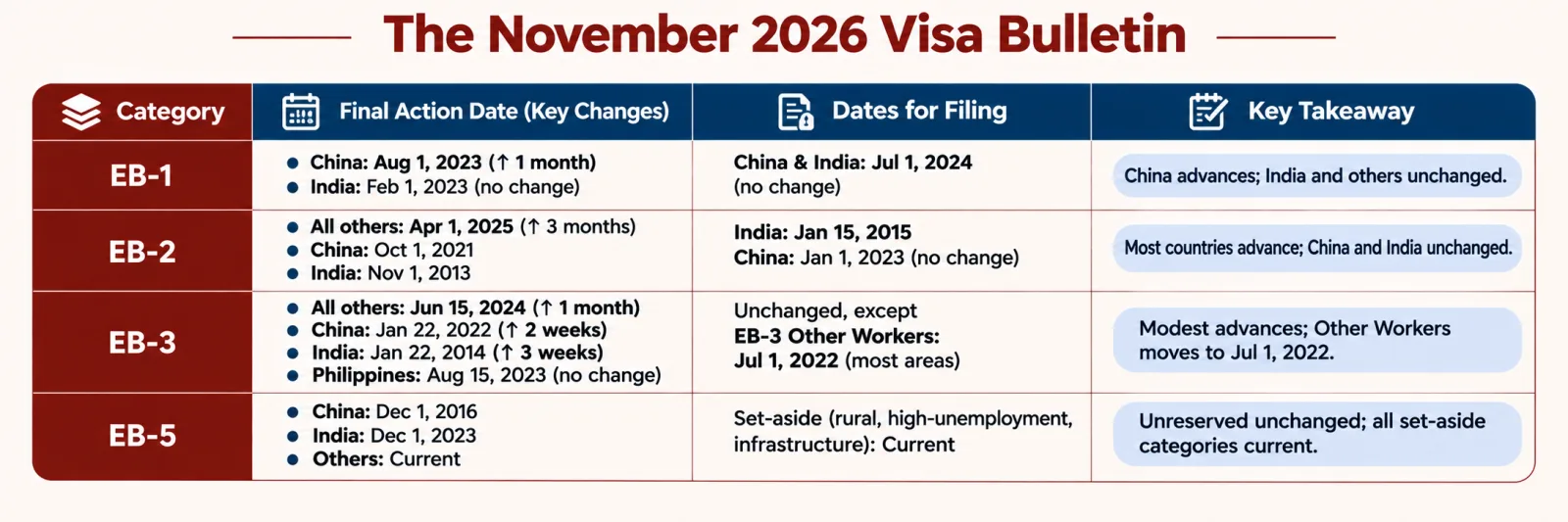
In the EB-1 category, the Final Action Date for China advances one month to August 1, 2023, while India remains fixed at February 1, 2023. All other chargeability areas remain current. Under the Dates for Filing chart, China and India both remain at July 1, 2024.
For EB-2, the Final Action Date for all countries other than China and India advances three months to April 1, 2025. China remains at October 1, 2021, and India remains at November 1, 2013. The Dates for Filing chart is unchanged: India stands at January 15, 2015, and China at January 1, 2023.
EB-3 skilled workers and professionals see the Final Action Date for all other countries advance one month to June 15, 2024. China advances two weeks to January 22, 2022, and India advances three weeks to January 22, 2014. The Philippines remains at August 15, 2023. The Dates for Filing chart holds steady for all countries except EB-3 Other Workers, which advances to July 1, 2022 for all areas except China, India, and the Philippines.
The EB-5 unreserved category remains unchanged: China at December 1, 2016, India at December 1, 2023, and all other countries currently. The set-aside categories for rural, high-unemployment, and infrastructure investments remain current for all chargeability areas.
Implications: What The Proposed Means in Practice
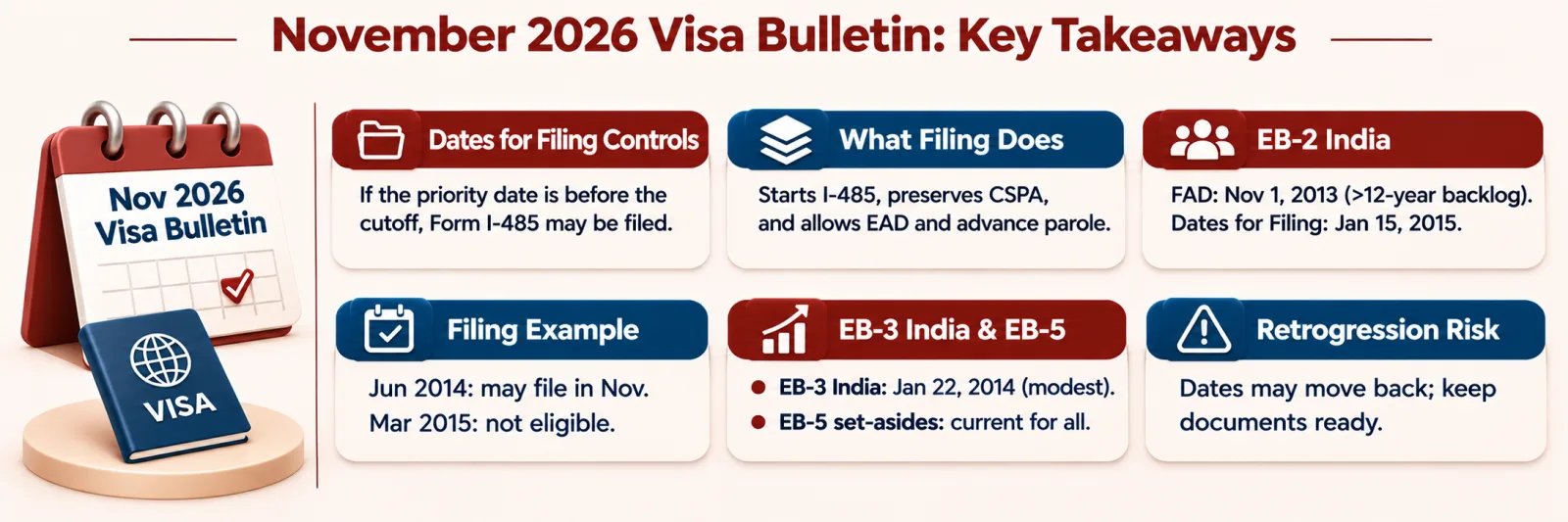
The designation of the Dates for Filing chart for employment-based adjustment of status is the controlling procedural fact of the November bulletin. Applicants whose priority date precedes the applicable Dates for Filing cutoff may submit Form I-485, even where the Final Action Date has not yet been reached.
This distinction is frequently misunderstood. Filing under the Dates for Filing chart does not confer immediate permanent residence; it initiates the adjudicative process, preserves aging out protections for derivative children under the Child Status Protection Act, and authorizes the filing of companion applications for employment authorization and advance parole.
For Indian nationals in EB-2, the Final Action Date of November 1, 2013 represents a backlog exceeding twelve years. The Dates for Filing cutoff of January 15, 2015 is the operative date for I-485 submission.
An applicant with a priority date of, for example, June 2014 is eligible to file in November despite the Final Action Date remaining in 2013. Conversely, an applicant with a priority date of March 2015 remains ineligible to file under either chart.
The advancement in EB-3 India to January 22, 2014 is incremental and does not materially alter the structural backlog. Of greater significance is the continued currency of the EB-5 set-aside categories for all countries, including India and China.
For clients with capital available and a genuine business interest in a rural or high-unemployment project, the set-aside pathway remains the sole employment-based category in which immediate visa availability exists irrespective of country of birth.
Retrogression risk warrants explicit attention. The Final Action Dates for several categories advanced in November, but advancement is not linear. Historical patterns demonstrate that priority dates may regress without advance notice when demand exceeds statutory numerical limits. Applicants who delay document preparation until a date becomes current frequently forfeit the filing window.
What to Consider Next
Eligible applicants should consider filing Form I-485 without delay under the Dates for Filing chart while the window remains open.
Priority dates should be tracked monthly, and applicants should watch for written notifications regarding categories that have advanced or retrogressed.
Document preparation, including Form I-693 medicals and civil records, should be initiated early to avoid forfeiture of the filing window.
Those approaching eligibility should confirm chargeability and concurrent filing eligibility before submission.
Consider scheduling a consultation to discuss your situation with experts.
FAQs
1. What is the distinction between the Dates for Filing and Final Action Date charts?+
The Final Action Date chart governs when USCIS may approve an adjustment application. The Dates for Filing chart governs when an applicant may submit Form I-485. For November 2026, USCIS has designated the Dates for Filing chart as operative for employment-based filings. Filing initiates adjudication, preserves CSPA aging-out protections, and permits employment authorization and advance parole applications, but does not confer permanent residence.
2. As an EB-2 Indian national with a June 2014 priority date, may I file in November 2026?+
Yes. The EB-2 India Dates for Filing cutoff is January 15, 2015, and a June 2014 priority date precedes it. Approval remains contingent on the Final Action Date (November 1, 2013) becoming current. A March 2015 priority date would be ineligible under either chart.
3. Which category affords immediate availability irrespective of country of birth?+
The EB-5 set-aside categories — rural, high-unemployment, and infrastructure — remain current for all chargeability areas, including India and China. This is the sole employment-based pathway with immediate availability regardless of birth country.
4. What is retrogression risk?+
Retrogression is the backward movement of cutoff dates, which may occur without notice when demand exceeds statutory limits. Applicants who defer document preparation risk forfeiting the filing window. Prompt filing and monthly monitoring are advised.
5. Does filing Form I-485 under the Dates for Filing chart provide any interim benefits while awaiting approval?+
Yes. Although filing does not confer permanent residence, it permits companion applications for employment authorization and advance parole, and preserves aging-out protections for derivative children under the Child Status Protection Act. These interim benefits remain available while the adjustment application is pending adjudication.