 SiliconPath Law
USCIS, a federal agency, adjudicates the EB-2 National Interest Waiver I-140 petition, and its filing does not depend on the petitioner’s or the attorney’s physical location in any city or state. The location of counsel is not required by law for representation in this matter.
NIW attorney searches are often made by researchers, founders, and engineers whose careers have been built on geographic mobility, and that search often reflects an assumption carried over from consumer legal transactions.
A local practitioner is instinctively associated with accessibility and accountability, but within the framework of federal immigration law, that assumption must be recalibrated.
The adjudication of an EB-2 NIW petition occurs within a centralized federal framework, and a petitioner’s representation before USCIS is governed by national standards of professional conduct rather than municipal geography.
What Stays Local: The Physical Touchpoints of the Process
While the strategic and legal labor of an NIW case is portable, certain procedural steps are tethered to physical locations. A biometrics appointment for background checks and fingerprinting is scheduled at a USCIS Application Support Center, and the location is assigned based on the petitioner’s residence or the relevant field office’s jurisdiction.
Similarly, the civil surgeon medical examination required for the final green card stage must be conducted by a USCIS-designated physician whose practice is local to the petitioner.
Should an I-485 adjustment of status interview be required, it will be conducted at a USCIS field office assigned to the petitioner’s geographic area.
These are acknowledged as logistical realities of the process, but they are not functions performed by the attorney.
What Does Not Stay Local: The Core of the Legal Work
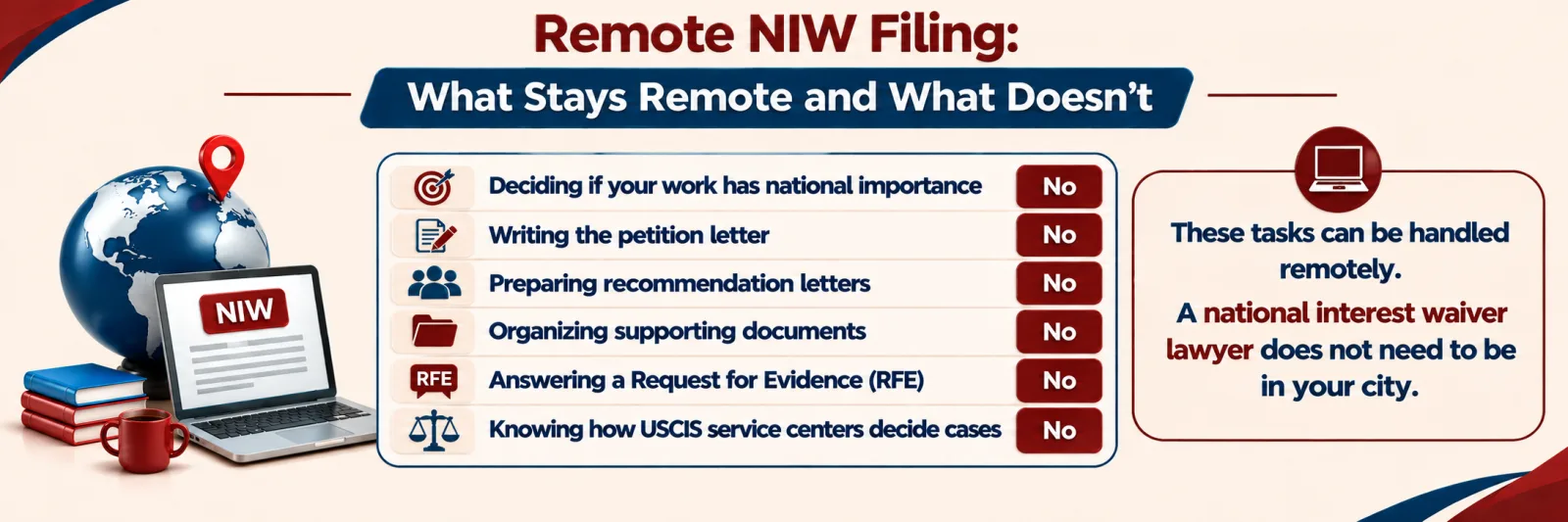
The substantive legal work of an EB-2 NIW petition is considered entirely detached from geography. The assessment of whether a proposed endeavor possesses substantial merit and national importance under the Matter of Dhanasar framework is treated as an exercise in legal argumentation and evidence evaluation, not as a local service.
The drafting of the petition letter, the preparation of recommendation letters, the curation of exhibits, and the response to a Request for Evidence are tasks that can be executed with equal efficacy from any location where secure internet access is available.
The national interest waiver lawyer who is familiar with the adjudicative trends of the Texas Service Center or the Nebraska Service Center is not rendered more effective by the sharing of a zip code with the petitioner.
Who can represent you before USCIS
Representation before USCIS is not limited to attorneys admitted in the petitioner’s state of residence.
Any attorney who is a member in good standing of the bar of the highest court of any state, possession, territory, or commonwealth of the United States, or of the District of Columbia, may be permitted to represent a client in immigration matters before the agency [8 C.F.R. § 1292.1(a)(1)].
Verification of an attorney’s admission is treated as a matter of public record. A state bar’s online directory confirms active status and disciplinary history.
For instance, a remote immigration lawyer practicing from Chicago is as legally authorized to file an I-140 for a client in Seattle as a Seattle attorney.
What A Good Remote Service Looks Like
The difference between adequate and excellent remote representation lies in operational discipline rather than physical office space.
A well-run remote practice should establish a predictable update cadence so the client is not left in informational silence between filing milestones.
A secure document portal is maintained to transmit sensitive personal and professional records, avoiding the vulnerabilities of unencrypted email. Communication windows are defined with explicit acknowledgment of time-zone differences, and a protocol is established for urgent matters such as a deadline-driven RFE.
These are regarded as operational choices that signal the maturity of a practice.
Questions to Ask Any Remote Firm
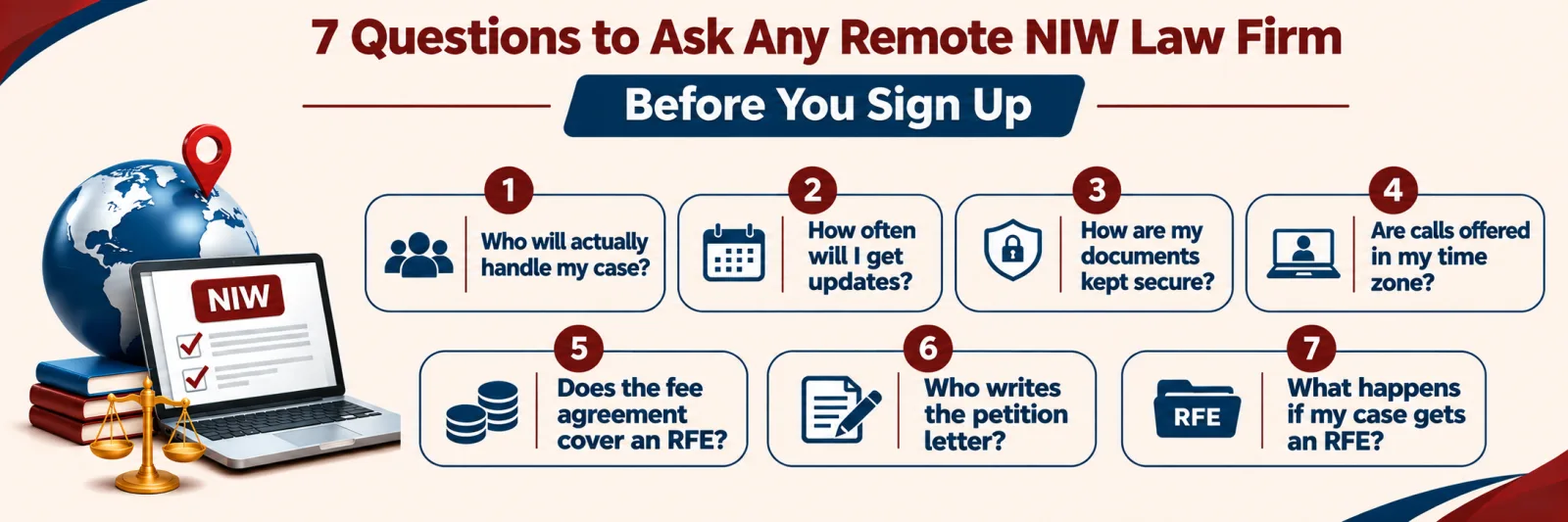
Prospective petitioners should request clarity on several operational points before engagement. To be certain of the process in advance, it is best recommended to ask questions before signing a contract.
Majorly, the identity of the individual who will actually draft and manage the case should be confirmed, not merely the identity of the attorney who conducts the initial consultation.
The firm’s policy on update frequency and the channels used to deliver updates should be documented. The security infrastructure for document storage and transfer merits inquiry. For EB-2 NIW lawyer consultation scheduling, the availability of time slots that accommodate the petitioner’s time zone is treated as a practical indicator of a firm’s experience with remote clientele.
Finally, a written fee agreement should clearly set out the scope of services, including handling an RFE, before any payment is made.
When Local Help is Useful
There are narrow circumstances in which a local professional relationship is found to be practically useful, though it is not legally mandated.
Notarization of certain forms and declarations is a physical act that requires a notary public, and while remote online notarization has been expanded, an in-person notary is sometimes preferred by petitioners.
A local representative may collect certain original evidentiary documents, such as institutional letters or sealed transcripts, if the petitioner is abroad.
And for a petitioner by whom a face-to-face meeting would simply be preferred for the review of a complex exhibit set, a local attorney may be engaged for a limited consultative role, while the national interest waiver lawyer manages the federal filing.
These are treated as matters of convenience and personal preference, not as legal necessity.
Why SiliconPath Law As Your Remote Law Firm
SiliconPath Law is operated as a boutique immigration practice structured for the realities of a geographically distributed clientele. The firm’s case management protocol is built around a secure client portal through which all documents are exchanged and archived and an auditable record of the evidentiary record is thereby created as it develops.
Communication cadence is established at the outset of engagement, and scheduled status updates are tied to procedural milestones rather than to arbitrary intervals.
For petitioners in time zones that diverge significantly from U.S. business hours, asynchronous communication through the portal is supplemented by scheduled consultation windows that are arranged to respect the client’s working day.
The integration of technological infrastructure with legal analysis is not adopted as a marketing posture; it is treated as an operational necessity for the delivery of consistent representation to founders and researchers whose professional obligations are not paused for administrative convenience.
To end your search for an attorney near me, schedule an online consultation and understand more about our services and procedures of operations.
FAQ
1. Do I need a local lawyer for an EB-2 NIW?+
No. The petition is filed with a federal agency, and representation may be undertaken by any attorney who is licensed and in good standing in any U.S. jurisdiction. Geographic proximity is not required by regulation.
2. Can an NIW petition be prepared and filed entirely remotely?+
Yes. The I-140 petition and its supporting evidence are submitted to USCIS, and no in-person appearance by the attorney or the petitioner is required at the filing stage. Communication and document exchange may be conducted through secure electronic means.
3. What parts of the green card process depend on where I live?+
Biometrics collection, the civil surgeon medical examination, and any required I-485 interview are the primary in-person requirements, and each is assigned based on the petitioner’s residence. Consular processing abroad, where applicable, is conducted at a U.S. embassy or consulate.
4. How do I verify an attorney’s license?+
Active bar membership is confirmed through the public directory of the relevant state bar association, where status and disciplinary history are recorded. Representation before USCIS is established through Form G-28.
5. How should remote communication work across time zones?+
A written communication protocol is expected to be provided at engagement, and the frequency of updates, the primary channel for document exchange, and the procedure for urgent matters are to be specified therein. Scheduled consultation windows are arranged to accommodate the client’s working day.
Disclaimer: Attorney Advertising. This article is provided for informational purposes only and does not constitute legal advice.