
 SiliconPath Law
Executing an H1B to green card small business strategy is one of the most effective ways for growing companies to retain top foreign talent, but it requires proactive planning across three critical pillars: timeline management, strict cost compliance, and talent retention risk.
Schedule a Business ConsultationUnlike large enterprises with dedicated immigration departments, SMBs often get caught off-guard by the 22-to-24-month end-to-end PERM labor certification timeline, non-negotiable employer-paid fee mandates, and rigid prevailing wage requirements set by the Department of Labor (DOL).
To successfully transition an employee from an H-1B visa to an employment-based green card (typically EB-2 or EB-3) without risking their work authorization or incurring sudden audit delays, SMB employers must initiate the green card process no later than year 3 or 4 of the worker's 6-year H-1B limit and establish a clear internal sponsorship policy.
Decoding the PERM Timeline for Small Businesses
Moving an employee from a temporary work visa to permanent residency isn't something you can rush at the last minute; it takes a deep understanding of how the Department of Labor's calendar actually moves. If your business relies on specialized talent, such as a Senior AI Research Engineer building your core tech, a sudden gap in their work permission can bring your product development to a screeching halt.
Typical PERM Process Duration Breakdown
- Phase 1: Prevailing Wage Determination (PWD): 5 to 7 Months
- Phase 2: Mandatory Recruitment & 30-Day Quiet Period: 2 to 3 Months
- Phase 3: Form ETA-9089 Processing (DOL Review): 10 to 14 Months
- Total Estimated Duration: 17 to 24+ Months
The Reality of DOL Processing Delays
- Prevailing Wage Determination (PWD): Right now, the Department of Labor takes roughly 5 to 7 months just to hand back a prevailing wage determination for a position.
- Mandatory Recruitment and Quiet Period: Before you can file, you have to run local hiring campaigns (including local newspaper ads, job orders with state workforce agencies, and internal job postings), and then wait out a mandatory 30-day "quiet period." This stage easily takes 2 to 3 months.
- Form ETA-9089 Processing: Once you finally submit the PERM application, the DOL's own internal review adds another 10 to 14 months of waiting.
Why Timeline Planning is Critical
Here is where the clock really matters: under Section 106(a) of the American Competitiveness in the Twenty-First Century Act (AC21), you can only extend an employee's H-1B status beyond the standard six-year cap if you filed their PERM application or Form I-140 petition at least 365 days before that sixth year runs out.
If you don't start employer sponsorship planning before your employee enters their fifth year on an H-1B, you lose that legal safety net entirely. While giant corporations can easily shift employees to offshore offices when paperwork gets delayed, losing a key team lead at a growing business can derail an entire business cycle.
Build Your Sponsorship StrategyFinancial Obligations and Prevailing Wage Rules
When it comes to small business immigration compliance, financial clarity and legal accuracy go hand in hand. Federal rules around employment-based immigration put the financial responsibility squarely on you, the employer, so there's no room for guessing games.
| Stage / Requirement | Responsible Party | Estimated Cost Range | Key Compliance Mandates |
|---|---|---|---|
| PERM Labor Certification | Employer (100%) | $4,000 – $8,000 | Mandatory employer expense; zero employee contribution permitted. |
| Form I-140 Petition | Employer / Business | $2,000 – $7,000+ | Includes government filing fees, legal fees, and optional premium processing. |
| Prevailing Wage Obligation | Employer | Varies by SOC Code & Metro Area | Must prove continuous Ability to Pay from the priority date onward. |
Non-Negotiable Employer Costs
Federal regulations are crystal clear on this point: the employer must cover 100% of all legal, advertising, and administrative costs for the PERM process. You cannot ask the worker to pay, you cannot dock their salary, and you cannot write "clawback" clauses into their contract to get reimbursed if they leave later. Doing any of those is illegal.
When putting together your budget for an H1B to green card transition, expect to spend anywhere between $6,000 and $15,000+ per employee to cover legal counsel, required ad placements, and government filings for both the PERM and Form I-140 phases combined.
Prevailing Wage Commitments And Ability to Pay
The day you file the PERM application, you lock in the employee's official "priority date." From that exact day forward, your business must be able to prove its Ability to Pay the prevailing wage tied to that job.
When USCIS reviews your Form I-140 down the line, they will look at your federal tax returns, audited financial statements, or annual reports to verify this. For growing mid-sized businesses, keeping clean financial records (showing enough net income or net liquid assets to cover the promised wage) is key to passing USCIS scrutiny without a hitch.
Protecting Your Case Against Audits and DOL Scrutiny
Smaller enterprises naturally face extra scrutiny during the recruitment and approval stages. Given that mid-sized company structures often involve specialized hybrid roles or close founding teams, your filings need to be airtight to pass Department of Labor checks.
Primary Audit Triggers for Small and Mid-Size Employers
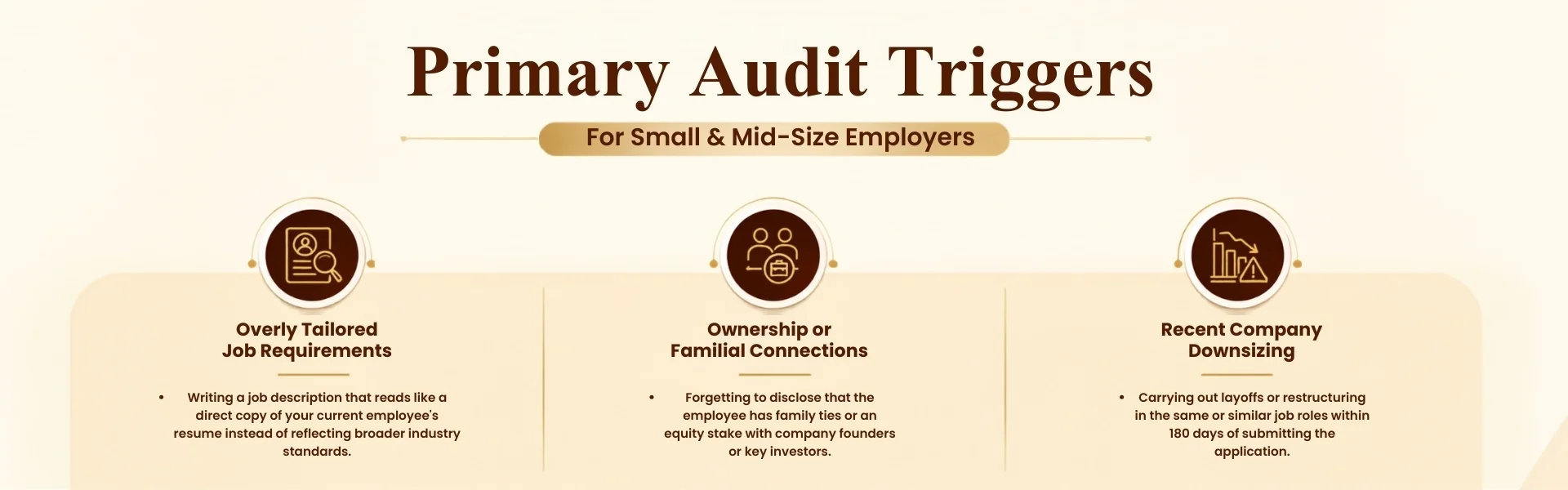
- Overly Tailored Job Requirements: Writing a job description that reads like a direct copy of your current employee's resume instead of reflecting broader industry standards.
- Ownership or Familial Connections: Forgetting to disclose that the employee has family ties or an equity stake with company founders or key investors.
- Recent Company Downsizing: Carrying out layoffs or restructuring in the same or similar job roles within 180 days of submitting the application.
Best Practices for Audit Delay Prevention
The best defense against audit delays is building an immaculate Audit Necessity File as you go. This file should hold a copy of every single resume submitted during recruitment, detailed interview notes, and clear, objective, job-related reasons explaining why candidate applicants were not qualified for the position.
It also pays to work with seasoned legal guidance, like the team at SiliconPath Law, to map out standard, defensible job requirements (combining degrees and relevant experience) before submitting your Prevailing Wage Determination to the DOL.
Key Action Plan for Small and Mid-Size Employers
Executing a smart H1B to green card small business strategy doesn't need to feel overwhelming. By taking proactive steps early, leadership teams can turn complex compliance into a reliable talent retention driver.
Action Checklist for Executive Leadership
- Audit Your Current H-1B Roster: Take a look at your foreign national employees today. Mark anyone who is in Years 1 through 3 of their H-1B status so you can plan well before the 365-day AC21 deadline hits.
- Formalize a Clear Company Sponsorship Policy: Put a simple, consistent policy in writing stating when sponsorship kicks in (for example, after 6 or 12 months of solid performance).
- Establish Financial Verification Systems: Sync up with your finance team to make sure tax returns, cash balance sheets, and wage structures clearly show your ability to pay the required prevailing wage.
- Partner with Experienced Counsel Early: Bring corporate immigration attorneys into the conversation early to fine-tune job descriptions, manage hiring campaigns correctly, and assemble complete audit files long before government deadlines arrive.
Turning Immigration Compliance into a Competitive Advantage
Sponsoring a foreign professional from an H-1B visa to permanent residency requires careful timing, rigorous adherence to financial rules, and clear ongoing planning. While the PERM timeline and Department of Labor requirements can feel complex for growing businesses, taking early action protects your company from unexpected talent loss and costly regulatory delays.
By starting the process during an employee's initial years on H-1B, maintaining accurate financial records, and establishing a fair, transparent sponsorship framework, small and mid-size companies can successfully secure their core team members for the long term.
Talk to an Immigration Attorney