
 SiliconPath Law
If your name did not come up in this year’s draw, you are not alone, and you are not out of options. Every spring, tens of thousands of skilled workers face the same moment: an email from USCIS confirming they were not selected, followed by the same urgent question, what now? This guide walks through what H-1B not selected in FY2027 actually means for your status, the H-1B lottery rejected next steps worth knowing, and the H-1B alternative after lottery paths that let many tech professionals keep moving forward without waiting an entire year.
Take the Free EB-1A Eligibility TestWhat Happens If You Are Not Selected?
When USCIS does not select your registration, nothing else happens automatically. No petition gets filed, no fee is charged beyond the registration itself, and no formal denial goes on your record. You simply are not eligible to file an H-1B cap petition for that fiscal year, and your case sits out until the next registration cycle opens, typically in March of the following year.
For FY2027, this cycle looked a little different than in past years. Registrations were no longer chosen through a purely random draw. A new wage-based weighted selection process took effect on February 27, 2026, giving each registration a number of entries tied to its offered wage level, from one entry at the entry-level wage tier up to four entries at the highest tier. Higher-paid roles gained better odds, but selection still ultimately comes down to a lottery draw, so being unselected still does not reflect anything about your qualifications.
The real risk is timing. If you are on F-1 status with OPT expiring soon, non-selection can mean your work authorization runs out before you have a backup plan in place, since cap-gap protection generally only applies once you are selected and a petition is filed. The same pressure applies to anyone on another temporary status with a fixed end date, since a missed lottery does not pause your clock. This is exactly why immigration attorneys recommend lining up a backup plan before results are announced, not after.
What Options Exist Without an H-1B?
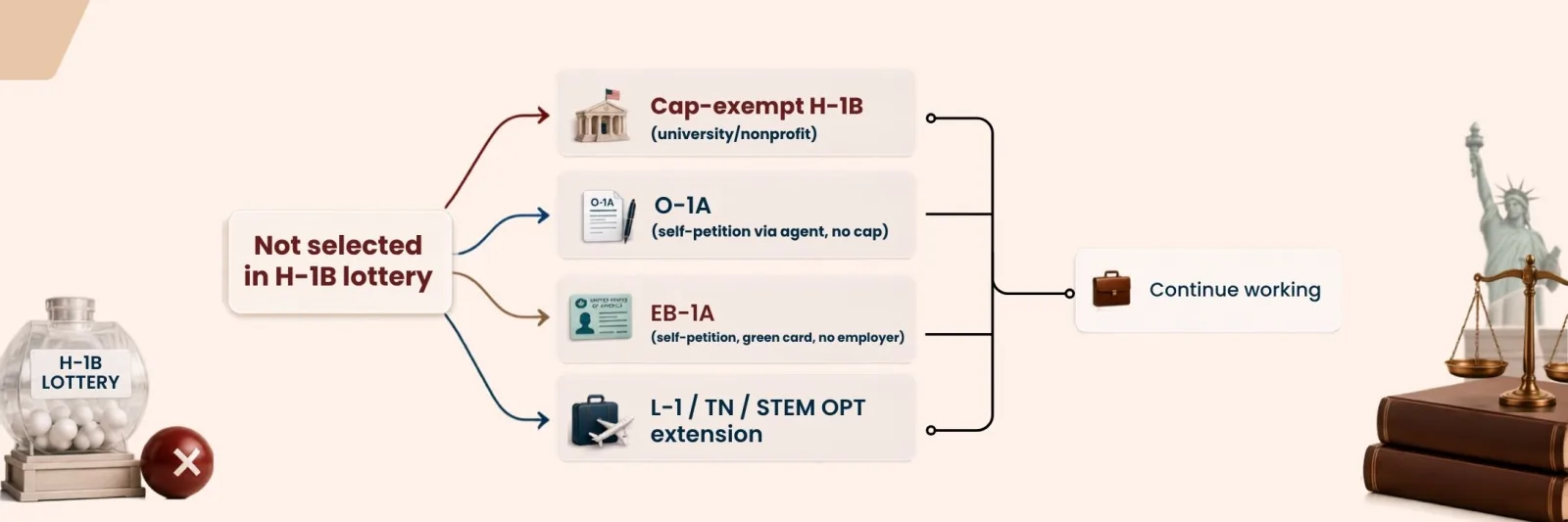
The H-1B is only one of several ways to work legally in the United States, and missing the lottery often pushes people to explore stronger, faster paths they had not considered. Common alternatives include cap-exempt H-1B employment through universities, affiliated nonprofits, and nonprofit or government research organizations, which are not subject to the annual lottery at all. Other options include the L-1 visa for employees transferring from a related company abroad, the TN visa for Canadian and Mexican citizens, the F-1 STEM OPT extension for eligible graduates already on OPT, and the E-2 treaty investor visa for qualifying founders.
For many tech professionals, the two strongest paths are O-1A and EB-1A. O-1A is a temporary work visa for individuals of extraordinary ability, with no annual cap and no lottery of any kind. EB-1A is the employment-based first preference green card category built for the same kind of extraordinary ability profile, but it grants permanent residence rather than temporary status. Both use overlapping evidence, awards, high salary, critical roles, published recognition, and original contributions, so a strong H-1B backup plan often builds one case file that supports either or both filings.
Can You Self-Petition Instead?
Yes, and this is the detail most people miss when they assume H-1B is their only route. Both O-1A and EB-1A allow a form of self-petitioning that H-1B simply does not offer. O-1A can be filed by an agent on behalf of a founder, consultant, or contractor working across multiple engagements, so you are not locked into one sponsoring employer the way H-1B requires. EB-1A goes further still: it is the one major U.S. immigration category where you can file the petition yourself, with no employer sponsor, no job offer, and no labor certification process required at all.
To qualify for EB-1A, you generally need to meet at least three of ten regulatory criteria, such as nationally or internationally recognized awards, membership in associations that require outstanding achievement, published material about your work, or a leading role for a distinguished organization, or demonstrate a single achievement of major, sustained acclaim. Because eligibility rests on your own record rather than an employer’s registration, there is no lottery to lose and no annual cap to miss.
How Soon Can You Start?
Timing depends on which path you choose, but both O-1A and EB-1A move considerably faster than waiting a full year for the next H-1B cycle. O-1A petitions can be filed year round, and with premium processing, USCIS commits to action within 15 business days of accepting Form I-907, for a current fee of $2,965. That timeline lets many candidates begin work again within weeks of deciding to switch strategies.
EB-1A follows a similar premium processing timeline for the initial I-140 petition, also 15 business days at the same $2,965 fee, though the full process to a green card includes an additional step, adjustment of status or consular processing, and possible visa bulletin wait times depending on country of birth. Regular processing without premium service can stretch to several months to a year or more for either category, which is why most candidates who need to move quickly choose to pay for the faster option.
Importantly, none of this requires starting from zero. Evidence gathered for an O-1A filing, awards, publications, salary documentation, and letters of recommendation, largely carries over to an EB-1A petition later, so candidates who build a strong case now often use it twice.
FAQ
1. What happens if you are not selected in the H-1B lottery?+
Your registration is simply not chosen, with no penalty or denial on record. You cannot file an H-1B petition this fiscal year and must wait for the next registration cycle, typically opening the following March.
2. What visa options exist without an H-1B?+
Options include O-1A, EB-1A, cap-exempt H-1B through qualifying nonprofits or universities, L-1 for intracompany transfers, TN for Canadian and Mexican citizens, and STEM OPT extensions for eligible F-1 graduates already on OPT.
3. Can you self-petition instead of re-entering the lottery?+
Yes. EB-1A allows a full self-petition with no employer, job offer, or labor certification required. O-1A can also be filed through an agent, giving founders and consultants a path around the lottery entirely.
4. How soon can you start an alternative filing?+
With premium processing, both O-1A and EB-1A guarantee USCIS action within 15 business days of acceptance, for a $2,965 fee, letting many candidates move forward within weeks instead of an entire additional year.
5. Do you need an H-1B before applying for EB-1A?+
No. EB-1A has no H-1B prerequisite. It is a standalone green card category based on extraordinary ability, available to qualified candidates regardless of current visa status or whether they ever held an H-1B.
Ready to Build Your Backup Plan?
Not being selected is a setback, not a dead end, and the strongest cases are the ones built before the next deadline arrives, not after. If you want a clear, honest read on whether O-1A or EB-1A fits your background, our team can review your case and map out the fastest realistic path forward.
Schedule a consultation with EB1A Experts today and turn this year’s lottery result into next month’s filing.