
 SiliconPath Law
If you are a software engineer, AI researcher, or startup founder weighing your visa options this year, one question keeps coming up in consultations: is O-1A faster than H-1B? In 2026, the honest answer is yes, and the gap is wider than most tech professionals expect. H-1B still runs on a random lottery with a hard annual cap, while O-1A has no cap, no lottery, and a premium processing option that can produce a decision in about three weeks. Below, we break down the real O1A vs H1B speed comparison, what O-1A processing time actually looks like in 2026, and who in tech typically qualifies.
Is O-1A Actually Faster?
Speed in immigration cases comes down to two things: how long you wait to file, and how long USCIS takes to decide. O-1A wins on both counts.
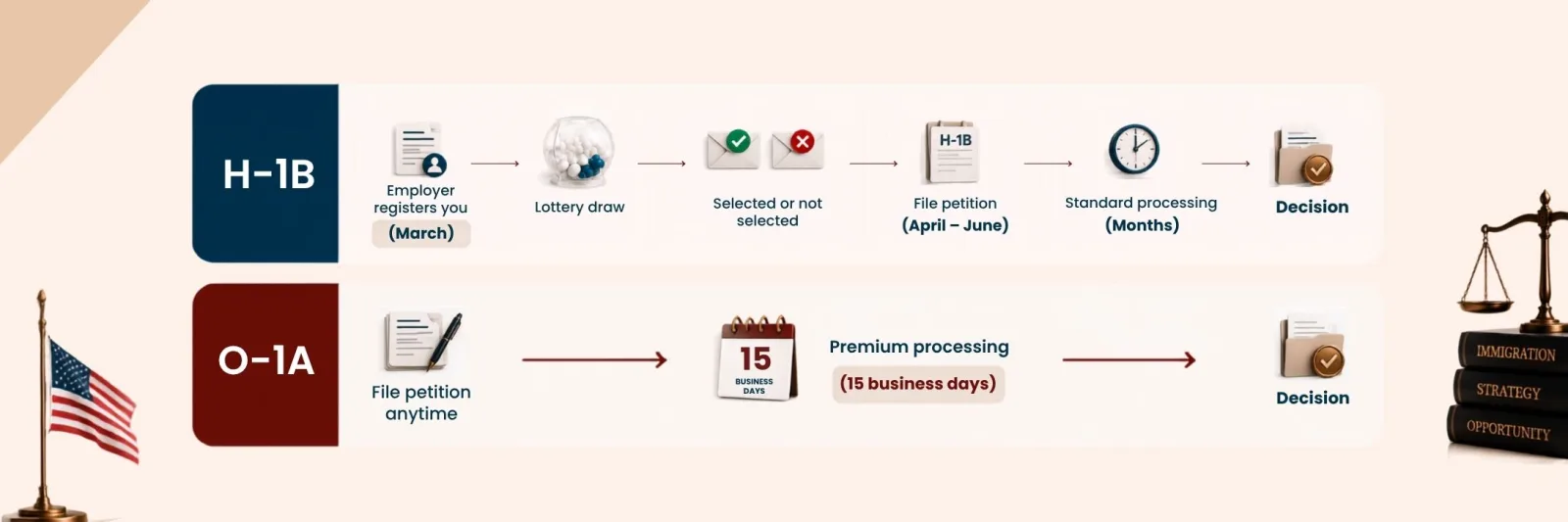
With H-1B, you cannot even submit a petition until your employer wins your name in the annual lottery, and even then USCIS has months to adjudicate the case under standard processing. With O-1A, there is no lottery step at all. Your attorney can file the petition as soon as your case is ready, and USCIS accepts O-1A petitions year round, not during a narrow springtime window.
Add premium processing and the contrast sharpens further. As of 2026, USCIS commits to a decision on a properly filed O-1A premium processing request within 15 business days, roughly three weeks in practice once mailing and receipt time are factored in. H-1B petitions can also use premium processing, but that only speeds up the paperwork stage after you have already cleared the lottery, which remains the real bottleneck for most candidates.
For a tech professional planning a job start date, offer letter, or funding milestone, that difference is not academic. Waiting on a lottery result you cannot control makes it nearly impossible to plan a start date with confidence, while an O-1A timeline can be mapped out in weeks, not seasons.
Does O-1A Skip the Lottery Entirely?
Yes, and this is the single biggest structural difference between the two categories. H-1B operates under a strict annual cap of 85,000 new visas: 65,000 under the regular cap plus 20,000 reserved for people with a qualifying U.S. master’s degree or higher. For the FY 2027 cycle, registration ran March 4 through March 19, 2026, with selected employers notified by the end of that month and a filing window running April 1 through June 30, 2026. Every year, USCIS receives far more registrations than available slots, so selection is decided by random draw, not by merit, timing, or how strong your case is.
O-1A has no such cap and no lottery of any kind. It exists specifically for individuals who can demonstrate extraordinary ability, so approval turns entirely on the strength of your evidence, not on chance. That also means a founder or engineer who misses the H-1B lottery, or whose employer never registers them at all, can still move forward on O-1A without waiting an entire year for the next registration cycle to open.
It is also worth noting that under current policy, a separate $100,000 fee applies to certain new H-1B petitions filed for workers who are outside the United States without a valid H-1B visa already in hand, which adds both cost and complexity that O-1A simply does not carry.
Who Qualifies as a Tech Professional?
O-1A was written for people in the sciences, education, business, and athletics who have risen to the top of their field, and USCIS has become increasingly comfortable applying it to technology roles. To qualify, you generally need to meet at least three of eight regulatory criteria, or show a single, one-time major achievement.
For tech professionals, the most common paths include original contributions of major significance, such as a widely adopted open-source project, patent, or technical innovation; published material about you in respected outlets or major tech press; a critical or essential role at a distinguished company or well-funded startup; a high salary relative to others in your field; judging the work of others, such as serving as a peer reviewer, hackathon judge, or conference program committee member; and authorship of scholarly or technical articles. Unlike H-1B, O-1A does not require a bachelor’s degree, a specific job offer structure, or even a single employer, since founders and consultants can petition through an agent.
Strong evidence tends to look different in tech than in academia. GitHub star counts, product launches covered by industry press, invited conference talks, and internal promotion records showing an outsized role can all support a case, provided each piece connects back to one of the eight regulatory criteria rather than standing alone as a general achievement.
FAQ
1. Is O-1A faster than H-1B in 2026?+
Generally yes. O-1A skips the lottery and can be decided in 15 business days with premium processing, while H-1B first requires winning a random cap lottery, adding months of uncertainty.
2. Does O-1A skip the lottery entirely?+
Yes. O-1A has no annual cap and no lottery. Petitions can be filed year round based on eligibility, unlike H-1B, which depends on random selection from a fixed 85,000 slot pool.
3. How fast can O-1A be approved with premium processing?+
With premium processing, USCIS acts within 15 business days of accepting Form I-907, for a 2026 fee of $2,965. Regular processing without it typically takes several months, varying by service center.
4. Who qualifies for O-1A as a tech professional?+
Engineers, researchers, and founders who meet three of eight USCIS criteria, such as original contributions, high salary, critical roles, or peer judging, typically qualify, even without an advanced degree or employer sponsor.
5. Can O-1A be filed without an employer sponsor?+
Yes. Founders, consultants, and independent professionals can file O-1A through an authorized agent instead of a single sponsoring employer, offering flexibility that H-1B, tied to one company at a time, cannot match.
6. Ready to Find Out If You Qualify?+
Every case is different, and the fastest path depends on your specific background, timeline, and career stage. If you are a tech professional wondering whether O-1A could get you working in the U.S. faster than another H-1B lottery cycle, talk to our team before your next filing window closes.
Schedule a consultation with EB1A Experts today and get a clear, honest assessment of where you stand.