 SiliconPath Law
If you’re weighing a national interest waiver green card, “how long does EB2 NIW take” is usually the first question — and the hardest to get a straight answer to. The EB2 NIW timeline in 2026 depends heavily on which USCIS service center adjudicates your case, whether you use premium processing, how strong your evidence is, and your country of chargeability.
Published estimates for EB2 NIW processing time vary widely across sources this year — some service centers report I-140 adjudication in under a year, others well over two. Rather than hand you one misleadingly precise number, this guide breaks down the real range behind the EB2 NIW timeline in 2026, what actually drives it, and how to plan around the uncertainty instead of against it.
At SiliconPath Law, we work with engineers, researchers, and founders navigating this category daily, and realistic timeline planning is one of the first conversations we have in every case evaluation.
Regular processing: Plan for a wide window, realistically 12 to 30+ months for the I-140 stage alone, depending on which service center receives your petition. Checking USCIS’s own processing-time estimator for your specific center will give you a far more reliable figure than any published industry average, since service center assignment is random and non-appealable.
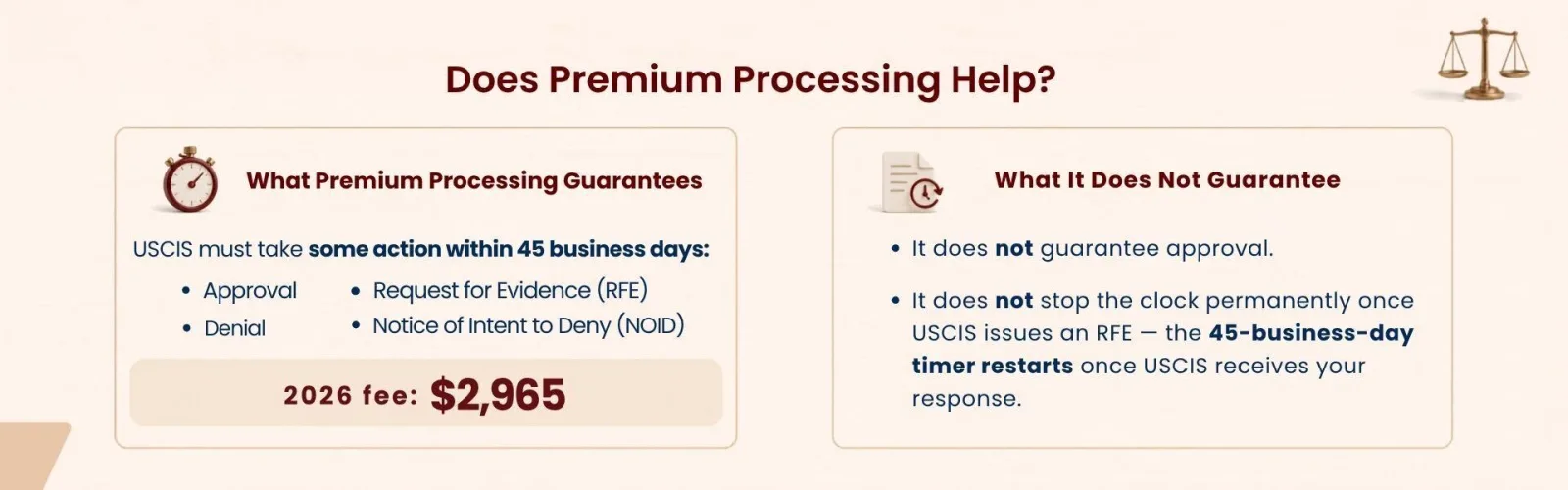
Premium processing: A fixed 45 business days (roughly 2 to 2.5 calendar months) for USCIS to take some action on your Form I-907 request.
This I-140 NIW processing time 2026 figure covers only the immigrant petition itself. Your full green card timeline also depends on visa availability under your priority date, and whether you adjust status inside the U.S. or go through consular processing abroad — often adding another 6 to 12+ months once your priority date is current.
Does Premium Processing Help?
Yes, but it’s worth being precise about what EB2 NIW premium processing actually buys you, since it isn’t a faster path to approval.
When Premium Processing Is Worth the Cost
EB2 NIW premium processing earns its cost when you:
- Need certainty for visa status planning, such as an OPT or H-1B expiration.
- Are timing a job change, funding round, or relocation around your case outcome.
- Want a fast, honest read on your case’s strength rather than finding out after a two-year standard queue.
Approval rates for EB-2 NIW have swung significantly across recent quarters — down sharply from the near-automatic approvals of a few years ago, then partially recovering, then dipping again. Given that volatility, premium processing is often less about buying a faster approval and more about buying faster clarity on your NIW approval timeline, well before a two-year standard queue would tell you the same thing.
What Slows a Case Down?
1. RFEs and NOIDs
A Request for Evidence typically lands when USCIS wants stronger proof of your advanced degree or exceptional ability, the national importance of your proposed endeavor, or your ability to carry that endeavor forward — the three prongs of the Matter of Dhanasar framework. Respondents usually get 30 to 90 days to reply, and USCIS needs further time to review the response.
A Notice of Intent to Deny is more serious, signaling USCIS is leaning toward denial, usually with 30 days to respond. Either can turn a 12-month case into an 18-to-36-month reality under standard processing, stretching what looked like a short EB2 NIW timeline in 2026 into a multi-year one.
2. Filing Volume and Service Center Backlogs
EB-2 NIW filing volume has grown substantially over the past several years, as more applicants discover the category as an alternative to PERM-based employer sponsorship. That growth directly drives the service-center variance behind published EB2 NIW processing time figures — the busier a center’s queue, the longer your case sits in it, independent of how strong your evidence is.
3. Weak or Generic Petitions
Adjudication standards have tightened noticeably since the historically high approval era of a few years ago. Petitions most likely to draw an RFE or denial share the same weaknesses:
- Vague or overly broad “national interest” claims
- Recommendation letters that don’t independently corroborate the petitioner’s specific, measurable contributions
- Thin evidence of real-world impact — citations, deployments, funding, media coverage, contracts
- A proposed endeavor that isn’t clearly or specifically articulated
This is precisely where strategic narrative building matters: your achievements need to map directly to the Dhanasar prongs, not just be listed.
4. Country Backlogs, for the Full Green Card
None of the above changes I-140 adjudication time, but it dramatically affects your total path to a green card. Applicants from countries with a current EB-2 priority date can move to I-485 or consular processing shortly after I-140 approval. Applicants born in India or China face a materially longer wait, since visa availability — not I-140 processing speed — dominates their total NIW approval timeline.
When Should You Start?
Start Early If You:
- Are on F-1 OPT or STEM OPT and want to anchor a green card path before your status window closes.
- Are on H-1B and want to maximize AC21 portability once your I-140 is approved.
- Are from a backlog country like India, where filing earlier locks in an earlier priority date, even if the green card itself is years away.
Practical Planning Windows
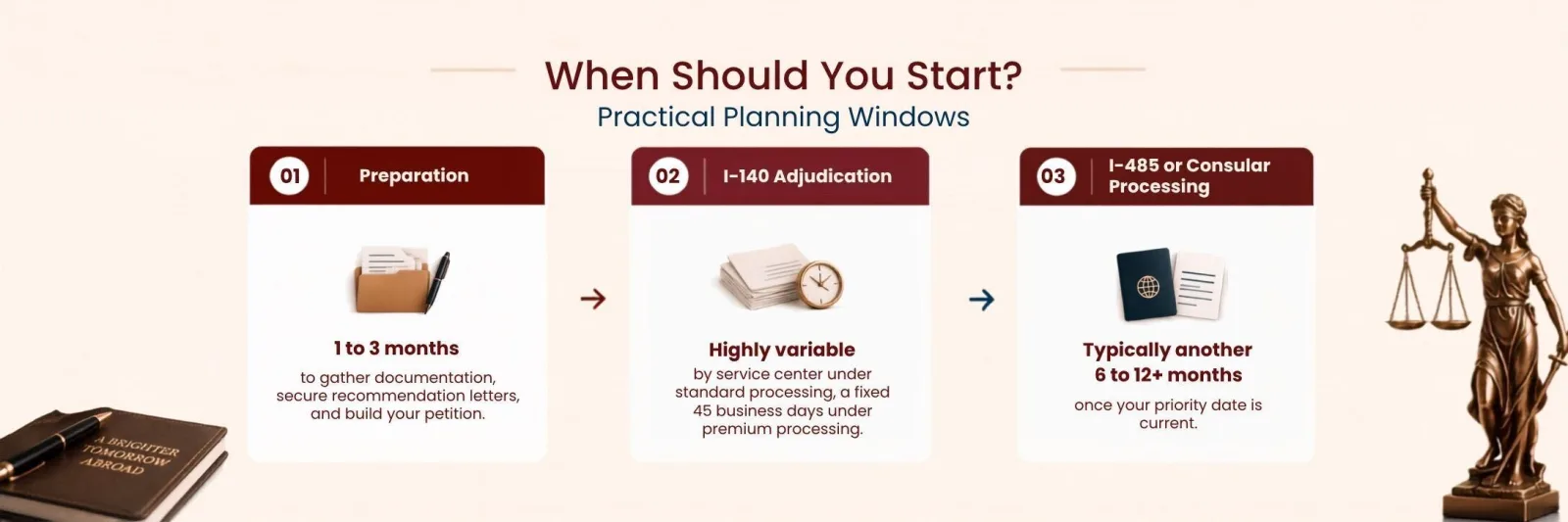
For applicants from non-backlog countries using premium processing, a realistic total timeline from starting preparation to green card in hand can land around 12 to 18 months in a smooth case. Under standard processing, plan for 2.5 to 4 years or more. If you’re in a backlog country, start as early as possible; your priority date locks in at filing, regardless of how long the visa wait ends up being.
FAQ: EB-2 NIW Timelines
How long does EB-2 NIW take in 2026? There’s no single reliable number. Published I-140 processing times for the EB2 NIW timeline in 2026 range from roughly 8 to well over 24 months depending on service center assignment. USCIS’s own processing-time tool, checked against your specific center, is the most accurate source available.
Does premium processing speed up NIW? Yes, in that EB2 NIW premium processing guarantees action — approval, denial, RFE, or NOID — within 45 business days for a $2,965 fee. It does not guarantee approval, and the clock resets if USCIS issues an RFE.
What causes NIW delays? RFEs and NOIDs tied to thin evidence, high filing volume at certain service centers, petitions that don’t clearly satisfy the Dhanasar three-prong test, and — for the full green card rather than I-140 approval alone — visa backlogs for countries like India and China.
When should you start your NIW case? As early as your circumstances allow, particularly if your nonimmigrant status has a limited runway, you’re from a backlog country, or you want your green card timeline aligned with a career move, funding event, or relocation plan.
The widest variable in any EB2 NIW timeline in 2026 isn’t the paperwork — it’s the adjudication queue you land in and the strength of the evidence you file with. At SiliconPath Law, we build your petition around the Dhanasar framework from day one and give you a clear, honest assessment of your strongest pathway and filing timeline, with no guesswork and no generic advice.
Ready to find out where your case stands?
Schedule a case evaluation with our attorneys for a realistic EB2 NIW processing time estimate built around your specific profile, not an industry average.