 SiliconPath Law
Navigating the path to an EB-2 NIW for small business owners can feel surprisingly intimidating in an immigration landscape that seems constantly obsessed with venture-backed tech startups and artificial intelligence pioneers.
If you run a manufacturing plant, manage a logistics firm, or build a service-based enterprise, it is easy to assume that the tech sector holds a monopoly on green cards.
Check Your NIW EligibilityMany non-tech business owners prematurely give up, believing that without software patents or Silicon Valley funding, securing an Employment-based Second Preference National Interest Waiver is out of the question.
That assumption misunderstands how federal immigration law actually works. The legal framework governing the National Interest Waiver does not require code repositories, algorithms, or millions in seed rounds.
Once you look past the tech hype, you will see that U.S. Citizenship and Immigration Services (USCIS) evaluates enterprise value far more broadly. Non-tech entrepreneurs can build a remarkably strong, bulletproof case grounded in real-world economic and community impact.
Read More: How to Choose the Right Immigration Attorney for Your EB-1A or NIW Case (2026 Guide)
The Core Reality: Demystifying the "Tech Bias" in EB-2 NIW
It is easy to see why people fall for the myth that securing a waiver requires a tech background. Headlines are full of high-profile visa approvals for AI researchers, biotech pioneers, and enterprise software founders. But statutory authority and administrative precedent tell a much friendlier story for traditional entrepreneurs.
The landmark precedent decision, Matter of Dhanasar, 26 I&N Dec. 884 (AAO 2016), set the record straight. The Administrative Appeals Office (AAO) explicitly stated that substantial merit and national importance can be found across a huge range of industries, specifically pointing to business, entrepreneurialism, agriculture, healthcare, culture, and education right alongside science and technology.
Key Legal Precedent: Under Matter of Dhanasar, USCIS evaluates the prospective impact of your proposed project itself, not how trendy or high-tech your field happens to be. You do not need to invent proprietary tech; you just need to show that your enterprise creates meaningful, systemic benefits for the United States.
Adjudicators are not checking whether your company writes code. Instead, they are looking at the ripple effect your business model creates. In fact, a non-tech small business that fixes local supply chain glitches, modernizes farm logistics, or expands trade education often presents a much clearer, more immediate national benefit than an early-stage app with no real users yet.
Get an EB-2 NIW EvaluationDecoupling "National Importance" from "Nationwide Scale"
The biggest hurdle for non-tech founders using small business immigration strategies is tackling Prong 1 of the Dhanasar framework: proving your endeavor has both substantial merit and national importance. Applicants often mix up national importance with geographic scale, assuming their company needs to operate in all 50 states on day one.
Fortunately, the AAO explicitly rejected the idea that you need massive geographic coverage. An enterprise operating in a specific, targeted region easily meets national interest standards if its strategic impact helps solve a broader national issue. Here are three practical ways non-tech small businesses usually make this case:
1. Regional Economic Revitalization
Federal policy explicitly recognizes that boosting local economies in distressed areas carries nationwide value. Setting up shop in designated HUBZones or Opportunity Zones directly aligns your business with congressional goals to revitalize economically struggling communities. Bringing capital and quality jobs to underserved areas turns a local business into a driver of federal policy goals.
2. Supply Chain & Critical Infrastructure Resilience
Recent years have shown just how fragile domestic supply chains, manufacturing, and shipping networks really are. If your small business focuses on specialized freight, cold-storage warehousing, or precision parts manufacturing, you are helping fix core infrastructure gaps. Resolving bottlenecks in food distribution, medical supplies, or raw industrial goods meets national impact standards by protecting American trade.
3. Systemic Solutions for Legacy Industries
Traditional industries, like standard farming, heavy construction, and basic healthcare delivery, struggle with long-standing inefficiencies. When a small business owner introduces a scalable operational plan, eco-friendly resource strategies, or a better worker-training framework, they fix systemic issues that spill over far beyond their immediate client list.
Three Non-Tech Strategic Angles for Your National Interest Argument
If you want to win an NIW without a tech angle, your petition needs to reframe your everyday business operations into a powerful national interest argument. Adjudicators want to see a clear narrative shift: you aren't just running a routine company; you are advancing an enterprise that benefits the country.
Strategic Blueprint Comparison
| Strategy Angle | Commercial Activity | The Strategic NIW Narrative Pivot | Primary National Impact Alignment |
|---|---|---|---|
| 1. Regional Economic Anchor | Agriculture & Equipment Sales | Shift from "selling farm equipment" to "deploying specialized post-harvest machinery that cuts crop spoilage by 15% across regional farming hubs." | Direct support for U.S. food security, rural economies, and agricultural efficiency. |
| 2. Supply Chain Integrator | Freight & Warehousing | Shift from "running delivery trucks" to "establishing cold-chain logistics for medical and perishable cargo along underserved rural supply lines." | Elimination of critical delivery bottlenecks and protection of essential U.S. supply chains. |
| 3. Human Capital Engine | Vocational & Trade Training | Shift from "operating a trade school" to "running an accredited training program designed to fill severe regional shortages in renewable energy technicians." | Workforce up-skilling, lowering structural unemployment, and fulfilling national energy goals. |
Deep-Dive Analysis of the Non-Tech Angles
- The Regional Economic Anchor: Your business becomes a regional anchor when it stabilizes local supply chains. For example, opening a specialized crop-processing facility in an agricultural county helps preserve local harvests, stabilizes regional food prices, and creates a ripple effect of great local jobs.
- The Supply Chain Integrator: Adjudicators love seeing evidence that your company keeps broader industries moving smoothly. By stepping into logistics gaps, such as middle-mile shipping for specialized manufacturers, you prove that your business safeguards essential commercial pipelines.
- The Workforce Engine: Shortages in skilled labor drag down national productivity. Creating structured hands-on training programs that directly address trade shortages proves that your enterprise boosts U.S. worker capabilities.
Navigating Adjudication Risks & Critical EB-2 NIW Requirements
Even though non-tech routes are completely legitimate under immigration law, adjudicators hold small business petitions to strict evidentiary standards. Many business owners run into Requests for Evidence (RFEs) or outright denials simply because they framed their petition incorrectly.
To hit all key EB-2 NIW requirements, make sure you avoid these three common traps:
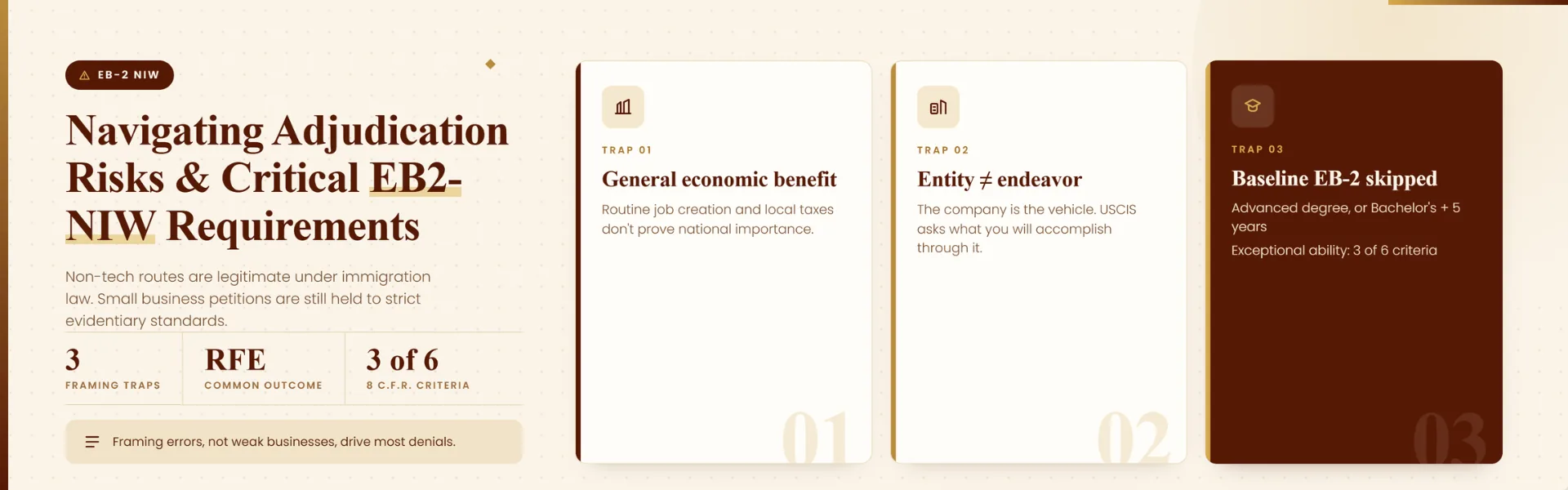
The "General Economic Benefit" Trap
USCIS guidelines make it clear that standard commercial achievements, like opening a local retail shop, launching a standard consulting firm, or hiring a handful of local staff, are not enough to prove national importance. Officers treat standard job creation and paying local taxes as routine features of any normal business. Your petition must show how your operational model delivers unique, strategic value beyond basic day-to-day operations.
Conflating the Business Entity with the Endeavor
Your business entity is just the vehicle you use to carry out your work; it isn't the endeavor itself. Petitioners often waste hundreds of pages dumping corporate filings, lease agreements, and marketing materials into their petitions without ever explaining the bigger picture. USCIS cares about what you plan to accomplish through your business, not just the fact that you registered an LLC.
Neglecting Baseline EB-2 Eligibility
Before USCIS even considers waiving the job offer and PERM labor certification, you have to prove you qualify for the base EB-2 category. That means documenting that you hold either:
- An Advanced Degree (a U.S. Master’s or foreign equivalent, or a Bachelor’s plus five years of progressive, post-degree experience in your field); or
- Exceptional Ability in business, arts, or sciences, satisfying at least three of the six regulatory criteria under 8 C.F.R. 204.5(k)(3)(ii).
Skipping or rushing this baseline step will lead to a quick denial, no matter how impressive your business strategy looks.
The Non-Tech Evidence Toolkit: Satisfying Prongs 2 & 3
Once you establish national importance (Prong 1), you need to show that you are well-positioned to advance your project (Prong 2) and that waiving the job offer requirement actually helps the U.S. (Prong 3).
Instead of pitch decks and code, non-tech business owners build their cases with solid commercial and industry proof. Organizing this evidence effectively often means following proven legal strategies, like those highlighted by legal boutique firms like SiliconPath Law, which focus on turning operational data into strong immigration evidence.
Comprehensive Evidence Framework
| Criterion / Prong | Tech Founder Standard Evidence | Non-Tech Small Business Evidence Standard |
|---|---|---|
| Prong 1: National Importance | Patent filings, software benchmarks, tech incubator spots. | Independent economic impact studies, industry data, alignment with federal policies (USDA, DOT, HUD guidelines). |
| Prong 2: Well-Positioned | VC pitch decks, code repositories, user adoption metrics. | Signed Letters of Intent (LOIs), active commercial contracts, equipment purchases, tax filings, detailed 5-year business plans. |
| Prong 3: Balancing Test | Rapid user scale, global app deployment plans. | Proof that the PERM process is impractical for self-employed owners, urgent local skill deficits, immediate economic contributions. |
| Expert Support Letters | Computer science professors, tech accelerator directors. | Regional economic board directors, trade association leaders, local government heads, supply chain executives. |
Winning Prong 3 as a business owner usually comes down to pointing out an obvious structural dilemma: under standard Department of Labor rules, business owners cannot sponsor themselves through a traditional PERM labor certification because there is no "open" job for a U.S. worker if you control the company.
Demonstrating that your self-directed enterprise creates net-positive American jobs makes waiving the PERM requirement a logical win for the country.
Building a Winning Non-Tech Petition
Getting a National Interest Waiver Non Tech petition approved does not require breakthrough code or millions in venture capital. It comes down to crafting a clear, grounded narrative that ties your enterprise directly to U.S. economic and infrastructure priorities.
When you establish your core EB-2 eligibility, frame your work around regional or systemic impact, and back it up with solid real-world proof, you give USCIS a compelling case to approve. You don't need lines of code to prove your worth; you just need to show how your business acts as a genuine engine for American growth.
Speak With an Immigration Attorney